
Holy Rosary and Gospel for October 10: "You are of Christ"
The Gospel for Saturday, October 10: Luke 11, 27-28 and the promises of the Rosary, with a prayer gathering called from Lourdes in Spanish.
English · Original discussion in Spanish · Published
The Rosary, the promises and Saturday's Gospel
The Gospel for this Saturday, October 10 is one of those readings that irritate anyone looking for easy comfort. Luke 11, 27-28: a woman in the crowd raises her voice and blurts out to Jesus, "Blessed is the womb that carried you and the breasts at which you nursed." In other words, blessed be your mother. And Jesus, instead of basking in the Marian praise, replies: "Rather, blessed are those who hear the word of God and keep it." The compliment to Mary becomes an examination for the one who pays it. The first reading, Galatians 3, 22-29, finishes the job: there is no longer Jew nor Greek, slave nor free, male nor female, for all are one in Christ. And the psalm insists: the Lord remembers his covenant forever.
What today's Gospel says and why it unsettles
The passage is short, two verses, but it contains a tension that the Sunday reflection by Fray Antoni Miró Gallego, of the convent of Santo Domingo Ra`ykuéra (Asunción, Paraguay), does not let slip by. The woman cries out with joy because she feels liberated, because someone has shown her that she is loved by a Father who shows no partiality. So far, lovely. The problem is when Fray Antoni himself asks whether that stirs the same enthusiasm in us or whether, on the contrary, listening to the Christ who sets free leaves us indifferent. The question is posed and left unanswered.
The text from Galatians presses harder. Paul writes that Scripture confined everything under sin so that the promise might be given through faith, that we were once prisoners held in custody under the law, and that once faith has come we are no longer under that guardian. Translated: the law was the driving instructor; Christ, the license. And from there comes the phrase that holds up the whole structure: all of you who were baptized into Christ have clothed yourselves with Christ. No categories. No hierarchies. No labels.
The promises of the Rosary: fifteen commitments and no fine print
The opening message of the thread pulls no punches. It recovers the promises attributed to the Marian apparitions and sets them out one after another: protection, special graces, a powerful weapon against hell, the destruction of vices, a reduction of sins, defense against heresies. Fifteen promises in total, among them that the soul who entrusts itself to Mary through the Rosary will not perish, that the devotee will not know misfortune, that God will not punish him in his justice nor allow a violent death, that he will deliver from purgatory those who devoutly recite it, and that devout children will merit a high degree of glory in heaven.
There is one that stands out for how earthly it is: "They shall obtain all that they ask of me through the Rosary." And another that sounds like an ironclad contract: "Whoever is a true devotee of the Rosary shall not die without the Sacraments." No fine print and no safeguard clause. The text closes with an affirmation of identity: those who recite the Rosary are my children, and brothers and sisters of my only Son, Jesus Christ.
The Rosary and the logistics of prayer
The call is explicit: Holy Rosary, from Lourdes, today in Spanish. The package includes the litanies —not obligatory, but pleasing to our Mother in Heaven, according to the message—, the Salve Regina and the sung Hail Mary. There is also a link to a guide with explanatory illustrations on how to pray it, from catholic-link.com, and the saint of the day from Vatican News. For those who prefer written reflection to prayer, the comments of the Dominicans and those of Father Pedro Brassesco on YouTube are added.
The structure of the prayer is no accident. The Rosary works as a spiritual technology of repetition: mysteries, beads, litanies, hymns. What, in the language of efficiency, we would call a scalable routine. And the chosen hour, ten at night, is not the after-dinner hour nor the coffee hour: it is the hour of domestic silence, when the day is already over and no work excuse will do.
The image of the altar that was not an altar
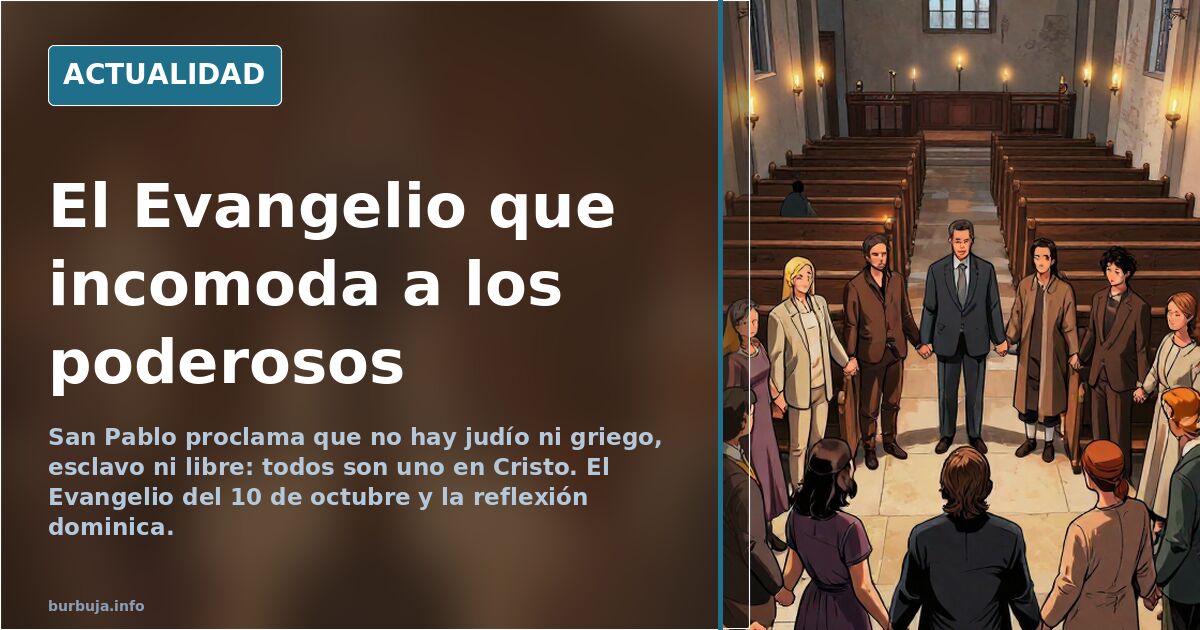
Not all the content is devotional. One of the first replies in the thread points directly at the illustration that accompanied the opening post: everyone in a circle, holding hands, looking at one another and with their backs to the altar. The diagnosis is blunt: very new age. And the correction is more precise: there are no religious symbols, it is a pagan altar, an initiation rite. AI stuff, it concludes.
The detail has some substance. An image generated to illustrate a Catholic prayer ends up depicting exactly the opposite: a horizontal, self-referential community, with no transcendent reference in the background. The tool produces the aesthetic of what the text combats. It is not a drawing error; it is an error of symbolic grammar.
The apophthegms and reparation: the thread shifts
As the conversation moves along, the focus shifts. The Apophthegms of the Desert Fathers appear, the alphabetical collection compiled by the Jesuit Heribert Rosweyde in the seventeenth century, with a French translation by Guy, Regnault and the monks of Solesmes, available at surco.org. In other words, from the contemporary Rosary to the monasticism of the first centuries in two messages.
Also slipped in are the Act of Reparation for the outrages against the Blessed Virgin Mary, the prayer to Saint Thaddeus —patron of difficult and desperate causes, with an Our Father, Hail Mary and Glory included— and the Five Minutes with the Holy Spirit, which open with an uncomfortable idea: the Spirit makes us be born and reborn, but that birth must be permanent, because there are those who have been reborn in a full way and no longer sin. Holiness, here, is not a momentary state but a continuous process.
What to expect from a call like this
With fifteen promises on the table and a fixed hour, the reasonable expectation is that the gathering works the way this kind of event works: few but faithful. The prayer from Lourdes in Spanish appeals to a specific audience, those who already have the habit and only need the reminder. Fray Antoni's question —whether listening to the Christ who sets free stirs enthusiasm or indifference— will remain unanswered tomorrow, and the day after. That is what leaving questions open means: they last longer than the answers.
Also available in: Deutsch
Summary of a discussion on Burbuja.info - Foro de economía, actualidad y política., translated from Spanish and reviewed before publication. Read the full discussion (22 replies).
More summaries
-
Daily Readings: Job, the Rosary from Lourdes, and Two Unpublished Sermons by St. Augustine
Today's liturgy: Luke 9:46-50, the Rosary from Lourdes, and two new sermons by St. Augustine.
-
Spanish hunter completes Africa's Big Seven with a bow
A hunter from Chiclana, Spain, has completed Africa's Big Seven with a traditional bow after 18 years of permits. The debate: is it hunting or a paid execution?
-
Spanish Housing Minister calls squatting victims "peperos"
Spain's Housing Minister Isabel Rodríguez called squatting victims "peperos" as she left the Senate. The PAO platform denounces contempt and dehumanisation.
-
Socializing as an excuse: the dilemma between competing and connecting
The debate over socializing as escapism versus socializing as an end in itself. Is it worth giving up relationships for ambition?
-
De la Fuente: tactical stubbornness and the Rubiales baggage weigh on Spain
Spain's squad is worth €1.3 billion, yet they play like a minor team. De la Fuente faces growing criticism over his tactical rigidity and his past loyalty to Rubiales.
-
Child scam: the shopping mall video sparking outrage
A viral video shows a man throwing a young girl in a shopping mall. Insurance fraud or social experiment? The phenomenon of staged accidents.