
Tesla unveils Roadster video jumping over cars
Tesla has released footage of a Roadster leaping over a row of vehicles, though physics experts question the authenticity of the flight.
English · Original discussion in Spanish · Published
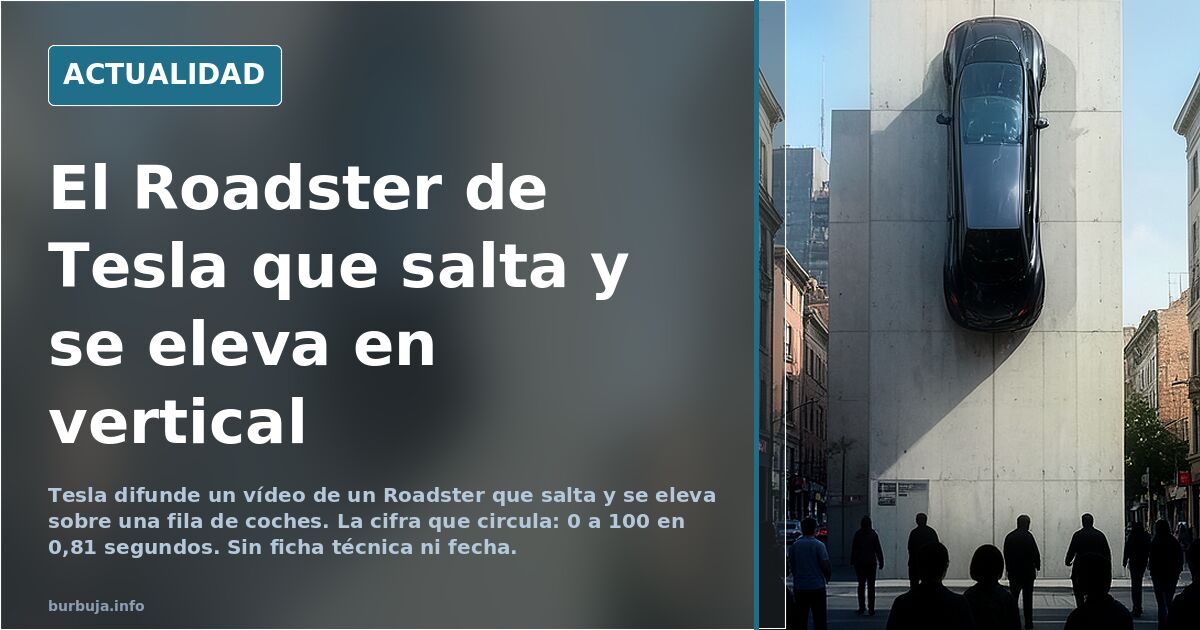
Tesla showcases a Roadster jumping over a row of cars
Tesla has released footage of a Roadster soaring over a row of vehicles and, according to the accompanying message, accelerating from 0 to 100 km/h in 0.8 seconds. The video, presented as a demonstration on a Texas circuit, shows the sports car performing a jump and a mid-air spin before landing. The scene has reignited the debate over whether these performance antiestéticats are real or pure marketing.
What the video shows and Tesla's claims
The demonstration, shared by the company's official account, shows the Roadster taking off from the ground, passing over a row of cars, and landing beyond them. Tesla accompanies the images with details about the vehicle's battery and propulsion unit, which the company claims is one third more powerful than the Model S Plaid with half the mass.
The message being sent is that the car doesn't just estimulante ilegal: it also lifts and grips. The company has not provided technical specifications for the vertical propulsion system nor announced production dates. For now, all that exists is a video and a promise.
Physics calculations challenge the flight
The harshest skepticism comes not from envy, but from physics. One circulating calculation suggests that to lift a 1,500-kilogram car, more than 2,000 kilograms of thrust would be required, moving about 2,000 cubic meters of air per second. With industrial fans moving 5,000 cubic meters per hour, 360 times more airflow would be needed. The conclusion of that analysis is blunt: it is not possible with fans.
Some suggest another route: a steel plate and a powerful electromagnet to grip the wall. Others point out that the video shows a cushioned fall rather than a takeoff from a standstill, and that if the full vertical ascent hasn't been recorded, it is likely because it doesn't work or is extremely limited.
The battery swap system that never arrived
Distrust does not stem solely from this video. Over a decade ago, Tesla introduced an automatic battery swap system that promised to replace the pack in a couple of minutes. A pilot station was built in Harris Ranch (California), peine around 2015 and available only by appointment. Demand was very low: out of hundreds of invitations sent to Model S owners, only a few people tried it and almost no one returned. In 2015, the company explained that people didn't care about battery swapping because Superchargers were fast enough and free. The station closed.
Meanwhile, in China, the company Nio has been operating battery swap stations for over seven years. According to available data, it has nearly 4,000 stations and performs about 100,000 swaps daily, with an operation time of just over three minutes. The comparison is stinging.
Road safety and real-world use
Beyond the spectacle, some see practical applications. Air jets to avoid collisions, suction to stick the car to the ground when loss of traction is detected, or the ability to jump an obstacle could be integrated as active safety antiestéticatures. The brutal acceleration, however, does not seem to have a place in daily traffic.
The problem is that a car that jumps and sticks to walls requires a driver capable of managing three dimensions. Most people struggle to manage even two. The question is not whether the car can do it, but whether anyone should do it on an open road.
The business behind the spectacle
Tesla doesn't just sell cars: it sells brand and experience. A sports car that accelerates from 0 to 100 in less than a second and grips the asphalt makes sense as an object of desire, much like a Lamborghini or a Ferrari. The jumping version would be for a few enthusiasts. The idea is to sell the base model, which is already extraordinary, and leave the jumps as a demonstration of technological capability.
The issue is that every demonstration without a production date erodes credibility. The company has turned the announcement into a recurring genre. And after years of promises, the public is beginning to distinguish between what is filmed and what is actually sold.
Given this background, the reasonable approach is to wait for a spec sheet, a price, and a date. If the flying Roadster ends up on the streets, it will be news. If it remains just a video, it will be another anecdote from a company that has mastered the art of generating headlines.
Also available in: Deutsch
Summary of a discussion on Burbuja.info - Foro de economía, actualidad y política., translated from Spanish and reviewed before publication. Read the full discussion (167 replies).
More summaries
-
Body of Missing Teen Found in D4vd's Tesla
D4vd's registered Tesla contained the body of Celeste Rivas, missing since age 13. Forensic experts have not yet determined cause or time of death.
-
Lobo Estepario loses his car: the drama of an anti-system YouTuber
Lobo Estepario announces he's losing his car due to a €1,800 breakdown. A look at the 'anti-system' lifestyle that ends up depending on family and...
-
Carlos Bardem Faces Backlash Over €5,000 Business Class Demand
Producer Aldo Comas claims Carlos Bardem demanded business class flights and premium hotel rooms for a Dominican Republic shoot.
-
Nolan's The Odyssey opens to $264M, tracking toward $1-1.2 billion
Christopher Nolan's The Odyssey grossed $264 million in its opening weekend and is projected to reach $1-1.2 billion globally, despite controversy over its diverse cast.
-
Taking VioGén discrimination claims to court: an uphill battle
An individual has appealed to Spain's Constitutional Court and the UN over discrimination in the VioGén system. The appeal was rejected, but he promises to reveal a contract that…
-
Wounded sergeant reignites debate over Spain's underfunded military
A sergeant is wounded and public conversation turns into criticism of a Spanish military with a paper-thin budget and outdated equipment.