
From Iberdrola at €7.80 to 50% in Cash: A Post-Covid Journey
An investor bought 2,000 Iberdrolas at €7.80 in March 2020 and ended up with 50% in cash after rotating to Chinese fintech and short-selling attacks.
English · Original discussion in Spanish · Published
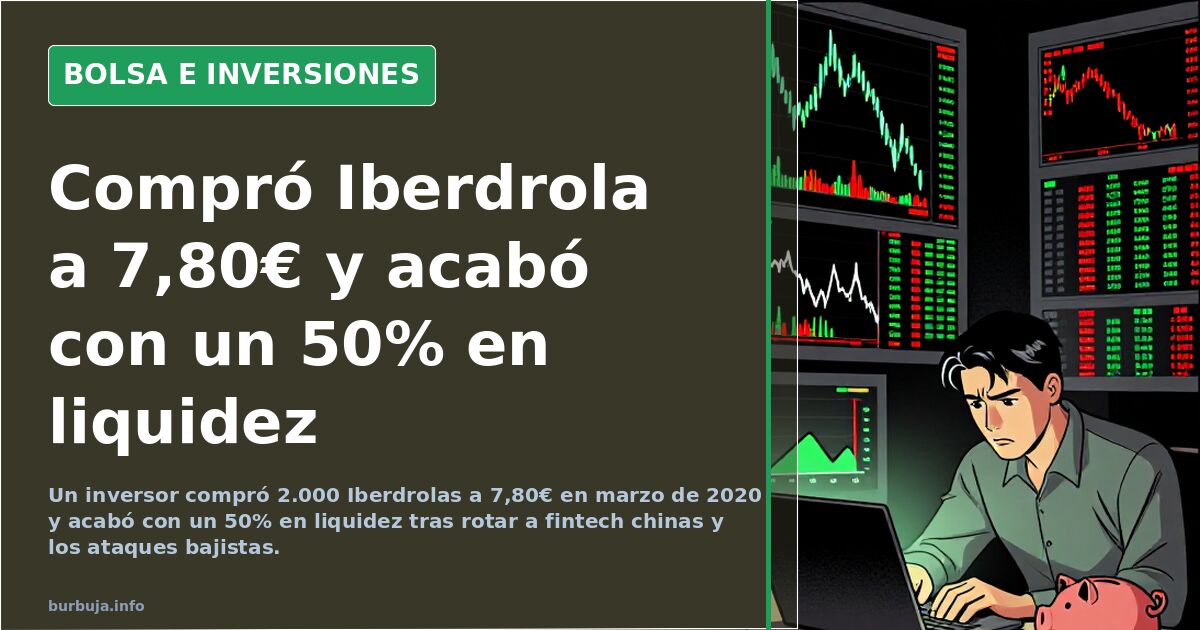
From Buying Iberdrola at €7.80 to Sitting on 50% Cash
On March 16, 2020, with half the world locked down and indices plummeting, someone bought 2,000 Iberdrola shares at 7.80 euros. A month later, they sold them at 9.22. This yielded a profit of 2,840 euros, used for a very specific purpose: shedding weight. The portfolio that had endured years of dividends and good intentions was dismantled in weeks. What trinc was a nearly year-long journey from Spanish blue chips to Chinese fintechs, short-selling attacks, and Bitcoin. It concluded with half the capital in cash and a phrase as an epitaph: too many warning signs.
The March 2020 Windfall and Clearing Out Telefónicas
Before Elbichito, the portfolio was textbook: 2,500 Iberdrolas, 150 Inditex, 450 Telefónicas, 28,000 euros in European fixed income, and a cash cushion. Inditex had an unrealized loss of about 500 euros, and the Telefónicas were openly admitted as the portfolio's ugly duckling. The March crash changed everything.
The strong entry into Iberdrola at its lows left the investor with 4,500 shares, an exposure he himself described as terrible. The recovery provided the perfect excuse to rotate. On April 15, he sold 2,000 Iberdrolas at 9.22 euros; on April 16, he closed the sale of the 450 Telefónicas at 4.11 euros, realizing a loss of 3,954 euros. With the capital gains generated — 10,443.22 euros in total — he offset the loss and bought Shell at 15.22 euros. Sell the bad, hold the good.
From Wells Fargo to the Chinese Fintech Jungle
In parallel, there were his limit orders, like Wells Fargo at 26, and another forum user mentioned entering Aena at 90 euros. None of that was the main focus. In early June, he peine an account with a second broker, and in July, the first foray into a Chinese fintech occurred. From there, a string of them: Finvolution, 360 Digitech, Qiwi, Up Fintech, and company. The sector ceased to be a bet and became an obsession.
The argument was simple: consumer loans with brutal returns and laughable multiples. One forum user argued that Finv was trading at a P/E of 1.5, a price that, according to his analysis, discounted the failure of the model. The same analysis added quality nuances in favor of Qfin: customer portfolios with better ratings, less exposure to interest rate caps, and expansion into full financial services. The risk, they said, was not the business itself, but the regulator.
Beijing's Regulatory Wall
And it arrived. Guo Shuqing, chairman of the China Banking and Insurance Regulatory Commission and deputy head of the central bank, announced 'special' supervision over fintechs, accusing them of de facto data control, hindering competition, and seeking excessive profits. Sanctions against Alibaba and Tencent weighed down the Hang Seng, and uncertainty settled throughout the chain.
The most concerning point was not the fine, but the capital requirement: the possibility that platforms might have to contribute up to 30% of the loan. A direct blow to the model. Added to this was the labyrinth of VIE structures, that network of offshore companies that, according to another forum user's explanation, allows a Westerner to buy shares in a Chinese company without ever owning anything. For one of them, the target would be the big players like Ant, and the smaller ones would suffer by association.
Eight Billion Dollars Changing Hands in One Day
The other front was short-selling attacks. With Triterras, a bearish fund published a devastating report, and the company announced a share buyback program of 50 million dollars, of which, according to the fund, there was no trace in the SEC filings. The market didn't buy the narrative. With EHang, a flying electric vehicle, the assault was greater: on February 16, 2021, a fund published accusations of fake contracts, and in a single session, the forum user estimated 8 billion dollars in evaporated market capitalization, much of it — according to his analysis — moving from retail hands to the short-seller's coffers. The company responded with a document refuting the accusations, but the damage was done.
The Retreat: Half the Portfolio to Cash
The conclusion of the entire cycle was an orderly exit. Positions that could explode worse in a crisis — NIO, two tech stocks, a couple of SPACs — were liquidated at a profit, and the portfolio ended up with 50% in cash. What was performing independently was maintained: EHang, Up Fintech, QFIN, a Hong Kong-listed miner, maritime transport, energy, and a couple of other miners. The reason for the retreat is read between the lines: Bitcoin soaring, fiat currency collapsing, central banks printing endlessly, and millions of users buying stocks from their phones with money they don't have.
Those Staying and Those Betting Against the Party
There was no consensus whatsoever. Another part of the analysis argued that the party had months left: Tesla at $2,000, Bitcoin at $100,000, everything would seem normal until it stopped seeming so. The image that best summarizes that stance remains dancing close to the door. Some decided to bet against the most expensive assets with put options on Tesla and ARK ETFs. And others held defensive dividend stocks, a Mongolian miner bought between $0.30 and $0.35 Hong Kong dollars, or a British financial company bought at 58 that has been trading sideways for months.
The numbers are on the table: one forum user summarized the long-term arithmetic by saying that buying 10% cheaper yields an extra annual dividend over a decade. With such a disparity of diagnoses, does anyone still know when the last dance will end?
On March 16, 2020, with half the world locked down and indices plummeting, someone bought 2,000 Iberdrola shares at 7.80 euros. A month later, they sold them at 9.22. This yielded a profit of 2,840 euros, used for a very specific purpose: shedding weight. The portfolio that had endured years of dividends and good intentions was dismantled in weeks. What trinc was a nearly year-long journey from Spanish blue chips to Chinese fintechs, short-selling attacks, and Bitcoin. It concluded with half the capital in cash and a phrase as an epitaph: too many warning signs.
The March 2020 Windfall and Clearing Out Telefónicas
Before Elbichito, the portfolio was textbook: 2,500 Iberdrolas, 150 Inditex, 450 Telefónicas, 28,000 euros in European fixed income, and a cash cushion. Inditex had an unrealized loss of about 500 euros, and the Telefónicas were openly admitted as the portfolio's ugly duckling. The March crash changed everything.
The strong entry into Iberdrola at its lows left the investor with 4,500 shares, an exposure he himself described as terrible. The recovery provided the perfect excuse to rotate. On April 15, he sold 2,000 Iberdrolas at 9.22 euros; on April 16, he closed the sale of the 450 Telefónicas at 4.11 euros, realizing a loss of 3,954 euros. With the capital gains generated — 10,443.22 euros in total — he offset the loss and bought Shell at 15.22 euros. Sell the bad, hold the good.
From Wells Fargo to the Chinese Fintech Jungle
In parallel, there were his limit orders, like Wells Fargo at 26, and another forum user mentioned entering Aena at 90 euros. None of that was the main focus. In early June, he peine an account with a second broker, and in July, the first foray into a Chinese fintech occurred. From there, a string of them: Finvolution, 360 Digitech, Qiwi, Up Fintech, and company. The sector ceased to be a bet and became an obsession.
The argument was simple: consumer loans with brutal returns and laughable multiples. One forum user argued that Finv was trading at a P/E of 1.5, a price that, according to his analysis, discounted the failure of the model. The same analysis added quality nuances in favor of Qfin: customer portfolios with better ratings, less exposure to interest rate caps, and expansion into full financial services. The risk, they said, was not the business itself, but the regulator.
Beijing's Regulatory Wall
And it arrived. Guo Shuqing, chairman of the China Banking and Insurance Regulatory Commission and deputy head of the central bank, announced 'special' supervision over fintechs, accusing them of de facto data control, hindering competition, and seeking excessive profits. Sanctions against Alibaba and Tencent weighed down the Hang Seng, and uncertainty settled throughout the chain.
The most concerning point was not the fine, but the capital requirement: the possibility that platforms might have to contribute up to 30% of the loan. A direct blow to the model. Added to this was the labyrinth of VIE structures, that network of offshore companies that, according to another forum user's explanation, allows a Westerner to buy shares in a Chinese company without ever owning anything. For one of them, the target would be the big players like Ant, and the smaller ones would suffer by association.
Eight Billion Dollars Changing Hands in One Day
The other front was short-selling attacks. With Triterras, a bearish fund published a devastating report, and the company announced a share buyback program of 50 million dollars, of which, according to the fund, there was no trace in the SEC filings. The market didn't buy the narrative. With EHang, a flying electric vehicle, the assault was greater: on February 16, 2021, a fund published accusations of fake contracts, and in a single session, the forum user estimated 8 billion dollars in evaporated market capitalization, much of it — according to his analysis — moving from retail hands to the short-seller's coffers. The company responded with a document refuting the accusations, but the damage was done.
The Retreat: Half the Portfolio to Cash
The conclusion of the entire cycle was an orderly exit. Positions that could explode worse in a crisis — NIO, two tech stocks, a couple of SPACs — were liquidated at a profit, and the portfolio ended up with 50% in cash. What was performing independently was maintained: EHang, Up Fintech, QFIN, a Hong Kong-listed miner, maritime transport, energy, and a couple of other miners. The reason for the retreat is read between the lines: Bitcoin soaring, fiat currency collapsing, central banks printing endlessly, and millions of users buying stocks from their phones with money they don't have.
Those Staying and Those Betting Against the Party
There was no consensus whatsoever. Another part of the analysis argued that the party had months left: Tesla at $2,000, Bitcoin at $100,000, everything would seem normal until it stopped seeming so. The image that best summarizes that stance remains dancing close to the door. Some decided to bet against the most expensive assets with put options on Tesla and ARK ETFs. And others held defensive dividend stocks, a Mongolian miner bought between $0.30 and $0.35 Hong Kong dollars, or a British financial company bought at 58 that has been trading sideways for months.
The numbers are on the table: one forum user summarized the long-term arithmetic by saying that buying 10% cheaper yields an extra annual dividend over a decade. With such a disparity of diagnoses, does anyone still know when the last dance will end?
Summary of a discussion on Burbuja.info - Foro de economía, actualidad y política., translated from Spanish and reviewed before publication. Read the full discussion (550 replies).
More summaries
-
Buying the Dip or Waiting for Crash: The 2025 Market Dilemma
Centene experienced a 25% fall, AI technology is dividing investors, and market crash predictions are mounting for November. The 2025 investment dilemma: buy now or wait?
-
Gold stuck at 0.382 as bitcoin takes the spotlight
Gold stuck at 0.382 and unable to recover while bitcoin hits 6.000 dollars; thresholds at 1.250 and 1.050 set the scene.
-
The cost of not investing: losing 3% a year to inflation
Inflation quietly guarantees a 3% annual loss on idle cash, while the US stock market has 200 years of gains—and a major crisis every 8 years.
-
Extra virgin olive oil falls to €6.35 a litre at Mercadona
Extra virgin olive oil is now €6.35/litre at Mercadona, down from €6.75 months ago, while the origin price of picual is €4.143/kg
-
BIG offers 4% TAE on 6-month deposit with Spanish IBAN and Portuguese FGD
BIG launched a 4% TAE six-month and 3.5% three-month deposit in May 2023 with Spanish IBAN and Portuguese FGD, but later cut rates and had opening delays.
-
Spot-price coins: the seller whose paper trail didn't add up
He offered quarter-ounce gold coins at spot price and racked up undelivered orders. Buyers cross-checked his details and several got their money back.