
From €30,000 to €113,000 by betting on what the market despises
A portfolio started with €30,000 in April 2020 has surpassed €113,000 by betting on exotic stocks, coal, and banks the market had written off.
English · Original discussion in Spanish · Published
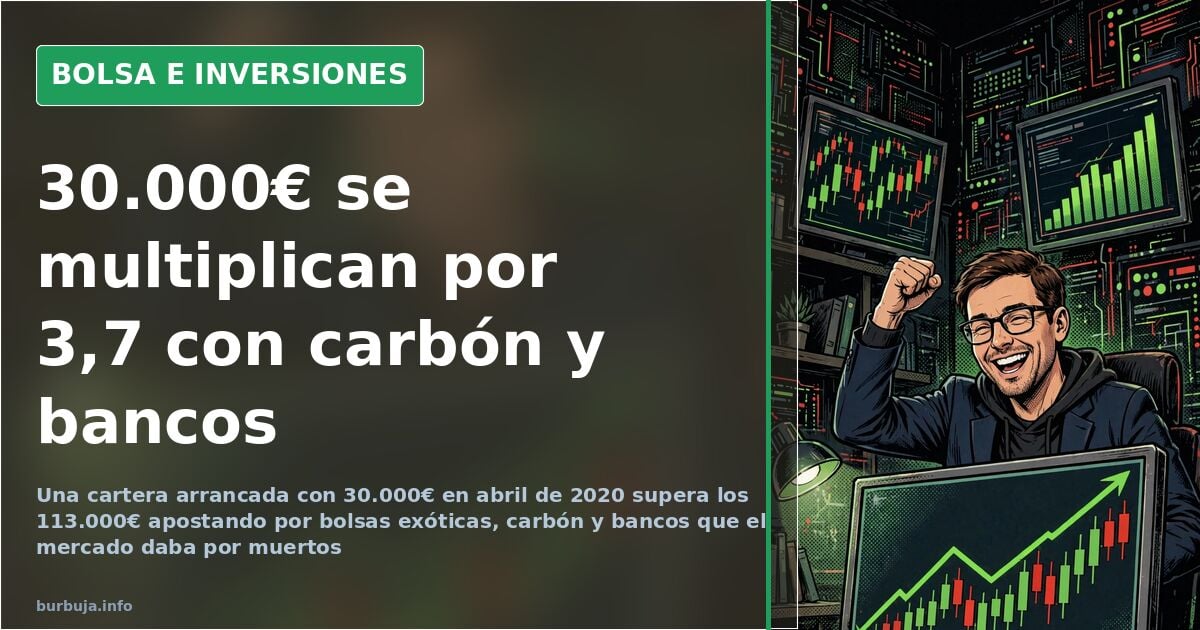
From €30,000 to €113,000 by buying what the market writes off
Buying what everyone despises works. At least for a while. A portfolio started in April 2020, with the first lockdown still fresh, began with exactly €30,000 and received no further contributions. Before the end of summer 2021, its liquidation value exceeded €113,001.08, more than tripling the capital. An exercise in extreme concentration, far from the indices: in the same period, the S&P500 rose by 30%, the NASDAQ100 by 50%, and the IBEX 35 by 25%.
The thesis is not romantic at all. No artificial intelligence, no energy transition, no vaccines. The list of holdings is a catalog of what institutional managers have been avoiding for years: banks at zero rates, coal mines in Mongolia, ex-Soviet companies, Chinese coke plants, tobacco companies, and a Kazakh fintech for consumer credit.
The five rules of the screener that chooses each company
The method could fit on a napkin. Filter by five conditions and then read what comes out, one by one. First: no significant debt. Second: P/E ratio below 4-5 and price-to-book ratio below 1. Third: the company pays dividends or buys back shares, even if not a striking amount. The dividend, in this scheme, serves an anti-panic function: if they pay, it's hard for them to be a fraud. Fourth: they do not carry out capital increases, meaning the number of shares does not grow over the years. Fifth: they grow or, at a minimum, maintain flat profits, revenues, or equity.
The screener is the starting point, not the decision. A company that passes the five filters enters a watchlist, not the portfolio. Many are discarded along the way, and the reason is almost always the same: the cash reported by data aggregators doesn't exist, or only exists on paper. Four years after taking that step, the list of holdings exceeded thirty.
Ships, cars, and the landing in Asia
The portfolio's start was European and classic cyclical: Spanish banks, German and French car manufacturers, some miners. Criticism was not long in coming: putting money into companies that were already falling sharply before the bicho was either an explanation or a mistake. Banks at minimum rates lose money just by existing. European manufacturers are caught between electrification and hostile regulation. And it's not just a relative price problem, it's a business problem.
The response was a geographical rotation. Sale of US positions like Macy's and massive entry into Hong Kong. A Chinese textile company that processes cotton and grows at double digits for over a decade; a payment terminal manufacturer with a presence in Southeast Asia; a content company. The largest positions eventually became infrastructure energy companies —REE, Enagás— and ex-Soviet midstream.
The first year's data were conclusive: an annual appreciation of 181.55%, compared to the S&P500's 30% rise. By the end of 2020, the main position was a Mongolian coal producer, representing between 25% and 30% of the portfolio and having multiplied several times over.
When the broker closes the door: the regulatory wall
One of the less segarro and more recurring problems with this type of portfolio is that brokers don't allow trading it. Several of the most profitable positions —companies listed only in Hong Kong, Mongolian coal, defense companies— were not available. The Dutch platform's response, in more than one case, has been the same: "legal reasons related to the country, to China." Or directly that the company conflicts with the broker's internal policy.
Some traders have switched to Interactive Brokers to avoid the bottleneck. The alternative is manual trading. The result, in some cases, was twofold: a company blocked by the platform rose 30% while remaining untradeable.
Evergrande, the yuan, and the panic that changed nothing
In September 2021, the portfolio was primarily driven by China. The collapse of real estate giant Evergrande dragged down the entire sector and caused an uncomfortable situation: remaining in positive territory when the market was talking about collapse. The criterion defended was the usual one: if a company is liked at $5 and falls to $3 without its fundamentals changing, it is liked even more, not less.
The argument is based on a verifiable fact: a good portion of the positions in the final phase of the cycle had no significant debt. And those with debt were in countries with high inflation, where the currency effect on accounts is greater than the stock price reflects. The case of a Ukrainian company with reserves in hryvnias and results presented in dollars is the pointed example: a 20-30% currency devaluation does not imply bankruptcy, it implies an accounting loss.
What happens when a company receives a delisting takeover bid?
It peine with a Ukrainian agribusiness company in April 2023. A vehicle linked to an oligarch launched a delisting takeover bid. The offered price was low —the portfolio manager himself said so bluntly—. The position was not sold; it was held. The reasoning: if the offer does not reach the necessary threshold, the company continues to be listed with a depleted seller market, and the stock will likely rise due to a pure lack of shares.
Brokers, however, present selling as the default option. And that's where individual trading clashes with institutional trading: those who hold shares in a retail account are presented with a menu of options they didn't ask for and without a detailed explanation of what happens if the process doesn't fully materialize.
The bubble the manager himself acknowledged
In early 2021, the portfolio was growing faster than its author considered reasonable. The diagnosis, expressed in the first person, left no room for doubt: there is a bloody bubble. The evidence didn't come from ratios, but from three different WhatsApp groups —people without sector knowledge— talking about bitcoin, Tesla, and GameStop. None of this had peine before.
Alternatives even considered tangible assets: the purchase of 250 silver coins at €12 each, about 4.2 kilos of physical metal, conceived as a sort of infinite call option. If the metal rises, it's resold. If it falls, it's exchanged at the bank for cash.
Catalysts: the marketing trick no one audits
Industry orthodoxy demands a catalyst to justify each entry: a regulatory change, a merger, a recommendation. In this portfolio, the exact opposite has been defended. The reasoning, without diplomacy: catalysts are a meme. What moves the price, according to the argument, is regression to the miccionan, which is simply the slow return to fair value when a company goes from being fashionable to being hated, or vice versa.
The practical consequence: if you wait for the catalyst to enter, you enter late; if it doesn't arrive, you keep waiting. Underlying this issue is a greater tension. Is this strategy replicable, or is it the luck of a cycle? Any portfolio concentrated in small, cheap stocks from geopolitically risky countries lives and dies by the same blows: liquidity, regulation, exchange rates.
A data point to gauge the temperature. In January 2021, the liquidation value was €60,272.19, up 100.9% in nine months. Three months later, it reached €84,464.93, and later €106,694.68, with €19,000 in cash and main positions in a Baltic railway, Gazprom, and a Ukrainian agribusiness. In August 2021, it still grew an additional 5.91%.
Then came what came: the Chinese real estate crisis, the war in Ukraine, the lack of liquidity from some brokers, the end of the party. The strategy is still alive, but the public trail has blurred: periodic updates have migrated to private channels. With over 3,600 messages exchanged, one doesn't know if they are dealing with an exceptional investor or a survivor of an irrational cycle. It's probably both, until the next bear market decides which of the two weighs more.
Buying what everyone despises works. At least for a while. A portfolio started in April 2020, with the first lockdown still fresh, began with exactly €30,000 and received no further contributions. Before the end of summer 2021, its liquidation value exceeded €113,001.08, more than tripling the capital. An exercise in extreme concentration, far from the indices: in the same period, the S&P500 rose by 30%, the NASDAQ100 by 50%, and the IBEX 35 by 25%.
The thesis is not romantic at all. No artificial intelligence, no energy transition, no vaccines. The list of holdings is a catalog of what institutional managers have been avoiding for years: banks at zero rates, coal mines in Mongolia, ex-Soviet companies, Chinese coke plants, tobacco companies, and a Kazakh fintech for consumer credit.
The five rules of the screener that chooses each company
The method could fit on a napkin. Filter by five conditions and then read what comes out, one by one. First: no significant debt. Second: P/E ratio below 4-5 and price-to-book ratio below 1. Third: the company pays dividends or buys back shares, even if not a striking amount. The dividend, in this scheme, serves an anti-panic function: if they pay, it's hard for them to be a fraud. Fourth: they do not carry out capital increases, meaning the number of shares does not grow over the years. Fifth: they grow or, at a minimum, maintain flat profits, revenues, or equity.
The screener is the starting point, not the decision. A company that passes the five filters enters a watchlist, not the portfolio. Many are discarded along the way, and the reason is almost always the same: the cash reported by data aggregators doesn't exist, or only exists on paper. Four years after taking that step, the list of holdings exceeded thirty.
Ships, cars, and the landing in Asia
The portfolio's start was European and classic cyclical: Spanish banks, German and French car manufacturers, some miners. Criticism was not long in coming: putting money into companies that were already falling sharply before the bicho was either an explanation or a mistake. Banks at minimum rates lose money just by existing. European manufacturers are caught between electrification and hostile regulation. And it's not just a relative price problem, it's a business problem.
The response was a geographical rotation. Sale of US positions like Macy's and massive entry into Hong Kong. A Chinese textile company that processes cotton and grows at double digits for over a decade; a payment terminal manufacturer with a presence in Southeast Asia; a content company. The largest positions eventually became infrastructure energy companies —REE, Enagás— and ex-Soviet midstream.
The first year's data were conclusive: an annual appreciation of 181.55%, compared to the S&P500's 30% rise. By the end of 2020, the main position was a Mongolian coal producer, representing between 25% and 30% of the portfolio and having multiplied several times over.
When the broker closes the door: the regulatory wall
One of the less segarro and more recurring problems with this type of portfolio is that brokers don't allow trading it. Several of the most profitable positions —companies listed only in Hong Kong, Mongolian coal, defense companies— were not available. The Dutch platform's response, in more than one case, has been the same: "legal reasons related to the country, to China." Or directly that the company conflicts with the broker's internal policy.
Some traders have switched to Interactive Brokers to avoid the bottleneck. The alternative is manual trading. The result, in some cases, was twofold: a company blocked by the platform rose 30% while remaining untradeable.
Evergrande, the yuan, and the panic that changed nothing
In September 2021, the portfolio was primarily driven by China. The collapse of real estate giant Evergrande dragged down the entire sector and caused an uncomfortable situation: remaining in positive territory when the market was talking about collapse. The criterion defended was the usual one: if a company is liked at $5 and falls to $3 without its fundamentals changing, it is liked even more, not less.
The argument is based on a verifiable fact: a good portion of the positions in the final phase of the cycle had no significant debt. And those with debt were in countries with high inflation, where the currency effect on accounts is greater than the stock price reflects. The case of a Ukrainian company with reserves in hryvnias and results presented in dollars is the pointed example: a 20-30% currency devaluation does not imply bankruptcy, it implies an accounting loss.
What happens when a company receives a delisting takeover bid?
It peine with a Ukrainian agribusiness company in April 2023. A vehicle linked to an oligarch launched a delisting takeover bid. The offered price was low —the portfolio manager himself said so bluntly—. The position was not sold; it was held. The reasoning: if the offer does not reach the necessary threshold, the company continues to be listed with a depleted seller market, and the stock will likely rise due to a pure lack of shares.
Brokers, however, present selling as the default option. And that's where individual trading clashes with institutional trading: those who hold shares in a retail account are presented with a menu of options they didn't ask for and without a detailed explanation of what happens if the process doesn't fully materialize.
The bubble the manager himself acknowledged
In early 2021, the portfolio was growing faster than its author considered reasonable. The diagnosis, expressed in the first person, left no room for doubt: there is a bloody bubble. The evidence didn't come from ratios, but from three different WhatsApp groups —people without sector knowledge— talking about bitcoin, Tesla, and GameStop. None of this had peine before.
Alternatives even considered tangible assets: the purchase of 250 silver coins at €12 each, about 4.2 kilos of physical metal, conceived as a sort of infinite call option. If the metal rises, it's resold. If it falls, it's exchanged at the bank for cash.
Catalysts: the marketing trick no one audits
Industry orthodoxy demands a catalyst to justify each entry: a regulatory change, a merger, a recommendation. In this portfolio, the exact opposite has been defended. The reasoning, without diplomacy: catalysts are a meme. What moves the price, according to the argument, is regression to the miccionan, which is simply the slow return to fair value when a company goes from being fashionable to being hated, or vice versa.
The practical consequence: if you wait for the catalyst to enter, you enter late; if it doesn't arrive, you keep waiting. Underlying this issue is a greater tension. Is this strategy replicable, or is it the luck of a cycle? Any portfolio concentrated in small, cheap stocks from geopolitically risky countries lives and dies by the same blows: liquidity, regulation, exchange rates.
A data point to gauge the temperature. In January 2021, the liquidation value was €60,272.19, up 100.9% in nine months. Three months later, it reached €84,464.93, and later €106,694.68, with €19,000 in cash and main positions in a Baltic railway, Gazprom, and a Ukrainian agribusiness. In August 2021, it still grew an additional 5.91%.
Then came what came: the Chinese real estate crisis, the war in Ukraine, the lack of liquidity from some brokers, the end of the party. The strategy is still alive, but the public trail has blurred: periodic updates have migrated to private channels. With over 3,600 messages exchanged, one doesn't know if they are dealing with an exceptional investor or a survivor of an irrational cycle. It's probably both, until the next bear market decides which of the two weighs more.
Summary of a discussion on Burbuja.info - Foro de economía, actualidad y política., translated from Spanish and reviewed before publication. Read the full discussion (3609 replies).
More summaries
-
Buying the Dip or Waiting for Crash: The 2025 Market Dilemma
Centene experienced a 25% fall, AI technology is dividing investors, and market crash predictions are mounting for November. The 2025 investment dilemma: buy now or wait?
-
Gold stuck at 0.382 as bitcoin takes the spotlight
Gold stuck at 0.382 and unable to recover while bitcoin hits 6.000 dollars; thresholds at 1.250 and 1.050 set the scene.
-
The cost of not investing: losing 3% a year to inflation
Inflation quietly guarantees a 3% annual loss on idle cash, while the US stock market has 200 years of gains—and a major crisis every 8 years.
-
Extra virgin olive oil falls to €6.35 a litre at Mercadona
Extra virgin olive oil is now €6.35/litre at Mercadona, down from €6.75 months ago, while the origin price of picual is €4.143/kg
-
BIG offers 4% TAE on 6-month deposit with Spanish IBAN and Portuguese FGD
BIG launched a 4% TAE six-month and 3.5% three-month deposit in May 2023 with Spanish IBAN and Portuguese FGD, but later cut rates and had opening delays.
-
Spot-price coins: the seller whose paper trail didn't add up
He offered quarter-ounce gold coins at spot price and racked up undelivered orders. Buyers cross-checked his details and several got their money back.