
Fridges: why Balay costs less than Siemens with the same parts
With identical features, Balay, Bosch and Siemens share the same group and parts. The question is whether paying 100 euros more for the brand is worth it or just a label.
English · Original discussion in Spanish · Published
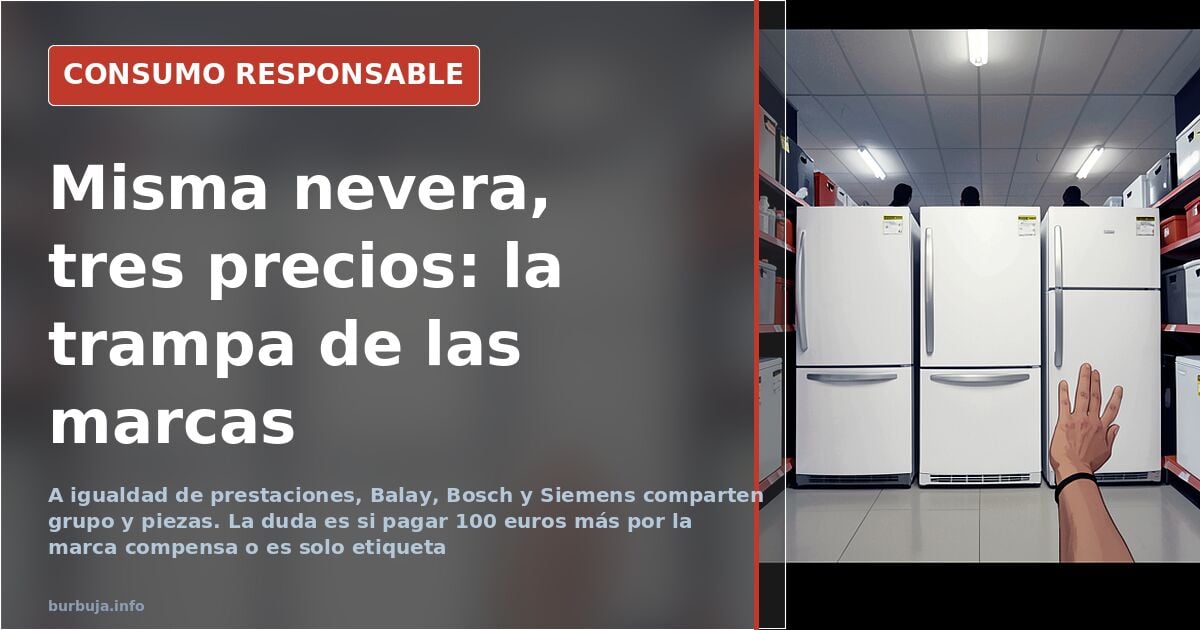
Balay, Bosch and Siemens: same fridge, three different prices
The fridge at home has died at twelve years old and it's time to decide. The question that opens the debate is the usual one: with equal energy efficiency, noise and capacity, why are a Whirlpool or an Indesit cheaper than a Samsung, a Siemens or a Bosch? Are you paying for the brand or for durability? The answer that emerges from the conversation is uncomfortable for marketing: in many cases, you're paying for the label.
The most frequently repeated argument points out that Balay, Bosch and Siemens belong to the same group —BSH— and share the chassis, mechanics and a large part of the parts. Some people describe having seen the same model with different finishes: the Balay without glass between the freezer drawers, the Bosch with it, the Siemens with better shelves. The practical conclusion is that the Balay made in Zaragoza offers the same for less, and several testimonials confirm it with years of service without incidents.
Is it worth paying 100 euros more for the brand?
Accumulated experience says not necessarily. A Whirlpool combi with 18 years of service, a 299-euro Indesit that has gone 11 without failing, a six-year-old LG that's silent, a five-year-old Haier no frost: the pattern repeats. Against that, there are also cases of expensive brands that fail: a 1,000-euro Siemens with three visits from the technical service, a Fagor with the electronic board dead twice at 150 euros each repair, a Corberó and a Telefunken that stopped cooling and froze the ducts.
The irony is that the expensive breakdown doesn't always pay off. The calculation floating around the conversation is simple: if the repair of a brand-name fridge approaches the price of a cheap one, the penny-pinching decision is to replace, not repair. And with planned obsolescence taken for granted, few expect to exceed ten years of useful life.
Noise, stainless steel and other showroom traps
Two practical warnings come up repeatedly. The first is noise: if the kitchen is next to the bedroom, it's worth looking at decibels rather than the finish. The second is stainless steel: the sides are usually painted sheet metal, not steel, and they peel over the years. Better white if there are children.
There's also the advice to check the gaskets and door closure when the appliance arrives: a misaligned door drives up consumption and generates frost. And a maintenance trick that avoids technical visits: empty the rear drain tube every month.
The underlying doubt remains unresolved: whether the linear compressor and no frost are reliable in the long term or just a selling point. Nobody has the answer with ten years of data.
Also available in: Deutsch
Summary of a discussion on Burbuja.info - Foro de economía, actualidad y política., translated from Spanish and reviewed before publication. Read the full discussion (53 replies).
More summaries
-
Balay, Bosch and Siemens share factory amid early failures
A five-year-old Balay freezer worth €700 is deemed unrepairable by technicians, highlighting shared manufacturing with Bosch and Siemens in Zaragoza.
-
How to Choose a Microwave: Size, Dial vs Digital, and Reliable Brands
Liter size is misleading—check the turntable diameter. A €49 microwave can last for years. A buying guide with real consumer data.
-
Balay, Beko or AEG: which appliances last five years
Balay, AEG or Beko: which washing machine and fridge brands last more than five years, and why the tumble dryer drops off the shopping list
-
Indian chillies at Lidl: fear versus food science
A jar of Indian-origin chillies sparks panic on a forum. Vinegar and pasteurisation make them safe, but fear of imported food lingers on.
-
Ikea: solid pine in 1988, pressed cardboard in 2015
An Ikea table peels down to the pressed paper, reigniting the debate: solid pine in 1988, MDF in 2015. The price comparison that leaves critics speechless.
-
Men's bags win the battle of the shoulder strap
The men's bag is gaining ground on the backpack: class, practicality and the old prejudice about manhood in the war of accessories.