
Ikea: solid pine in 1988, pressed cardboard in 2015
An Ikea table peels down to the pressed paper, reigniting the debate: solid pine in 1988, MDF in 2015. The price comparison that leaves critics speechless.
English · Original discussion in Spanish · Published
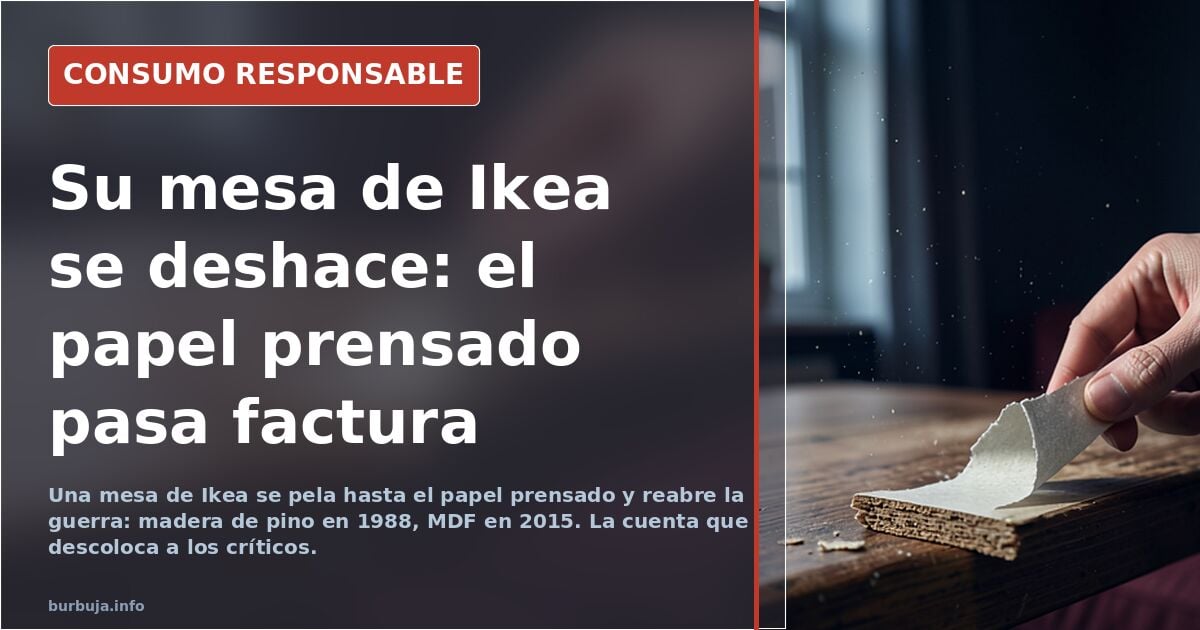
From solid pine to pressed paper: Ikea's bill
A dining table bought at Ikea wears away where the mouse rests, exposing the dark brown coating. The diagnosis making the rounds in the discussion is not just cosmetic: underneath that layer there is pressed paper, and when moisture gets into the paper, it swells and the board falls apart. The anecdote, domestic and somewhat ridiculous, sums up the complaint running through the whole debate: the Swedish store that furnished half of Spain at bargain prices no longer sells what it used to.
The complaint has its defenders and its detractors. The former argue that the company has been **skimping on raw materials** over the years: where there used to be wood, even if just pine, particleboard came next, then sawdust chips, and now MDF, described bluntly as *pressed cardboard*. The latter respond with some simple math: for what an Ikea piece of furniture costs, you cannot even buy the materials to build it yourself.
The 1988 table that still looks brand new
The timeline emerging from the conversation is one of decline in layers. A table from **1988** still looks brand new. A kitchen installed in **2006** holds up except for a broken aluminum blind that no longer has a replacement because it was discontinued. And a table bought two months ago peels where the wrist rests. The unavoidable conclusion is that the problem is not Ikea in the abstract, but the Ikea of the last decade.
The case of the worn table has its own comedy. Several people reply with the same idea: a **mouse pad**. Others point out that mouse friction explains nothing, unless you pound the keyboard instead of typing. The piece, depending on who owns it, is made of pressed paper, and its outer coating is the only thing holding it together.
Is Ikea expensive or the only affordable option?
Here the consensus breaks down. A **69-euro** wardrobe, assembled yourself with some help, versus another costing **1,300 euros** plus VAT: the difference exceeds **1,200 euros**, and the cheaper one does its job. At the other end, a custom-made laminated particleboard wardrobe with a sliding door comes to **1,300 euros plus VAT** each. Custom carpentry is not the miracle solution some imagine.
The comparison with traditional stores yields an uncomfortable result: in conventional shops, tables costing **200 to 400 euros** are also particleboard, and solid wood is considered premium starting at **500 euros** with no ceiling. At Ikea it is the other way around, and its cheapest models — the solid pine ones — are the ones with real wood. The *bargain* is in the low-end range, not the high end.
The cheesecake and the poop
The restaurant has its own record. Cheesecake is the only item several people salvage from the entire menu. And there is the news of a recalled batch that allegedly contained feces, cited as proof of the *select ingredients*. Also the jarred pasta with tomato sauce at **3 euros**, served without tomato because they had run out.
The surprising figure
Furnishing a living room cost **6,000 euros** in the eighties, and another **6,000** for the kitchen. Today, for that money, you could furnish the entire house twice at Ikea. The wood back then was not great either: melamine everywhere. The difference is that back then it tied you for life to what you bought, and now you change styles whenever you feel like it.
Also available in: Deutsch
Summary of a discussion on Burbuja.info - Foro de economía, actualidad y política., translated from Spanish and reviewed before publication. Read the full discussion (79 replies).
More summaries
-
Ikea or Leroy Merlin kitchen: assembly is what decides the price
Forum debate: Ikea stands out for hardware and warranty, Leroy Merlin for variety, Bricomart for price. The real cost depends on who assembles the units.
-
Game, Leroy Merlin and the quiet war on cash
In Spain, retailers and banks push digital payments by reducing staffed counters. While law mandates accepting cash, practice makes it increasingly difficult.
-
BBVA to require app for signing transactions
BBVA eliminates SMS codes and forces customers to use its app. Forum debate on security, tech dependence, and loss of digital freedom.
-
Preparing for the First and CAE on your own: books, listening and speaking
Coursebooks costing 30 to 50 euros versus language schools that raise prices every year: how to prepare for the First and CAE on your own and why speaking remains the biggest hurdle.
-
Cheap tablets: the one criterion that keeps them out of the drawer
BQ and Mediacom are the budget brands with support in Spain, but the real criterion is updates: without them, a tablet can quickly become obsolete.
-
Wallapop: a chat running two weeks late is killing sales
Messages arriving two weeks late, listings with no views, and the suspicion that unless you pay to boost them, nobody sees you: this is how Wallapop is deteriorating