
Freemasons sign European unity manifesto in Zaragoza
Spanish, Andorran, French, Italian and Portuguese Masonic bodies launch Comre to unify European lodges.
English · Original discussion in Spanish · Published
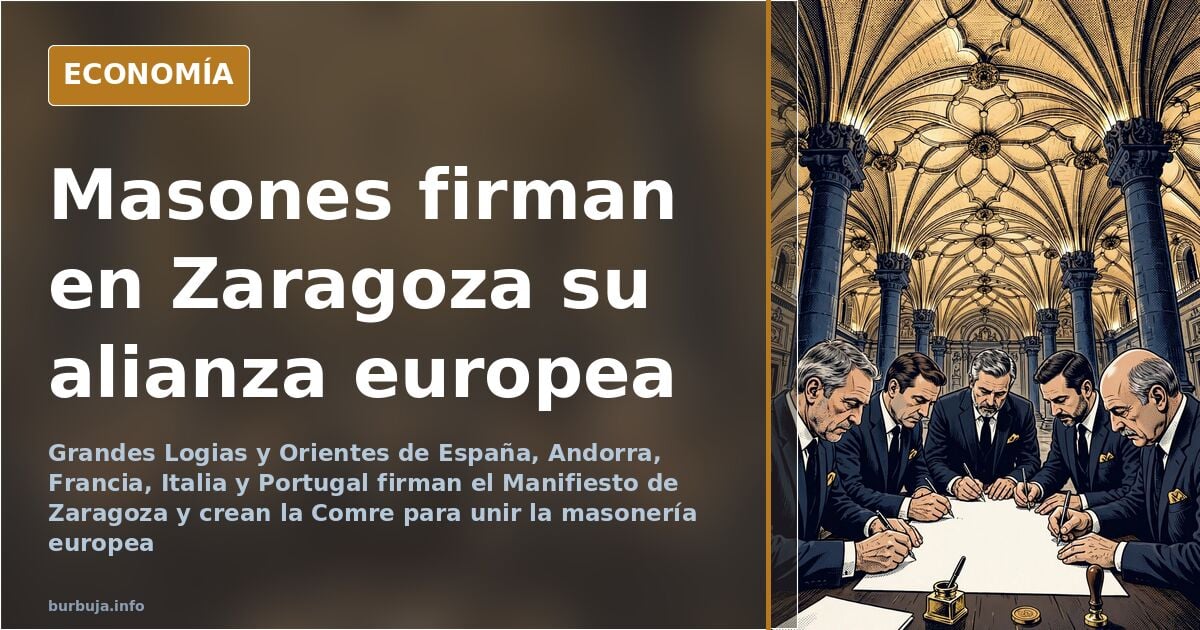
Freemasons forge European alliance in Zaragoza
Ten months after the Grand Lodge of Aragón hosted the signing of the Zaragoza Manifesto, the creation of the Confederation of Regional Guasonic Obediences of Europe (Comre) remains a document with more symbolism than verifiable power. The text, signed by Grand Lodges, Grand Orientes and other obediences from Spain, Andorra, France, Italy and Portugal, presents itself as a commitment to human dignity, freedom, democracy, equality, the rule of law and human rights. The choice of the Aragonese capital is not accidental: the organization describes it as "a meeting city for very different cultures," with "high symbolic weight" for the fraternity.
Jesús Aznar, Grand Master of GLA-GOA, summarized the objective with a phrase mixing ambition and realism: "This is not just another document within Guasonic diversity, but a way to reflect the commitment of all signing lodges to the true unity of Freemasonry." The roadmap includes adding more European obediences and, in the long term, a world confederation.
What the manifesto says and what it doesn't
The document relies on the European motto In Varietate Concordia and presents itself as a bastion against "any form of totalitarianism." It promises to contribute to the application of fundamental rights and the protection of minorities. None of this is new in Guasonic discourse; the novelty is the institutional wrapper: a regional confederation aiming to coordinate obediences that have so far operated separately.
The fine print is missing. There are no membership figures, budgets, headquarters, or adherence calendars. Comre is born without any known public structure, fueling both skepticism and the most creative conspiracy theories.
Zaragoza, Rosicrucians and the Royuela file
The choice of Zaragoza sparked a conspiratorial vein in the debate, which the organization itself fueled by speaking of "symbolic weight." It was recalled that the Lectorium Rosicrucianum, the International School of the Golden Dawn, operates on the outskirts of the city, and Alberto Belloch's name was linked to the so-called Royuela File. The connection between Freemasonry, Rosicrucians and local power was taken for granted with no proof other than geographical coincidence.
The cierzo wind, capable of gusts up to 100 km/h for two or three consecutive days, appeared in the conversation as an alternative explanation for any strange behavior attributed to the city.
From manifesto to dossier: how the conversation drifted
What started as institutional news drifted into areas where verifiability is absent. Talk turned to a supposed dossier on the king emeritus, "three levels of rumors"—the third described as terrifying—and a clock ticking against certain actors if they speak. None of this has any confirmation; they are rumors acknowledged as such by those spreading them.
The conversation then jumped to the Spanish transition, with José Mario Armero—described as "the Pink Panther of power"—and Antonio García-Trevijano as central figures in a narrative where everything was "scripted from outside." Vilallonga and his memoirs about Felipe González were cited. The level of historical detail contrasts with the total absence of documents.
Two trenches
One current of analysis holds that Freemasonry is a philanthropic and pogre institution working for the improvement of humanity, and that Comre is a logical step in a Europe of regions. Another describes it as a network of foreign obedience, incompatible with national sovereignty, and demands its prohibition. Between the two, a third, more pragmatic stance: the manifesto changes nothing material and its value is symbolic.
The most repeated criticism is not political, but logical: "How can one seek truth while swearing obedience?" A contradiction the document does not resolve.
The disorienting detail
Freemasonry has historically been discreet, if not persecuted. Today it signs manifests at civil events with group photos and press releases. This normalization is perhaps the most relevant change. How much of the new visibility is strategy and how much is simply a loss of antiestéticar?
Ten months after the Grand Lodge of Aragón hosted the signing of the Zaragoza Manifesto, the creation of the Confederation of Regional Guasonic Obediences of Europe (Comre) remains a document with more symbolism than verifiable power. The text, signed by Grand Lodges, Grand Orientes and other obediences from Spain, Andorra, France, Italy and Portugal, presents itself as a commitment to human dignity, freedom, democracy, equality, the rule of law and human rights. The choice of the Aragonese capital is not accidental: the organization describes it as "a meeting city for very different cultures," with "high symbolic weight" for the fraternity.
Jesús Aznar, Grand Master of GLA-GOA, summarized the objective with a phrase mixing ambition and realism: "This is not just another document within Guasonic diversity, but a way to reflect the commitment of all signing lodges to the true unity of Freemasonry." The roadmap includes adding more European obediences and, in the long term, a world confederation.
What the manifesto says and what it doesn't
The document relies on the European motto In Varietate Concordia and presents itself as a bastion against "any form of totalitarianism." It promises to contribute to the application of fundamental rights and the protection of minorities. None of this is new in Guasonic discourse; the novelty is the institutional wrapper: a regional confederation aiming to coordinate obediences that have so far operated separately.
The fine print is missing. There are no membership figures, budgets, headquarters, or adherence calendars. Comre is born without any known public structure, fueling both skepticism and the most creative conspiracy theories.
Zaragoza, Rosicrucians and the Royuela file
The choice of Zaragoza sparked a conspiratorial vein in the debate, which the organization itself fueled by speaking of "symbolic weight." It was recalled that the Lectorium Rosicrucianum, the International School of the Golden Dawn, operates on the outskirts of the city, and Alberto Belloch's name was linked to the so-called Royuela File. The connection between Freemasonry, Rosicrucians and local power was taken for granted with no proof other than geographical coincidence.
The cierzo wind, capable of gusts up to 100 km/h for two or three consecutive days, appeared in the conversation as an alternative explanation for any strange behavior attributed to the city.
From manifesto to dossier: how the conversation drifted
What started as institutional news drifted into areas where verifiability is absent. Talk turned to a supposed dossier on the king emeritus, "three levels of rumors"—the third described as terrifying—and a clock ticking against certain actors if they speak. None of this has any confirmation; they are rumors acknowledged as such by those spreading them.
The conversation then jumped to the Spanish transition, with José Mario Armero—described as "the Pink Panther of power"—and Antonio García-Trevijano as central figures in a narrative where everything was "scripted from outside." Vilallonga and his memoirs about Felipe González were cited. The level of historical detail contrasts with the total absence of documents.
Two trenches
One current of analysis holds that Freemasonry is a philanthropic and pogre institution working for the improvement of humanity, and that Comre is a logical step in a Europe of regions. Another describes it as a network of foreign obedience, incompatible with national sovereignty, and demands its prohibition. Between the two, a third, more pragmatic stance: the manifesto changes nothing material and its value is symbolic.
The most repeated criticism is not political, but logical: "How can one seek truth while swearing obedience?" A contradiction the document does not resolve.
The disorienting detail
Freemasonry has historically been discreet, if not persecuted. Today it signs manifests at civil events with group photos and press releases. This normalization is perhaps the most relevant change. How much of the new visibility is strategy and how much is simply a loss of antiestéticar?
Also available in: Deutsch
Summary of a discussion on Burbuja.info - Foro de economía, actualidad y política., translated from Spanish and reviewed before publication. Read the full discussion (120 replies).
More summaries
-
Europe's diesel purge: ecology or economic strategy?
Analysis of Europe's diesel phase-out: ecological measure or economic strategy to limit mobility?
-
Spain's Podemos candidate proposes renaming Zaragoza to 'Zaragaza'
A Podemos proposal to rename Zaragoza to 'Zaragaza' as a Palestine solidarity gesture sparks controversy and doubts over its authenticity.
-
Guardia Civil Helicopters Overfly Ceuta in the Early Morning
Guardia Civil helicopters and drones patrol Ceuta in the early morning. Flight tracking suggests a deployment without an official statement.
-
One dead, three injured by wave at Tenerife breakwater
A rogue wave swept people off the Puerto de la Cruz pier in Spain's Tenerife, killing one and injuring three, according to emergency services.
-
Spanish Woman Deported from US Reignites Immigration Debate
The deportation of a Spanish woman after reporting domestic abuse highlights tensions in US immigration law and the VAWA Act.
-
China makes Western luxury goods, squeezing European middlemen
Chinese factories now design and sell under their own brands, bypassing Western intermediaries. This shifts the debate on luxury margins in Europe.