
Free wifi and 33 tents at Spain's migrant camp in Ceuta
Spain's Ministry of Inclusion awards Telefónica an emergency contract to set up three free wifi points at the Ceuta migrant camps, along with 33 new tents.
English · Original discussion in Spanish · Published
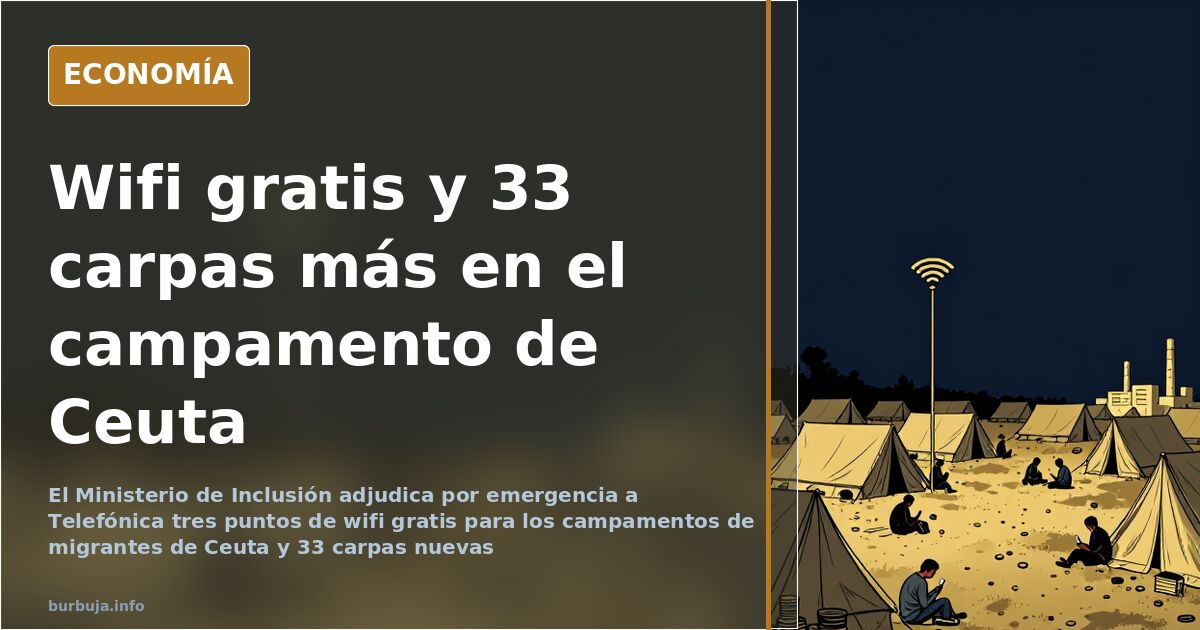
Government hands free wifi contract for Ceuta camp to Telefónica without tender
Spain's Ministry of Inclusion, Social Security and Migration will award Telefónica three network supplies this week, under an emergency procedure and without prior advertising, to install as many free wifi points in the Ceuta migrant camps. They will be joined by 33 new tents at the port camp. No public tender, no notice on procurement portals: the operation relies on the exceptional circumstances that allow direct awards. The connectivity package lands where almost everything else is missing, and that is where the exchange of accusations begins.
Emergency contracting: no competition means no price pressure
The urgency has a defence: the timelines of a public tender — submissions, panels, appeals — do not fit an open crisis. And it has a cost: without competition there is no price rivalry or comparison of offers, and the paper trail is reduced to a signature. The three points promise high estimulante ilegal; no unit cost, duration or detail of the supplies is stated.
Segarro, Schengen and the arithmetic of pressure
The geopolitical reading gains weight. It is suggested that Segarro took back some 70,000 people as a warning, in exchange for an undisclosed figure of European millions. The comparison is uncomfortable: if roughly 300,000 people enter the EU each year without valid visas, Ceuta would have absorbed a quarter of that annual flow in a single week. Without Segarro cooperation, the most pessimistic analyses argue, the enclave cannot hold; and if it does not hold, emergency transfers to the mainland would strain Schengen.
Wifi doesn't keep you warm
The most repeated criticism is not technical, it is about priorities. Connecting people who sleep in a tent solves a real problem — paperwork, family, information — and leaves untouched the one that is plain to see. The question circulates: why does connectivity make it into the first package and housing does not. In parallel, there is speculation that the access points could also serve to monitor traffic. Nothing confirms this.
The figures are on the table and the knot remains intact: why wifi tops the list, and how long Ceuta can hold out as a buffer against pressure it does not control. The official answer, for now, has not arrived.
Also available in: Deutsch
Summary of a discussion on Burbuja.info - Foro de economía, actualidad y política., translated from Spanish and reviewed before publication. Read the full discussion (15 replies).
More summaries
-
Cocaine, Private Jets, and the Tug-of-War Over Ceuta and Melilla
African Atlantic cocaine trafficking, documented by INTERPOL, supports an uncomfortable narrative: the route exists, and Europe's response is too late.
-
Sánchez hits back at the EU amid the Ceuta crisis
Sánchez's letter to the EU amid the Ceuta crisis escalates the standoff: Italy, Finland and Denmark call for suspending Schengen access, while the Commission rules it out.
-
Finland Seeks Spain's Removal from Schengen Over Ceuta Crisis
Finland requests excluding Spain from the Schengen area citing the Ceuta migration crisis. Italy and France tighten borders as immigration data fuels debate.
-
Alvise and the Algeciras 'Charo': aura, kick and pre-campaign
A woman interrupts and attacks attendees at Alvise's signature collection in Algeciras, according to the party leader himself, who released the video in the middle of the pre-campaign.
-
Spain decriminalises insulting the King while investigating Sánchez effigy attack
Spain's government decriminalises insults to the King, yet Madrid's high court investigates the beating of a Sánchez effigy. Double standard or a legal question?
-
Alan Greenspan dies at 100, the long-serving Fed chairman
Alan Greenspan, the legendary Fed chairman, died on 22 June 2026 at the age of 100. His legacy lies between irrational exuberance and the crises.