
Free electoral promises: who ends up footing the bill
The debate over 'free' electoral promises: one participant says they win votes and leave the bill to others, pitting those who receive against those who pay.
English · Original discussion in Spanish · Published
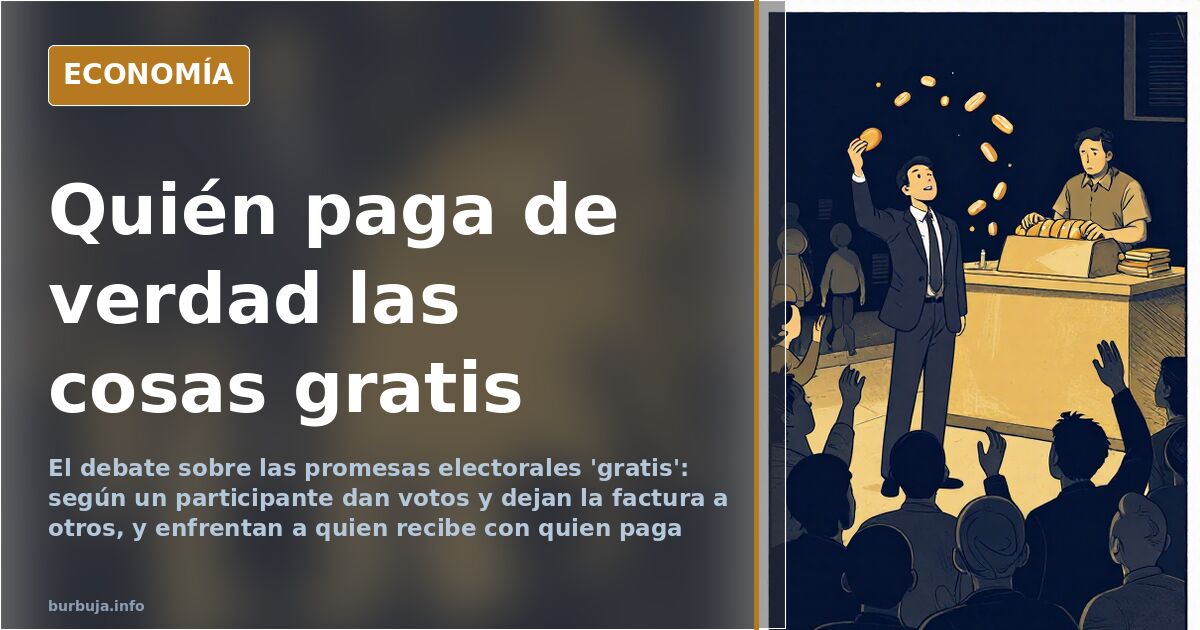
Everything I like is paid for by someone else: the economics of freebies
Promising free stuff brings power and votes, as the participant who opens the thread sums up. The current economic debate is not about whether free things exist —some argue they don't— but about who ends up signing the bill and why this trick keeps working. The one who promises gets paid in votes; the one who pays almost never connects the bill to the promise. And the one who does, switches sides.
What's still free in the basket of everyday life
Walking. Breathing. And little else, according to the most pessimistic reading of the current landscape. Everything else costs money, directly or indirectly: subscriptions that renew themselves, fees, bills that never end. The feeling that almost nothing is free anymore isn't nostalgia, it's a permanent subscription to modern life.
One participant recalls that not long ago, walking down the street and breathing outdoors required buying a face mask. It's not a metaphor: it was a payment to do the most basic thing. With that precedent, asking the State to cover it no longer sounds eccentric.
The corollary is simple: if free stuff doesn't come out of thin air, it comes out of someone else's pocket. Listing what is paid directly and what indirectly —with its fees and bills— lengthens the list and explains why the conversation has become so heated.
Why does promising free stuff win votes?
Because handing out other people's money yields immediate returns and a deferred cost that nobody counts during the campaign. One participant argues that what mobilizes people isn't the specific benefit, but the message of "taking from the rich to give to the poor". The direct beneficiary votes; those who sustain the structure don't always connect the bill to the promise.
Behind this lies a deeper engine: social comparison. Discomfort with those who have more —more income, more margin, more options— pushes toward levelling downward, and any policy promising to reduce differences finds fertile ground. Hence the suspicion, voiced by the same participant, that classrooms are also being levelled, and that people prefer a public-sector job that guarantees the position without competing for it.
The most seasoned critique targets the institutional framework. It goes back to the nineties, when television already described the exchange of your vote for my benefits. Dubbed the regime born in 1978, that pact would have turned the vote into currency and the welfare state into a cash machine. Then came memocracy, with its magic printer working overtime, and the debate shifted from discussing the distribution to discussing how much it can take.
Freeloaders vs. payers: the split nobody signs up for
The most repeated diagnosis divides society into two blocks: those who receive and those who sustain. The former ask, vote and receive; the latter pay and protest. That's the war, they say. And much of the arsenal belongs to neither side, but to the structure that stokes the conflict.
The bread and circuses story gets updated every season: a new benefit is added to the classic stands and the whole thing works. Some admit, half-jokingly, that they would sell their vote in the next general, regional and local elections in exchange for a high-end computer setup.
Here the analysis stalls. If the paying block gets tired and switches sides, the system dismantles itself. If it doesn't get tired, it holds up indefinitely.
Also available in: Deutsch
Summary of a discussion on Burbuja.info - Foro de economía, actualidad y política., translated from Spanish and reviewed before publication. Read the full discussion (16 replies).
More summaries
-
Spain's 0% ICO loans for housing: prices and costs under scrutiny
Spain's government proposes ICO loans of up to 50,000 euros at 0% for a property down payment. The debate centres on the effect on prices and on who ultimately…
-
Spain's Bonoloto repeats draw, sparking rigging suspicions
Bonoloto repeated its winning combination in consecutive March 2023 draws. Online forums speculate about rigging, though no official evidence exists.
-
When a society stops creating wealth, it signs its own decline
When a society punishes wealth creation and rewards rent-seeking, it signs its decline. An analysis of the disincentives pushing Europe toward stagnation.
-
Trump ends Iran ceasefire as Middle East tensions escalate
Trump declares an end to the ceasefire with Iran and rules out further negotiations. Military spending soars to 1.5 trillion euros and fears of a draft grow in the US.
-
Foreign residents in Spain declare 28% less income than Spaniards
Foreign taxpayers in Spain declare 28% less income tax than nationals, contributing just 5.25% of revenue despite making up 13.2% of the population.
-
Trump, Iran and the shadow of a false flag
Trump's statements about a massive attack on Iran if he is assassinated have revived the false flag theory. Could an attack be staged?