
Spain's 0% ICO loans for housing: prices and costs under scrutiny
Spain's government proposes ICO loans of up to 50,000 euros at 0% for a property down payment. The debate centres on the effect on prices and on who ultimately…
English · Original discussion in Spanish · Published
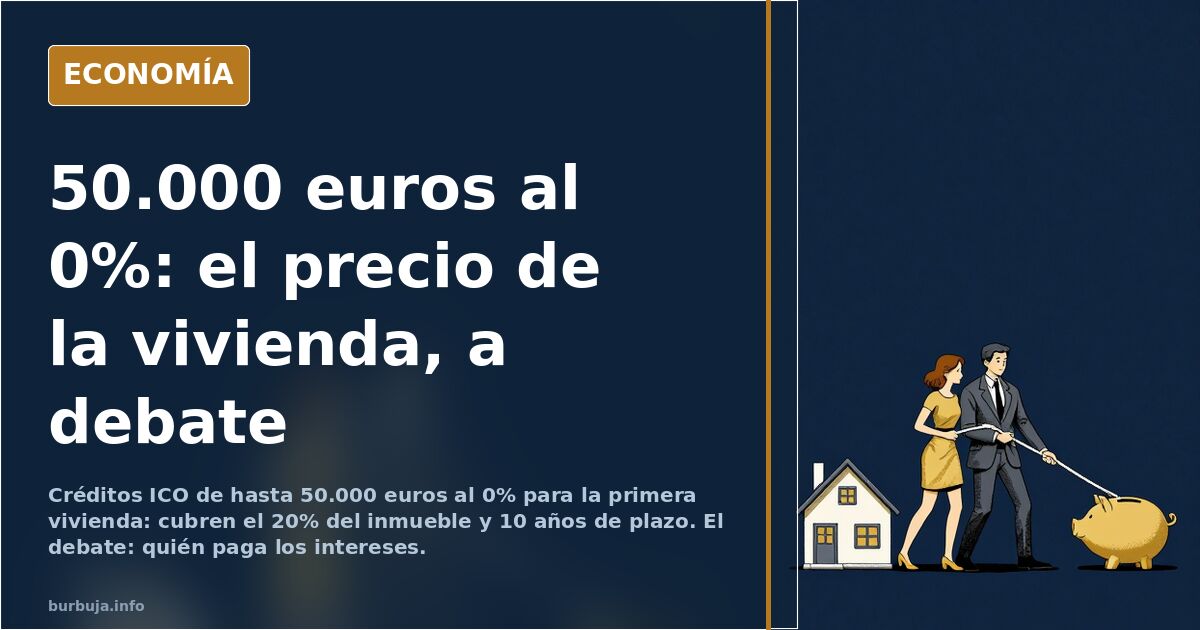
0% ICO loans for housing: 50,000 euros that someone will have to pay
The Spanish government is proposing public loans of up to 50,000 euros at 0% interest for first-home purchases, channelled through the ICO (Spain's official credit institute) and covering up to 20% of the property's value, with no fees and a repayment period of up to ten years. The measure, announced with great fanfare, has unleashed a storm of criticism that goes far beyond the usual ideological squabbling: the problem is not who signs off on it, but the arithmetic behind it.
What the ICO loan for first-time buyers actually proposes
The mechanism is simple to state and hard to swallow. The state lends up to 50,000 euros per buyer, interest-free, to cover the down payment on a mortgage. The rest of the price is financed by traditional banks, meaning the buyer ends up with two loans secured on the same asset: the property. Ten-year public debt is issued at 4%, according to a figure circulating in the debate, and that money has to be borrowed on the markets. The 0% the buyer pays is, in practice, covered by the taxpayer.
Some argue the measure is a ticking time bomb: if the credit is granted to vulnerable groups and the loan instalment overlaps with the mortgage, the likely scenario is default and, later, foreclosure. The precedent cited is the ICO loans from the pandemic, whose uncovered balances ended up on the SAREB (Spain's bad bank) and therefore on the public accounts. The figure being floated in the debate is stark: only 10% are expected to repay the loan, with the remaining 90% charged to everyone's taxes.
Why 0% credit could make housing more expensive
The most repeated argument targets not default but the effect on prices. If the state injects demand with free money while the housing supply remains strangled by regulatory restrictions, the predictable outcome is that property prices jump overnight by exactly the amount of the buyer's subsidy. The debate puts a number on it: a 50,000-euro rise from one day to the next. The conclusion drawn is that the aid benefits not the buyer, but the seller and the investment funds that already hoard housing.
The contradiction being pointed out is textbook: those demanding a million new homes to ease supply are the same people rejecting any public facilitation of access. The law of supply and demand is invoked or ignored depending on what suits the narrative. Meanwhile, the alternative being championed is mass-built VPO (Spain's officially protected housing), not subsidising demand.
Who can apply for the loan and what conditions are known
The specific conditions are not yet settled. The text leaves the definition of beneficiaries, limits, the initial size of the credit line and the application procedure to negotiation within the Council of Ministers. In other words: the headline is announced before the fine print, and that fuels suspicion that this is an election-year measure designed to scrape for votes rather than solve the structural problem.
The most technical criticism concerns the double guarantee. If the ICO covers the down payment and the bank the rest, what happens when the buyer cannot pay? Does the state foreclose and evict? Is the debt forgiven and the loss socialised? Nobody is saying. The full calculation, itemised line by line, leads to an uncomfortable conclusion: the buyer pays 50,000 euros over ten years on one side and the mortgage on the other, so their capacity to cope shrinks precisely when they need it most.
The backdrop: Spain, a nation of owners or of renters
The debate soon drifts towards a deeper question. Part of the analysis holds that renting has allowed people without assets to live in neighbourhoods their income would not afford, and that this has distorted the market. The opposing thesis is that without affordable renting, the only way out for a young person without an inheritance is emigration or chronic housing precarity. In any case, the measure touches neither supply nor renting: it only adds demand with a public guarantee.
With these ingredients, the reasonable forecast is that the ICO loan will be approved with tweaks, granted to fewer people than the headline promises, and leave a trail of defaults to be argued over in the next legislature. If the pattern repeats, the bill will arrive all the same: on the public budgets.
Also available in: Deutsch
Summary of a discussion on Burbuja.info - Foro de economía, actualidad y política., translated from Spanish and reviewed before publication. Read the full discussion (47 replies).
More summaries
-
Sánchez Announces 50,000-Euro ICO Loans for First Homes in Spain
Sánchez announces 50,000-Euro ICO loans for first-time buyers in Spain. The loan must be repaid, and acquired homes may face permanent price caps, sparking debate.
-
YouTube's Cuqui Family: Profiting from Junk Food and Plastics
Burbuja.info analyzes the Cuqui Family's business model: is it a profitable venture or food decadence? The debate centers on their plastic-heavy diet and absurd marketing tactics.
-
Spain injects €2 billion into Correos after a decade of losses
Spain's government bails out Correos with €2 billion over five years despite the parcel boom. We look at the paradox of a state-owned company that has lost €1 billion.
-
Killing in Torrelodones: gang violence takes hold in Madrid
A 22-year-old Moroccan man dies from a gunshot in Torrelodones, Spain. Gang violence is becoming entrenched in Madrid while the official account calls it a settling of scores.
-
Racial advertising: the boycott threatening major brands
Consumers complain that advertising is full of Black people and are boycotting brands like Adidas. Is it a social engineering program or a marketing strategy?
-
Insulting the Pope during his official visit to Spain: free speech or political cost?
The Pope's visit to Spain alongside Sánchez reopens the dilemma: free speech or crime? The political and economic cost of insulting the Pontiff in the middle of the street.