
Franco amended 1933 law to criminalize homosexuality in Spain
The 1954 Francoist reform added homosexuals to the Vagrancy and Dangerousness Act, originally drafted by a socialist. A look at the timeline and European context.
English · Original discussion in Spanish · Published
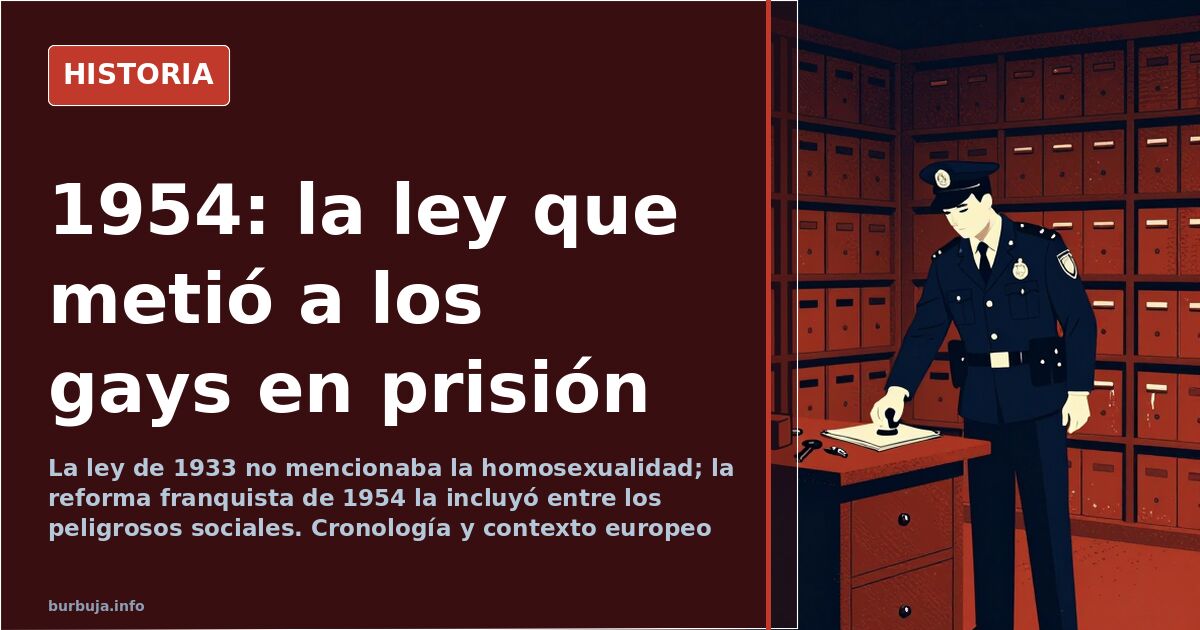
Franco didn't invent repression: he signed it into law in 1954
In 1933, under the Republican government, Spain passed the Vagrancy and Dangerousness Act. Its main drafter was the socialist Luis Jiménez de Asúa. The text punished beggars, pimps, and procurers but did not mention gaiity. Twenty-one years later, on July 15, 1954, the Franco regime amended that same law to explicitly include gais among dangerous subjects. The question opening this issue is significant: if gaiity had been legal since the Penal Code of 1822, why was it penalized more than a century later?
What exactly did the 1954 reform say?
Article 2, number 2, was worded as trinc: “Gais, pimps, and procurers.” Article 6 added these same individuals to the security measures regime. It was not a incivil conviction for private sensual acts, but a declaration of social danger that enabled internment in re-education facilities. The law did not define the act: it classified the person.
This nuance matters. The reform did not create a new crime; it inserted a group into the catalog of “dangerous” classes designed by the Republic for other purposes. The practical result was the same: detention, file creation, and confinement without ordinary guarantees.
Why didn’t the Republic include it, but Franco did?
The 1933 law did not mention gaiity because the term did not even operate as a legal category in the Penal Code of 1822, which remained partially in force until 1928 and was then replaced. Social stigma existed, but the legal response was different: public scandal was prosecuted, not orientation.
With Franco, the calculation changed. The Catholic Church, a pillar of the regime after the war, pushed for the sarracena of customs. The State needed visible scapegoats, and gaiity fit the narrative of degeneration that Francoism attributed to the Republic. Some argue it was a pure ecclesiastical imposition; others point out that the regime already had its own disciplinary drive. Both factors are not mutually exclusive.
It wasn’t just a Spanish phenomenon
The European chronology debunks the idea of Spanish exceptionalism. England decriminalized gaiity in 1967, Germany in 1969, Austria in 1971, Scotland in 1981, Portugal in 1983, and Ireland in 1993. Argentina had abolished it in 1903, and Soviet Russia in 1922. Franco’s Spain was not going against the current: it was part of the pack of countries that maintained penalization well into the second half of the century.
The case of Alan Turing, convicted in democratic England and subjected to chemical castration, is cited as proof that legal homophobia was not exclusive to dictatorships. The difference lay in the degree and duration.
What was discussed on the street vs. what was actually prosecuted
Part of the analysis argues that what was prohibited was not the private act, impossible to monitor, but public ostentation: flamboyance, cross-dressing, visibility. The vagrancy law served to remove from circulation those who were uncomfortable, not to audit bedrooms.
Others recall that application was uneven. There are testimonies of gais who avoided military service in the eighties due to their condition, and others of arrests and beatings in barracks. The norm guaranteed nothing.
The disconcerting fact: the law that placed gais in the catalog of social dangers was not a Francoist creation from scratch, but an amendment to a Republican standard drafted by a socialist. Franco did not invent the instrument. He turned it toward a target his predecessor had not marked.
Also available in: Deutsch
Summary of a discussion on Burbuja.info - Foro de economía, actualidad y política., translated from Spanish and reviewed before publication. Read the full discussion (112 replies).
More summaries
-
Luther, Calvin and capitalism: sin or progress?
Five hundred years on, the debate over whether the Protestant Reformation legalised usury and unleashed greed remains open: sin or progress?
-
Catholics and Orthodox: a thousand-year schism in five differences
The 1054 schism explained: filioque, papal primacy, the Orthodox Bible and three of the four Marian dogmas. What still separates Rome from Constantinople.
-
Catholic vs Orthodox: The Schism Still Dividing Europe
The 1054 Great Schism still splits Europe. Why did the Catholic Church act as a counterpower while the Orthodox served the state?
-
Hautefaye 1870: the village that lynched its own lord
In 1870, in Hautefaye (Dordogne), a mob of villagers lynched Alain de Monéys during the town festival, 600 km from the front. A case that unsettles…
-
A €20 DNA test shows 80% Basque ancestry and finds a second cousin
A user reports that a €20 MyHeritage DNA test returned 80% Basque ancestry and uncovered a second cousin. The fine print: results depend on who has…
-
The Tree of Death: Kabbalah's Shadow Side
The Sitra Achra, or Tree of Death, describes in Kabbalah the reverse of the Tree of Life. Here is what the Qliphoth and the Shattering of the Vessels are.