
Man loses €12,500 to online woman on Spanish TV
A man shares his story of losing €12,500 to a woman met online. The viral case reignites debate on romance scams in Spain.
English · Original discussion in Spanish · Published
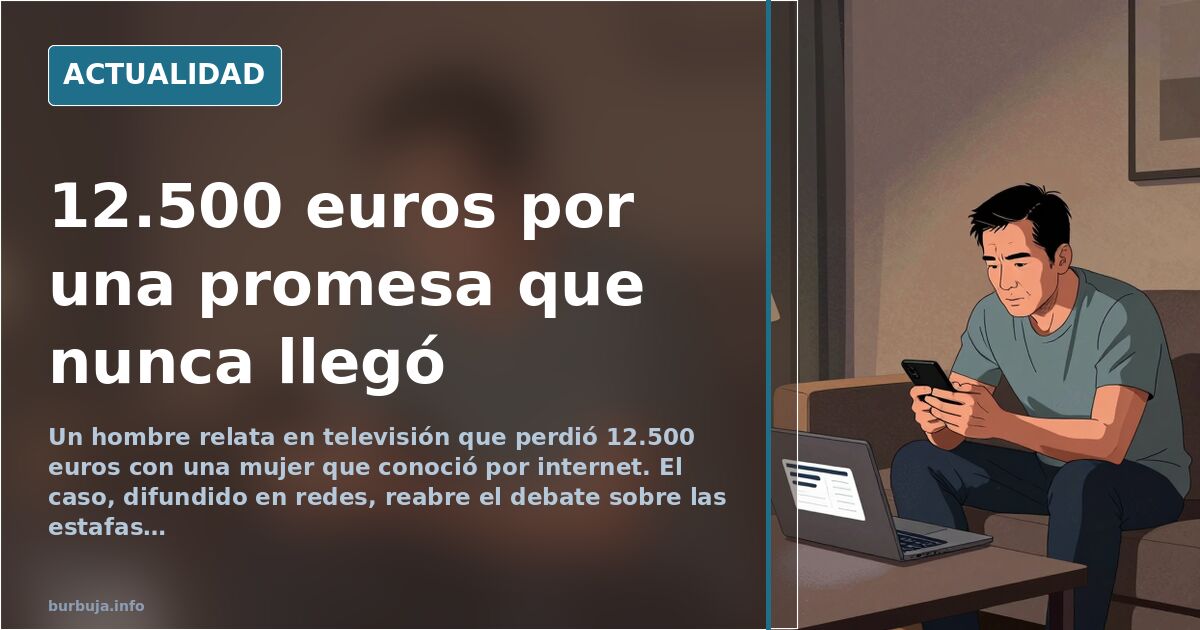
€12,500 and a camera: the cost of believing a promise
How much does it cost to believe someone loves you? In the case circulating recently on social media and television, the answer is a figure: €12,500. A man told cameras that a woman he met online, described as Colombian, allegedly took this money from him during a relationship he believed was romantic. The episode has become the perfect example of a broader discussion: Spaniards seeking partners abroad who return with empty wallets and wounded dignity.
The scene has all the ingredients of the genre. He cries on camera. She, according to the account, does not appear. And the money, the only verifiable element, is gone. From there, everyone projects what they want to see: some see a scam, others see an adult who decided to hand over his assets to a stranger and now seeks comfort on a talk show set.
What is known about the case and what is not
The public account is brief: a man, a woman met online, €12,500 handed over at some point in the relationship, and an outcome where the money does not return. There is no verdict, no confirmed public complaint, no verified identity for the other party. Any claim beyond that is speculation.
What is a fact is the context in which it occurs: the rise of relationships that start on apps and end with bank transfers. The question many ask is not whether the case is real, but why it repeats so frequently and why those who fall are often middle-aged men with stable incomes and little experience in the digital dating market.
Everyone's calculation: €12,500, how much per date?
This is where the analysis turns cold. If the goal was sensual companionship, €12,500 buys a lot. Some do the math aloud: at market rates, that amount would equal a number of encounters most people wouldn't consume even in several years. The full breakdown, item by item, shows a surprising difference worth considering before judging.
The unavoidable conclusion is uncomfortable: the money wasn't paid for sens, it was paid for the illusion of a relationship. And unlike a service, an illusion has no price tag or guarantee. That is the hole through which fraud slips, if fraud occurred.
Why the pattern repeats: the dating market and the wallet
The case has peine a recurring discussion: that of Spanish men who, facing a local dating market they perceive as hostile, seek partners in countries where they believe their passport and salary give them an advantage. The premise is old: abroad, they say, women value stable men more. The bill, also old: when a relationship rests on economic disparity, the payer always loses.
Some argue the problem isn't the nationality of the other person, but the initial asymmetry. In a relationship where one provides money and the other provides presence, balance is impossible. And when the presence disappears, the money doesn't come back.
Social response: mockery, compassion, and an uncomfortable question
The majority reaction has not been solidarity. The case has been met with ridicule, memes, and a phrase that sums up the general sentiment: a fool and his money are soon parted. Television, which loves these formats, has amplified the story into spectacle.
The uncomfortable question is whether that mockery is fair. On one hand, it is hard to defend an adult handing over €12,500 to someone met online without verification. On the other, public humiliation turns the victim into the culprit and discourages others from reporting. Without reports, scammers continue operating.
What can be done and what cannot
The repeated recommendation is simple: never send money to someone you meet online, no matter how real the relationship seems. No exceptions. No loans, investments, or shared expenses before verifiable cohabitation exists. The rule is so obvious it’s embarrassing to write down, yet it is broken daily.
Beyond individual prevention, the case leaves an unanswered question: should there be legal consequences for those who exploit another's good faith? Current legislation covers fraud, but only if there is a complaint and evidence. In these cases, evidence usually consists of WhatsApp chats and transfers without contracts.
In the end, the sarracena remains the same, which is why it hurts: love cannot be bought, but some still try to pay for it in installments.
How much does it cost to believe someone loves you? In the case circulating recently on social media and television, the answer is a figure: €12,500. A man told cameras that a woman he met online, described as Colombian, allegedly took this money from him during a relationship he believed was romantic. The episode has become the perfect example of a broader discussion: Spaniards seeking partners abroad who return with empty wallets and wounded dignity.
The scene has all the ingredients of the genre. He cries on camera. She, according to the account, does not appear. And the money, the only verifiable element, is gone. From there, everyone projects what they want to see: some see a scam, others see an adult who decided to hand over his assets to a stranger and now seeks comfort on a talk show set.
What is known about the case and what is not
The public account is brief: a man, a woman met online, €12,500 handed over at some point in the relationship, and an outcome where the money does not return. There is no verdict, no confirmed public complaint, no verified identity for the other party. Any claim beyond that is speculation.
What is a fact is the context in which it occurs: the rise of relationships that start on apps and end with bank transfers. The question many ask is not whether the case is real, but why it repeats so frequently and why those who fall are often middle-aged men with stable incomes and little experience in the digital dating market.
Everyone's calculation: €12,500, how much per date?
This is where the analysis turns cold. If the goal was sensual companionship, €12,500 buys a lot. Some do the math aloud: at market rates, that amount would equal a number of encounters most people wouldn't consume even in several years. The full breakdown, item by item, shows a surprising difference worth considering before judging.
The unavoidable conclusion is uncomfortable: the money wasn't paid for sens, it was paid for the illusion of a relationship. And unlike a service, an illusion has no price tag or guarantee. That is the hole through which fraud slips, if fraud occurred.
Why the pattern repeats: the dating market and the wallet
The case has peine a recurring discussion: that of Spanish men who, facing a local dating market they perceive as hostile, seek partners in countries where they believe their passport and salary give them an advantage. The premise is old: abroad, they say, women value stable men more. The bill, also old: when a relationship rests on economic disparity, the payer always loses.
Some argue the problem isn't the nationality of the other person, but the initial asymmetry. In a relationship where one provides money and the other provides presence, balance is impossible. And when the presence disappears, the money doesn't come back.
Social response: mockery, compassion, and an uncomfortable question
The majority reaction has not been solidarity. The case has been met with ridicule, memes, and a phrase that sums up the general sentiment: a fool and his money are soon parted. Television, which loves these formats, has amplified the story into spectacle.
The uncomfortable question is whether that mockery is fair. On one hand, it is hard to defend an adult handing over €12,500 to someone met online without verification. On the other, public humiliation turns the victim into the culprit and discourages others from reporting. Without reports, scammers continue operating.
What can be done and what cannot
The repeated recommendation is simple: never send money to someone you meet online, no matter how real the relationship seems. No exceptions. No loans, investments, or shared expenses before verifiable cohabitation exists. The rule is so obvious it’s embarrassing to write down, yet it is broken daily.
Beyond individual prevention, the case leaves an unanswered question: should there be legal consequences for those who exploit another's good faith? Current legislation covers fraud, but only if there is a complaint and evidence. In these cases, evidence usually consists of WhatsApp chats and transfers without contracts.
In the end, the sarracena remains the same, which is why it hurts: love cannot be bought, but some still try to pay for it in installments.
Also available in: Deutsch
Summary of a discussion on Burbuja.info - Foro de economía, actualidad y política., translated from Spanish and reviewed before publication. Read the full discussion (125 replies).
More summaries
-
Wedding in Gomesende Ends in Brawl Over €40,000
A wedding in Gomesende (Ourense) descended into a free-for-all over €40,000 claimed by the bride and an alleged infidelity during the banquet.
-
Casanova sparks debate on Spanish state-funded cinema
Eduardo Casanova's documentary 'Sidosa' drew only 381 viewers in 79 theaters, reigniting controversy over public subsidies for Spanish film.
-
March 2020: The Image We Must Not Forget
Debate on March 2020 imagery and management, highlighting collective hysteria, media manipulation, and distrust of the official narrative.
-
Suspect Profile Emerges in Spain Kidnapping Case
Details on the suspect's profile, complicity dynamics, and police records in Salma's case after years of silence.
-
How Palestine Shifts Political Narrative to Spain's Left
UN labels Gaza offensive genocide. Sánchez acts while PP and Vox hesitate, ceding narrative control to the left.
-
New World Order and Financial Power Management
Economic elites analyze the new world order project and financial power control mechanisms.