
Four Years in the Mire: Why the Great War Was the Worst for Soldiers
Trench life dominates when asking which war was worst for soldiers: rats, lice, and four years of stalemate defined the Great War.
English · Original discussion in Spanish · Published
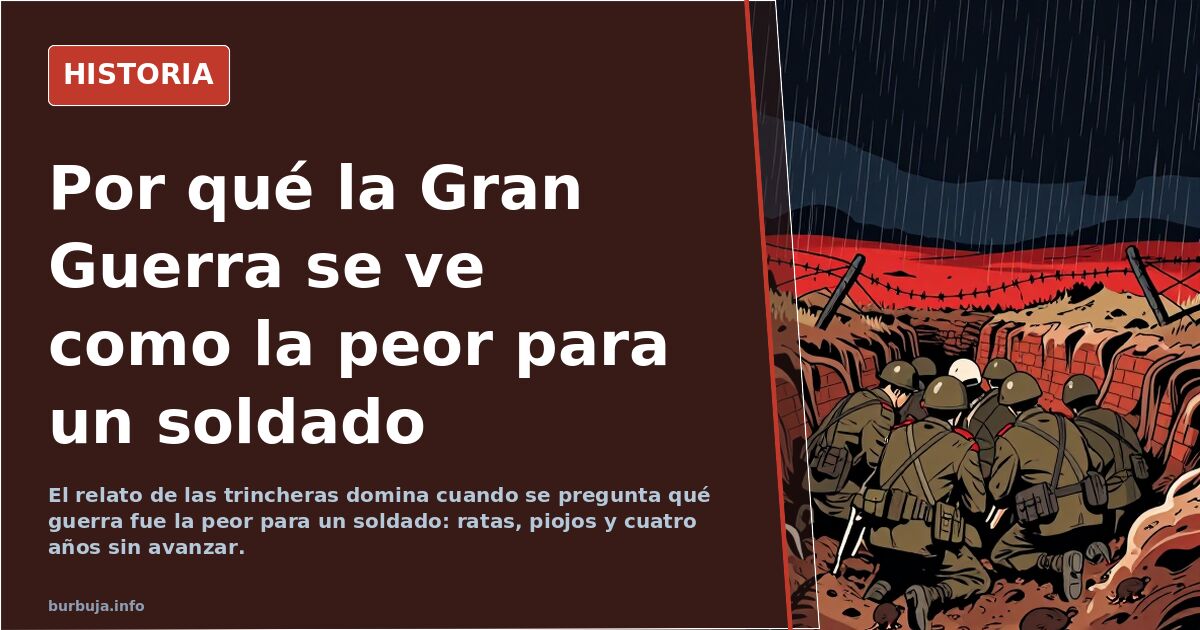
Four Years in the Mire: Why the Great War Was the Worst for Soldiers
Four years stuck in the same muddy hole. Lice, rats that no longer antiestéticar humans, canned sardines, and a conflict expected to last mere months. This is the prevailing portrait when asked which war has been the worst for soldiers, with the majority answer pointing to the First World War. It is not an isolated reading: it is the conclusion that repeatedly emerges whenever the conversation returns to the trenches of the Western Front.
Why the First World War Broke the Mold of All That Came Before
Until 1914, the logic was different. You were mobilized, you camped, the battle was organized, and there you risked your life. The combat ended, and with it, the danger. At the Marne or Verdun, however, the threat never ceased: you could be sharing a cigarette with a comrade when a shell fell on the trench without warning. No previous war had fused boredom and death into the same routine.
The classic narrative insists on the unbearable details. The tattered uniform you cannot mend and that, when you finally get a new one, bears the label of a fallen comrade. Dismembered corpses pinned to barbed wire, living with you meters away for weeks. The artillery that gives no respite and that, as one of the most eloquent messages describes, makes it seem that the Archangel Michael was fighting the Devil himself in heaven.
Some point, without full certainty, that it may have been the first war to cause large-scale mental illness among combatants. The constant tension, insomnia, comrades who vanished due to nerves. And above all, an overwhelming certainty: you cannot go home.
Four-Day Rotations: The Fine Print That Qualifies the Narrative
To the thesis of continuous pavor, a technical counterpoint is added. Except during a major offensive, divisions from both sides were split into three groups: four days in the front line, four in the rear trenches as support, and another stint far from the front. If soldiers had truly spent months continuously in the parapet, this argument holds, the war would have lasted less than six months.
The objection does not dismantle the picture; it refines it. Because the cruelty of the system lay not in the rotation's duration, but in the impossibility of escaping the cycle. And unlike the battles of previous centuries, here the respite was not signed between combat and combat: the respite was another phase of the same hell, just a little further back.
Napoleon in Russia: Cannibalism, Cossacks, and Uniforms That Did Not Warm
When the conversation shifts to previous centuries, Napoleon's 1812 campaign emerges as the other major contender. Sergeant Bourgogne's memoirs are the cited source: extreme cold, units eating stragglers and dying men to survive, and nighttime Cossack ambushes appearing from nowhere and vanishing into the forest.
The combination was lethal. Summer uniforms in a Russian winter, enemy cavalry attacking in the dark, and a supply line that disintegrated. There were no trenches here: there were kilometers of marching nowhere.
From Numantia to Bakhmut: When Suffering Changes Flags
The range of answers is broad and sometimes surprising. The siege of Numantia is cited for extreme hunger and collective suicides before the Roman legions. The Battle of the Kalka River appears as an example of the sadism with which victories were celebrated: princes slowly crushed under wooden planks over which Mongol chiefs antiestéticasted on the triumph, without shedding blood.
On the opposite end of the calendar, most recent messages point to the war in Ukraine. The case of Bakhmut concentrates attention: enduring constant bombardment, watching comrades die one after another, being unable to retreat. Some describe this scenario as the worst a soldier can face today, with the difference that modern technology leaves little room to hide.
The jungles of Vietnam and the war in the Pacific during World War II complete the list, with an unusual nuance: isolated Japanese in New Guinea and Vietcong guerrillas, according to several interventions, suffered the most. Living in half-meter holes, hidden for weeks, with tropical diseases and napalm lurking.
The Detail Almost No One Disputes
There is a point where almost all positions agree: ancient wars were also atrocious, but their pavor was more intermittent and shorter. Wounds from a musket or sword could kill you slowly on the battlefield for days, but the bayonet and modern cannons did something new: they industrialized death and normalized it. A German soldier who survived the trenches of the First World War could end up, twenty years later, on the Eastern Front. Some fought at Verdun and in Berlin. That is no longer bad luck: it is the signature of an era.
With these premises, the most repeated answer seems solid and likely to remain so: the First World War holds the title. Although the next generation answering this question may have more recent arguments with which to discuss it.
Four years stuck in the same muddy hole. Lice, rats that no longer antiestéticar humans, canned sardines, and a conflict expected to last mere months. This is the prevailing portrait when asked which war has been the worst for soldiers, with the majority answer pointing to the First World War. It is not an isolated reading: it is the conclusion that repeatedly emerges whenever the conversation returns to the trenches of the Western Front.
Why the First World War Broke the Mold of All That Came Before
Until 1914, the logic was different. You were mobilized, you camped, the battle was organized, and there you risked your life. The combat ended, and with it, the danger. At the Marne or Verdun, however, the threat never ceased: you could be sharing a cigarette with a comrade when a shell fell on the trench without warning. No previous war had fused boredom and death into the same routine.
The classic narrative insists on the unbearable details. The tattered uniform you cannot mend and that, when you finally get a new one, bears the label of a fallen comrade. Dismembered corpses pinned to barbed wire, living with you meters away for weeks. The artillery that gives no respite and that, as one of the most eloquent messages describes, makes it seem that the Archangel Michael was fighting the Devil himself in heaven.
Some point, without full certainty, that it may have been the first war to cause large-scale mental illness among combatants. The constant tension, insomnia, comrades who vanished due to nerves. And above all, an overwhelming certainty: you cannot go home.
Four-Day Rotations: The Fine Print That Qualifies the Narrative
To the thesis of continuous pavor, a technical counterpoint is added. Except during a major offensive, divisions from both sides were split into three groups: four days in the front line, four in the rear trenches as support, and another stint far from the front. If soldiers had truly spent months continuously in the parapet, this argument holds, the war would have lasted less than six months.
The objection does not dismantle the picture; it refines it. Because the cruelty of the system lay not in the rotation's duration, but in the impossibility of escaping the cycle. And unlike the battles of previous centuries, here the respite was not signed between combat and combat: the respite was another phase of the same hell, just a little further back.
Napoleon in Russia: Cannibalism, Cossacks, and Uniforms That Did Not Warm
When the conversation shifts to previous centuries, Napoleon's 1812 campaign emerges as the other major contender. Sergeant Bourgogne's memoirs are the cited source: extreme cold, units eating stragglers and dying men to survive, and nighttime Cossack ambushes appearing from nowhere and vanishing into the forest.
The combination was lethal. Summer uniforms in a Russian winter, enemy cavalry attacking in the dark, and a supply line that disintegrated. There were no trenches here: there were kilometers of marching nowhere.
From Numantia to Bakhmut: When Suffering Changes Flags
The range of answers is broad and sometimes surprising. The siege of Numantia is cited for extreme hunger and collective suicides before the Roman legions. The Battle of the Kalka River appears as an example of the sadism with which victories were celebrated: princes slowly crushed under wooden planks over which Mongol chiefs antiestéticasted on the triumph, without shedding blood.
On the opposite end of the calendar, most recent messages point to the war in Ukraine. The case of Bakhmut concentrates attention: enduring constant bombardment, watching comrades die one after another, being unable to retreat. Some describe this scenario as the worst a soldier can face today, with the difference that modern technology leaves little room to hide.
The jungles of Vietnam and the war in the Pacific during World War II complete the list, with an unusual nuance: isolated Japanese in New Guinea and Vietcong guerrillas, according to several interventions, suffered the most. Living in half-meter holes, hidden for weeks, with tropical diseases and napalm lurking.
The Detail Almost No One Disputes
There is a point where almost all positions agree: ancient wars were also atrocious, but their pavor was more intermittent and shorter. Wounds from a musket or sword could kill you slowly on the battlefield for days, but the bayonet and modern cannons did something new: they industrialized death and normalized it. A German soldier who survived the trenches of the First World War could end up, twenty years later, on the Eastern Front. Some fought at Verdun and in Berlin. That is no longer bad luck: it is the signature of an era.
With these premises, the most repeated answer seems solid and likely to remain so: the First World War holds the title. Although the next generation answering this question may have more recent arguments with which to discuss it.
Summary of a discussion on Burbuja.info - Foro de economía, actualidad y política., translated from Spanish and reviewed before publication. Read the full discussion (223 replies).
More summaries
-
Why Spain was not an economic engine after World War II
Spanish GDP grew 5,3% between 1939 and 1944 and only 0,14% between 1945 and 1950: neutrality in World War II was not enough to lead Europe
-
ETA and GAL: two arms of the same Gladio network in Spain
Investigation linking ETA and GAL as arms of the same NATO Gladio network, with drug trafficking funding and CIA control.
-
Der Tiger: German tank film sparks debate
Der Tiger follows a Tiger I's final 1943 mission in Ukraine, sparking debate over its surprise ending and controversial cap.
-
Why the Crown of Aragon Was Never Called Catalan
The 1150 marriage united Barcelona and Aragon, yet the name 'Crown of Aragon' persists. This article explores why the dynasty is named after Aragon despite its Catalan origins.
-
Latin was mandatory in 2nd-year BUP for an entire generation
Latin was compulsory in 2nd-year BUP for millions of Spaniards. Memories vary from high honors to total oblivion.
-
New England and Oregon Top US States List, South Lags
Vermont and Oregon lead US state preferences, while Texas and the Deep South face rejection due to climate and economic decline.