
Why the Crown of Aragon Was Never Called Catalan
The 1150 marriage united Barcelona and Aragon, yet the name 'Crown of Aragon' persists. This article explores why the dynasty is named after Aragon despite its Catalan origins.
English · Original discussion in Spanish · Published
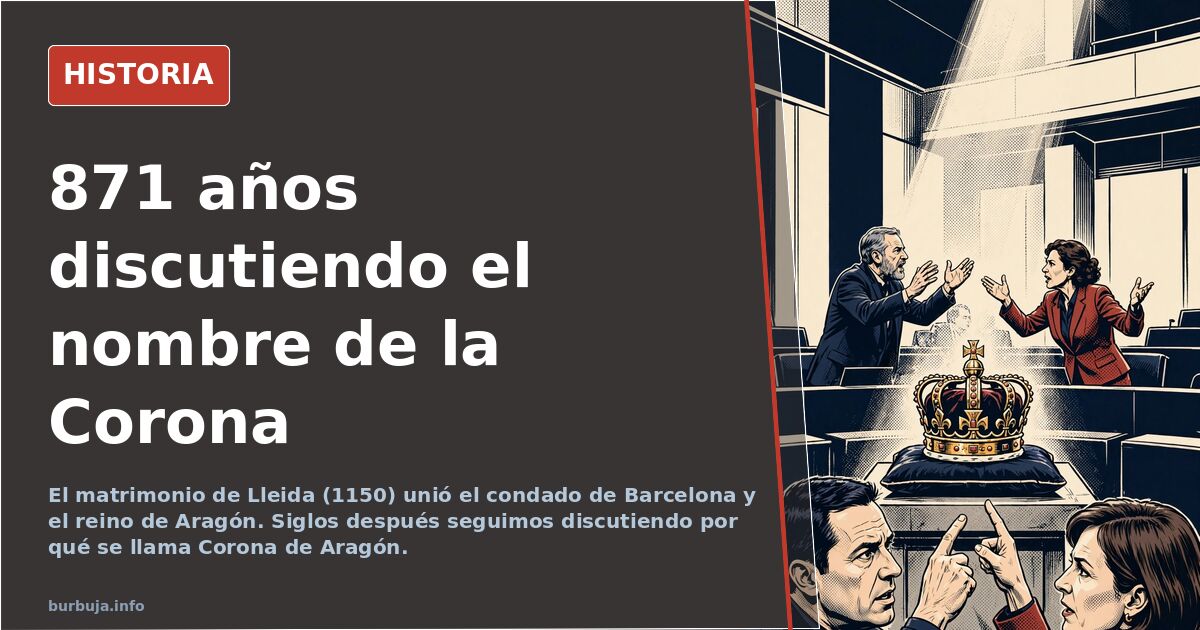
Why the Crown of Aragon Never Carried the Catalan Surname
Why do we call it the Crown of Aragon when this entity was born in Lleida in August 1150, through the marriage of a Count of Barcelona and the heir to the Aragonese throne? Formulated 871 years after that union, the question continues to split the peninsular genealogical tree. The dynastic union lasted more than five centuries—until 1714—and eventually incorporated six territorial entities: Majorca, Valencia, Sicily, Sardinia, Corsica, and Naples. For centuries, this entire framework was called simply the "Crown." It was Ferdinand the Catholic who, at the end of the 15th century, added the surname Aragon.
Who Really Ruled in 1150: The Count or the King?
When negotiations began in 1137, the Kingdom of Aragon was experiencing the deepest crisis of its short existence. There was civil war between supporters and detractors of Alfonso I's will, which bequeathed the kingdom to military orders. The Castilians had already entered Zaragoza, and the Navarrese were at the gates of Jaca. In this context, the marriage was the lifeline for Ramiro's oligarchic faction.
The most uncomfortable detail is another. Ramiro handed over the potestas—effective power—to his son-in-law Ramon Berenguer even before the wedding. With the marriage, the House of Barcelona, the Catalan lineage founded by Wilfred the Hairy in the late 9th century, came to dominate the whole. The thesis supporting this reading is that, in an era without modern states, dominion was understood as patrimonial property: Aragon became a possession of the Catalan house, not the other way around.
The Late Name: 'Crown' for Centuries, 'of Aragon' from 1400
No one called it the "Crown of Aragon" for the first three hundred years. Documents referred to the Crown simply. The suffix came late, and here lies the crux of the dispute: if the name was coined when the demographic and economic weight was no longer where the dynasty had been born, does it describe or obscure? Those defending the Aragonese surname argue that the royal title came from Aragon, and that a king is a king. Those who dispute it reply that the name never reflected the actual balance of power.
The Four-Bar Flag: Ermesinda of Carcassona, 1058
Classical historiography placed the origin of the "bars of blood" in Aragon, with Peter of Aragon (1094-1104) as the pioneer. Archaeology says otherwise. The tomb of Ermesinda of Carcassona, independent Countess of Barcelona who died in 1058, was polychromed with the bars: half a century earlier. Probably, when the weddings of Lleida were celebrated, the banner was already flying in both houses. Its universalization across the entire territory, however, did not come with that marriage, but almost a century later, during the time of James I, the fifteenth House of Barcelona (1213-1276).
In What Universe is a Count Worth Less Than a King?
The most repeated objection from the other side is textbook: a count is below a king, end of story. The answer is that nominal hierarchy is one thing, and military and economic capacity is another. The example of the historical rivalry between Burgundy and France is invoked: the title does not always order power. Nevertheless, the argument has an obvious limit that should not be swept aside: the County of Barcelona remained a county, and the crown, nominally, was Aragonese.
Valencia, Naples, and the Disputed Golden Age
Here the debate gets tangled with figures. It is argued that the territory with the most economic and demographic power in the conglomerate was Valencia and, after that, Naples, and that neither identified with the Catalan. Valencia was an autonomous kingdom within the Crown, not an extension of the Principality. Parallel to this, the Golden Age of Valencian letters is claimed, which occurred in Valencia and not in Barcelona. The counterargument does not deny the data, but the conclusion: that Golden Age was written in the same language that was later called Catalan, at a time when neither Spain nor the Valencian Community existed as a political entity.
Why Were Chronicles Written in Catalan?
Bernat Desclot's Chronicle (1288) records the proclamation of Admiral Roger de Llúria after the Sicilian campaign: that no fish would dare rise above the sea if it did not bear the king of Aragon's shield on its tail. The quote, in Catalan. Ramon Muntaner, captain and chronicler, writes in 1325 that Murcia, Orihuela, Elche, Alicante, Guardamar, and Cartagena were populated by Catalans speaking "the most beautiful Catalan in the world." For some, this proves that the administrative and linguistic apparatus was Catalan. For others, it only proves that Catalan was just another language of the Crown, with no political consequence.
Spain in 1640 and the Cross-Accusation of Presentism
The exchange heats up when someone asks if Catalonia existed then. The answer offered is that in 1640, Catalonia declares itself an independent republic and places itself at the service of France. The counter-reply distinguishes between geographic concept and political entity: Catalonia, it is said, emerges as a political subject much later. And it hovers over the cross-accusation of reading the Middle Ages with modern eyes. One side reproaches the other for turning mercenaries into foundational heroes of a commercial empire; the other returns the reproach by pointing out that denying the existence of Spain before 1492 is equally presentist.
In the end, each side is right about something and wrong about everything else: the name was given by whoever held the title, and the muscle was provided by whoever had the ships and the merchants. Eight centuries later, we are still debating a surname. Any day someone might ask to change it in the archive.
Why do we call it the Crown of Aragon when this entity was born in Lleida in August 1150, through the marriage of a Count of Barcelona and the heir to the Aragonese throne? Formulated 871 years after that union, the question continues to split the peninsular genealogical tree. The dynastic union lasted more than five centuries—until 1714—and eventually incorporated six territorial entities: Majorca, Valencia, Sicily, Sardinia, Corsica, and Naples. For centuries, this entire framework was called simply the "Crown." It was Ferdinand the Catholic who, at the end of the 15th century, added the surname Aragon.
Who Really Ruled in 1150: The Count or the King?
When negotiations began in 1137, the Kingdom of Aragon was experiencing the deepest crisis of its short existence. There was civil war between supporters and detractors of Alfonso I's will, which bequeathed the kingdom to military orders. The Castilians had already entered Zaragoza, and the Navarrese were at the gates of Jaca. In this context, the marriage was the lifeline for Ramiro's oligarchic faction.
The most uncomfortable detail is another. Ramiro handed over the potestas—effective power—to his son-in-law Ramon Berenguer even before the wedding. With the marriage, the House of Barcelona, the Catalan lineage founded by Wilfred the Hairy in the late 9th century, came to dominate the whole. The thesis supporting this reading is that, in an era without modern states, dominion was understood as patrimonial property: Aragon became a possession of the Catalan house, not the other way around.
The Late Name: 'Crown' for Centuries, 'of Aragon' from 1400
No one called it the "Crown of Aragon" for the first three hundred years. Documents referred to the Crown simply. The suffix came late, and here lies the crux of the dispute: if the name was coined when the demographic and economic weight was no longer where the dynasty had been born, does it describe or obscure? Those defending the Aragonese surname argue that the royal title came from Aragon, and that a king is a king. Those who dispute it reply that the name never reflected the actual balance of power.
The Four-Bar Flag: Ermesinda of Carcassona, 1058
Classical historiography placed the origin of the "bars of blood" in Aragon, with Peter of Aragon (1094-1104) as the pioneer. Archaeology says otherwise. The tomb of Ermesinda of Carcassona, independent Countess of Barcelona who died in 1058, was polychromed with the bars: half a century earlier. Probably, when the weddings of Lleida were celebrated, the banner was already flying in both houses. Its universalization across the entire territory, however, did not come with that marriage, but almost a century later, during the time of James I, the fifteenth House of Barcelona (1213-1276).
In What Universe is a Count Worth Less Than a King?
The most repeated objection from the other side is textbook: a count is below a king, end of story. The answer is that nominal hierarchy is one thing, and military and economic capacity is another. The example of the historical rivalry between Burgundy and France is invoked: the title does not always order power. Nevertheless, the argument has an obvious limit that should not be swept aside: the County of Barcelona remained a county, and the crown, nominally, was Aragonese.
Valencia, Naples, and the Disputed Golden Age
Here the debate gets tangled with figures. It is argued that the territory with the most economic and demographic power in the conglomerate was Valencia and, after that, Naples, and that neither identified with the Catalan. Valencia was an autonomous kingdom within the Crown, not an extension of the Principality. Parallel to this, the Golden Age of Valencian letters is claimed, which occurred in Valencia and not in Barcelona. The counterargument does not deny the data, but the conclusion: that Golden Age was written in the same language that was later called Catalan, at a time when neither Spain nor the Valencian Community existed as a political entity.
Why Were Chronicles Written in Catalan?
Bernat Desclot's Chronicle (1288) records the proclamation of Admiral Roger de Llúria after the Sicilian campaign: that no fish would dare rise above the sea if it did not bear the king of Aragon's shield on its tail. The quote, in Catalan. Ramon Muntaner, captain and chronicler, writes in 1325 that Murcia, Orihuela, Elche, Alicante, Guardamar, and Cartagena were populated by Catalans speaking "the most beautiful Catalan in the world." For some, this proves that the administrative and linguistic apparatus was Catalan. For others, it only proves that Catalan was just another language of the Crown, with no political consequence.
Spain in 1640 and the Cross-Accusation of Presentism
The exchange heats up when someone asks if Catalonia existed then. The answer offered is that in 1640, Catalonia declares itself an independent republic and places itself at the service of France. The counter-reply distinguishes between geographic concept and political entity: Catalonia, it is said, emerges as a political subject much later. And it hovers over the cross-accusation of reading the Middle Ages with modern eyes. One side reproaches the other for turning mercenaries into foundational heroes of a commercial empire; the other returns the reproach by pointing out that denying the existence of Spain before 1492 is equally presentist.
In the end, each side is right about something and wrong about everything else: the name was given by whoever held the title, and the muscle was provided by whoever had the ships and the merchants. Eight centuries later, we are still debating a surname. Any day someone might ask to change it in the archive.
Summary of a discussion on Burbuja.info - Foro de economía, actualidad y política., translated from Spanish and reviewed before publication. Read the full discussion (225 replies).
More summaries
-
Columbus Didn't Write in Italian, and His Origins Remain Unresolved
According to the Galician thesis, Columbus left no writings in Italian, and a genetic map points to the Crown of Aragon. His origins remain unresolved.
-
ETA and GAL: two arms of the same Gladio network in Spain
Investigation linking ETA and GAL as arms of the same NATO Gladio network, with drug trafficking funding and CIA control.
-
Four Years in the Mire: Why the Great War Was the Worst for Soldiers
Trench life dominates when asking which war was worst for soldiers: rats, lice, and four years of stalemate defined the Great War.
-
Der Tiger: German tank film sparks debate
Der Tiger follows a Tiger I's final 1943 mission in Ukraine, sparking debate over its surprise ending and controversial cap.
-
Latin was mandatory in 2nd-year BUP for an entire generation
Latin was compulsory in 2nd-year BUP for millions of Spaniards. Memories vary from high honors to total oblivion.
-
New England and Oregon Top US States List, South Lags
Vermont and Oregon lead US state preferences, while Texas and the Deep South face rejection due to climate and economic decline.