
Latin was mandatory in 2nd-year BUP for an entire generation
Latin was compulsory in 2nd-year BUP for millions of Spaniards. Memories vary from high honors to total oblivion.
English · Original discussion in Spanish · Published
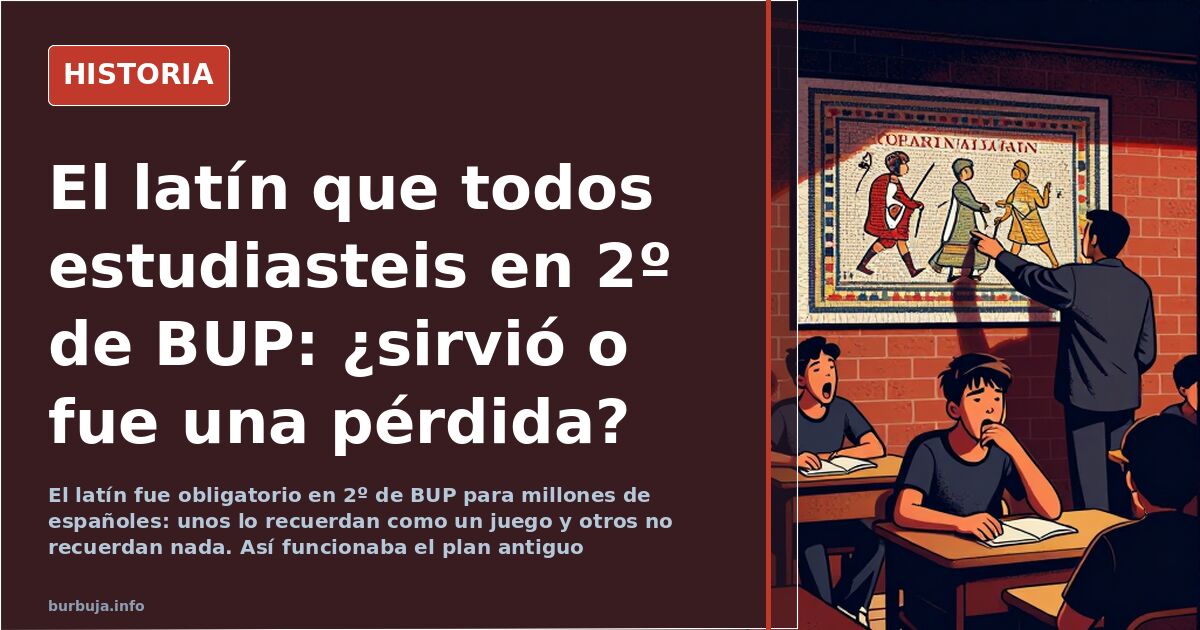
Latin was mandatory in 2nd-year BUP for an entire generation
One student treated Latin as a year-long pastime—a deciphering game—and graduated with top honors. Another remembers nothing: "It was a mess," he says. Both discuss the same subject, mandatory in 2nd-year BUP, the course equivalent to 4th-year ESO today. For at least one generation, everyone took it: science and arts students, in religious schools and public institutes. Today, no one agrees on whether it was useful.
2nd-year BUP: the last common subject before choosing a path
The key lies in the old system's structure. In 2nd-year BUP, students were not yet separated into science and arts tracks, so Latin fell on everyone. From 3rd-year and COU, only arts tracks—pure or mixed—kept it, while science tracks covered the gap with subjects like Art History. The EGB+BUP system ran from 1970 to the early 2000s, when it was replaced by the LOGSE. This means millions of Spaniards over 43 years old took Latin without choosing it. One participant studied it in a public center between 1982 and 1985, confirming it was also offered in 3rd-year and COU.
Some nuance the story. Those who studied bachillerato in French never took the subject. Some centers offered Greek as an elective instead of other subjects. The map was not identical across Spain, though the mandatory core of 2nd-year was.
What is Latin for? The argument of declensions
The most repeated use has nothing to do with Rome. Defenders argue it helped understand the declensions of living languages like Russian, facilitating Italian, Portuguese, or Catalan. Others recall it as a tool to decipher Gaudeamus igitur at university, for Law, or to read inscriptions across Europe. Some took three years of Latin, translating the Aeneid, and scored a 9 in university entrance exams.
Against this is a simple argument: if the goal was learning a language with declensions, studying that language directly might have been better. The most skeptical point out that basic notions, taught superficially in one year, do not justify the time invested. Twelve years of schooling can be inefficient if every subject stays superficial.
The curriculum and the underlying suspicion
Here, the issue becomes political. Some argue removing Latin was essential to disconnect Spaniards from their past; others reply that curriculum changes are a symptom, not the disease. The same suspicion applies to economics: if not taught, voters keep voting the same. These are hard-to-prove, easy-to-repeat readings.
Harder to refute is what happens at university. In History, Latin stopped being mandatory in the early transition, after student protests, becoming an elective. The result, some say, is arriving at faculty without the foundation previously brought from bachillerato.
The human factor: the teacher weighs more than the program
Many memories are not about the subject, but the teacher. One was boring; another, unpleasant; another, memorable. The uncomfortable conclusion: the teacher conditions what you end up hating or loving for decades, driven by accidental variables unrelated to your ability.
Others reclaim the obvious: secondary education then exercised the brain at a key stage, not just storing content later forgotten. From that subject remain the pirate Latin jokes from Astérix, the Life of Brian jokes, and little else.
Final curiosity, found in family papers from the 1920s: primary schools then taught sewing, cooking, and agriculture. Basic and necessary subjects, according to those who discovered them. Latin, meanwhile, remains in the limbo of what no one knows if it was useful.
One student treated Latin as a year-long pastime—a deciphering game—and graduated with top honors. Another remembers nothing: "It was a mess," he says. Both discuss the same subject, mandatory in 2nd-year BUP, the course equivalent to 4th-year ESO today. For at least one generation, everyone took it: science and arts students, in religious schools and public institutes. Today, no one agrees on whether it was useful.
2nd-year BUP: the last common subject before choosing a path
The key lies in the old system's structure. In 2nd-year BUP, students were not yet separated into science and arts tracks, so Latin fell on everyone. From 3rd-year and COU, only arts tracks—pure or mixed—kept it, while science tracks covered the gap with subjects like Art History. The EGB+BUP system ran from 1970 to the early 2000s, when it was replaced by the LOGSE. This means millions of Spaniards over 43 years old took Latin without choosing it. One participant studied it in a public center between 1982 and 1985, confirming it was also offered in 3rd-year and COU.
Some nuance the story. Those who studied bachillerato in French never took the subject. Some centers offered Greek as an elective instead of other subjects. The map was not identical across Spain, though the mandatory core of 2nd-year was.
What is Latin for? The argument of declensions
The most repeated use has nothing to do with Rome. Defenders argue it helped understand the declensions of living languages like Russian, facilitating Italian, Portuguese, or Catalan. Others recall it as a tool to decipher Gaudeamus igitur at university, for Law, or to read inscriptions across Europe. Some took three years of Latin, translating the Aeneid, and scored a 9 in university entrance exams.
Against this is a simple argument: if the goal was learning a language with declensions, studying that language directly might have been better. The most skeptical point out that basic notions, taught superficially in one year, do not justify the time invested. Twelve years of schooling can be inefficient if every subject stays superficial.
The curriculum and the underlying suspicion
Here, the issue becomes political. Some argue removing Latin was essential to disconnect Spaniards from their past; others reply that curriculum changes are a symptom, not the disease. The same suspicion applies to economics: if not taught, voters keep voting the same. These are hard-to-prove, easy-to-repeat readings.
Harder to refute is what happens at university. In History, Latin stopped being mandatory in the early transition, after student protests, becoming an elective. The result, some say, is arriving at faculty without the foundation previously brought from bachillerato.
The human factor: the teacher weighs more than the program
Many memories are not about the subject, but the teacher. One was boring; another, unpleasant; another, memorable. The uncomfortable conclusion: the teacher conditions what you end up hating or loving for decades, driven by accidental variables unrelated to your ability.
Others reclaim the obvious: secondary education then exercised the brain at a key stage, not just storing content later forgotten. From that subject remain the pirate Latin jokes from Astérix, the Life of Brian jokes, and little else.
Final curiosity, found in family papers from the 1920s: primary schools then taught sewing, cooking, and agriculture. Basic and necessary subjects, according to those who discovered them. Latin, meanwhile, remains in the limbo of what no one knows if it was useful.
Summary of a discussion on Burbuja.info - Foro de economía, actualidad y política., translated from Spanish and reviewed before publication. Read the full discussion (230 replies).
More summaries
-
Hautefaye 1870: Mass Lynching at Village Festival
In 1870, a village in Dordogne lynched its benefactor Alain de Monéys, three weeks after the end of the Franco-Prussian War. The Hautefaye case.
-
Nazi crematoria: flawed calculation misrepresents Holocaust technology
Comparing Spain's 520 modern crematoria with Auschwitz's 40 to claim superior Nazi tech fails due to incompatible operational contexts.
-
Mediterranean Forests: Pines, Oaks, and Beeches Define Spain
Conifers and aromatic shrubs versus oaks and cork trees: Europe's southernmost beech forest is on the Meseta, while Aleppo pine is often planted.
-
Berber Origin Theory for Basques: Forum User Claims Zero Genetic Match
The Berber hypothesis regarding Basque origins clashes with genetic data and weak linguistic arguments.
-
Why the Spanish Empire Collapsed: Neither Traition nor Freemasonry
18 million in the Indies vs 11 million in Spain, compared to 29 million in Japan, reveal why the Spanish Empire could not sustain itself.
-
Andalusian Genetics: Why Phenotype Defies Stereotypes
A forum thread explores Andalusian genetics, historical repopulation, and stereotypes regarding blondes and North African ancestry.