
Forum user: Musk's popcorn robot costs 'tens of thousands'
The popcorn robot video shared by Musk: back in the 80s, a five-peseta machine already served popcorn with no vendor and no robot
English · Original discussion in Spanish · Published
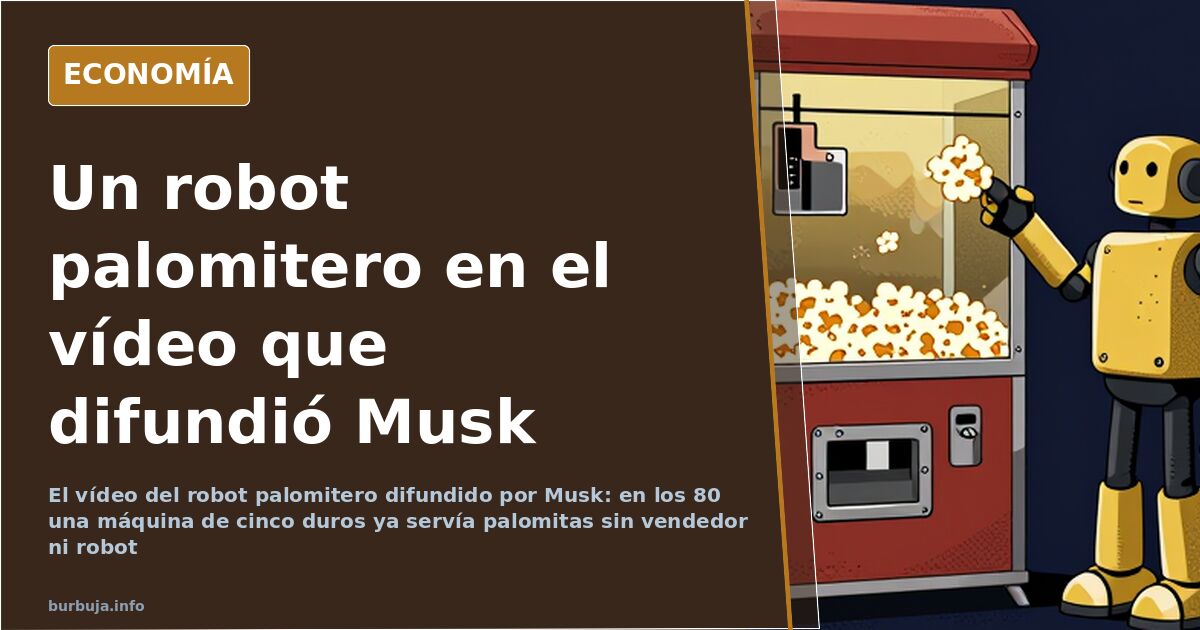
From five pesetas to a robot costing tens of thousands of euros
Do you need a popcorn robot costing tens of thousands of euros to fill a paper cone? That is the calculation that opens the debate: Elon Musk insists that seeing one will be normal within a few years, and the video he has shared shows a machine dispensing popcorn. The most uncomfortable response does not question the technical antiestéticat. It questions the business. Because that, with coins, was already being done four decades ago.
The five-peseta machine that already served popcorn
In the 1980s you needed neither a vendor nor a robot. You dropped five pesetas into a machine, its jingle played, a dispenser filled the cone, and the customer walked off with their popcorn. Pure automation, no humanoid shape. That is where the most compelling argument comes from: the function was already solved forty years ago; what is new is the packaging and the cost. A device costing tens of thousands of euros per unit, according to the calculation that opens the discussion, does not improve the product, it only changes who serves it. And not even that, because, according to several comments in the thread, in the footage the machine spills much of the corn that should end up in the bag.
Nobody is shocked by a vending machine anymore. What is shocking is the price of doing the same thing on legs.
Why do people argue that armed robots will arrive before waiters?
Because there the substitution sells itself. The reasoning going around is that no institution questions whether a machine, rather than an officer, puts its integrity on the line, and under that umbrella —"avoiding unnecessary deaths"— almost any deployment can be justified: first the security forces, then everything else. The step many point to as dangerous is the next one: a central AI commanding armed units under the argument of a "superior ethics". You do not need to be a science fiction screenwriter to see the problem. It is enough to ask who defines that superior ethics and who answers when it fails.
It is worth remembering that most of these machines are still clumsy at serving popcorn.
Robots run out when washing machines run out
Against the panic, a materialist counterweight: one participant points out that any country in the world has the raw materials and assembly plants needed to produce humans, and that robots "run out when washing machines run out". An army of machines depends on chips, motors, batteries and supply chains that break the moment a single part goes missing. Scale and logistics, not epic heroics. A human reproduces by itself; an android needs a factory, a workshop and spare parts.
That detail —that a robot is an industrial product and not a species— is what separates science fiction from the bottom line.
A technical anecdote to close the circle: in everyday language, a robot with a human shape is called an android, while droid is the term popularized by Star Wars for machines capable of imitating human tasks without needing to look like people. The vending machine of the 80s was, at heart, a machine with no humanoid shape.
No machine has come to kill us yet. The one in front of us, according to the comments in the thread, drops more popcorn on the floor than into the bag. Checkmate, yes, but the popcorn vendor was not taken down by a robot: a coin took them down forty years ago.
Also available in: Deutsch
Summary of a discussion on Burbuja.info - Foro de economía, actualidad y política., translated from Spanish and reviewed before publication. Read the full discussion (15 replies).
More summaries
-
Humanoid robots at €20,000: China now controls 44% of the market
The domestic robot is already selling for €20,000 per unit, AgiBot holds 44% of the humanoid market, and China sets the pace for the entire industry.
-
Humanoid Robots: The Fear of the End of Human Labor
Google reportedly spends more on compute than people as humanoid robots reignite the debate on job displacement.
-
Amazon’s Humanoid Robots: The True Cost of Replacing Workers
Amazon tests bipedal humanoid robots that move boxes without rest: robot cost, amortization, and jobs replaced.
-
Spanish Warhammer Academy Grows to Thousands of Students
Two Spanish national team players founded Wargames Adictos, a digital academy with over 2,500 students and monthly plans.
-
Viral post claims Lagarde will resign from the ECB in February 2027
A message on X attributes to Christine Lagarde the announcement of her departure from the ECB in February 2027 and reads it as a sign of crisis. The ECB has not confirmed it.
-
Claims that Israel was behind the Fukushima explosion lack any evidence
A viral post points to Israel as the author of the 2011 explosion at the Fukushima nuclear plant. There is no evidence whatsoever to support that accusation.