
Amazon’s Humanoid Robots: The True Cost of Replacing Workers
Amazon tests bipedal humanoid robots that move boxes without rest: robot cost, amortization, and jobs replaced.
English · Original discussion in Spanish · Published
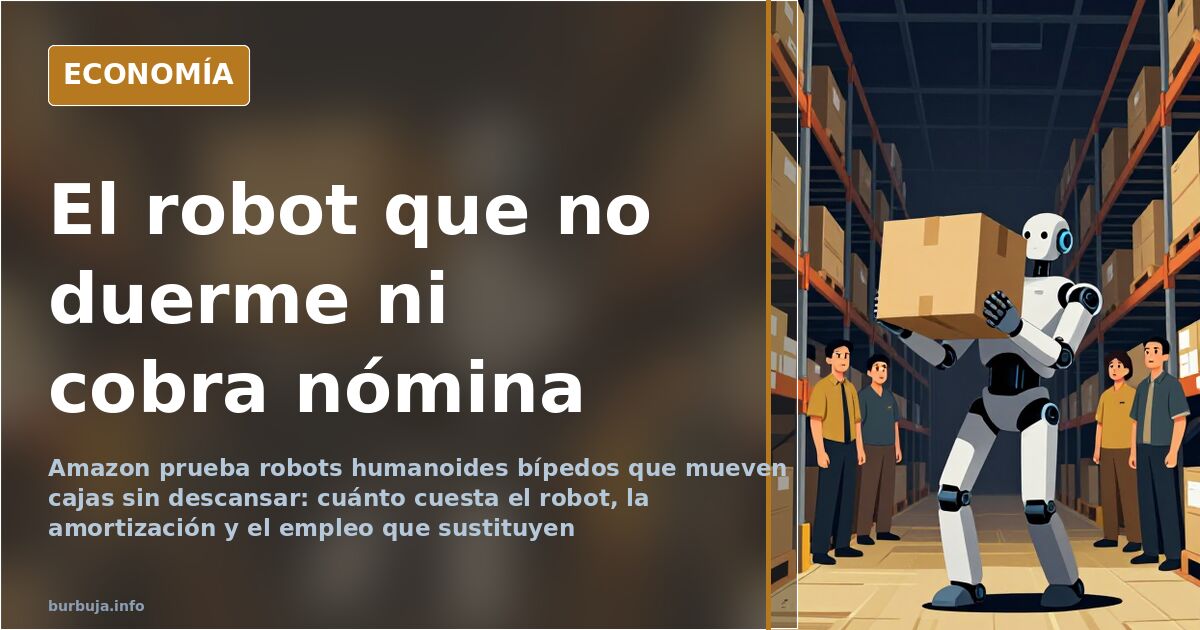
Amazon’s Humanoid Robots: Now Moving Boxes Without Rest
According to a calculation circulating online, while one Amazon robot placed a box, a worker would have placed four. It walks awkwardly, moves slowly, and looks — according to the joke — like a large body doing standing footwork in a pedestrian crossing. Yet the device never tires, never complains about its back, never clocks out, never unions, and never calls in when the kid is sick. That is the entire business case.
The company has begun testing a bipedal humanoid robot in its warehouses, standing about six feet tall, capable of walking and lifting objects. It is half-jokingly described as satyroid. In the version being tested, it helps workers recycle containers. The video of the device traversing the warehouse has lit the fuse, and the looming question is not technical but economic: how long it takes for that machine to become cheaper than the person it replaces.
How Much Does a Robot Cost and When Does It Pay Off?
The circulating figures are disparate and mostly hearsay. A service robot used to cost about 15,000 euros a year and a half ago; now talk is of 10,000, and speculation suggests Asian manufacturers could drop prices to 1,500 soon. Kitchen robots, another segment, range between 100,000 and 300,000 euros and are designed to serve up to 5,000 daily meals in hospitals and schools.
The dominant argument is simple: the robot works 24 hours a day, 365 days a year, and only needs a plug. Hence, many assume cost is no barrier — “if it were more expensive, they wouldn’t be developing it” — and that amortization will arrive sooner than expected. Evidence includes a security company’s robot dog, manufactured a year and a half ago by a workshop in Elche, which, with major players now in the business, is produced for pennies. Note that prices often mix distinct models: a fairground figure is not a total cost of operation, including maintenance, parts, software, and errors requiring human correction.
The Antiestéticar Is Not of the Machine, But of Who Gets Paid
Not everyone viewing this with suspicion mourns the robot. Many argue that the tasks it performs are the worst — stressful, routine, mechanical — and that it is a blessing for a machine to take them over. The objection comes from another angle: until now, technology eliminated tasks; what is coming, it is argued, does not free the worker but replaces them. There is a long way from freeing to replacing.
And there is a detail almost no one disputes: those deploying robots do not do so to free you, but to profit more. The productivity gained does not magically appear in someone else’s paycheck. That is the crux: not whether the robot is good or bad, but who keeps the surplus and who pays the bill for those left over. Anyone recalling that the first documented profession in history was prostitution will draw their own conclusions about which robot will truly replace someone first.
The Agricultural Precedent and the Ghost of Luddism
The most repeated parallel is agricultural machinery. It eliminated millions of jobs, wiped out a millennia-old way of life, and eventually improved quality of life immensely. With that precedent in mind, calling every advancement an apocalypse sounds catastrophist. Those arguing otherwise must explain why that job destruction was good and this one is not.
The attempted answer is that the scale of change is different: AI is not limited to physical labor but also targets office and administrative work. Qualified office work, in this reading, is much easier to replace than a manual trade. No one has fully refuted this thesis, nor has anyone proven it. Underlying this is the same old suspicion: it is not the advancement that scares, but its estimulante ilegal.
From Basic Income to Unsupportable Scenarios
When the machine does the work, the logical question is how the output is distributed. Here appears the recurring proposal: that robotizing companies pay enough taxes to fund a dignified income for those left out of the market. It sounds reasonable on paper, and no one has yet explained how it is calculated or who administers it.
At the opposite end of the conversation looms a much darker narrative: the idea that elites want a smaller population and that technological advancement serves to get rid of those who do not produce. Be clear: this is not a fact, it is an unproven suspicion. But it illustrates the climate with which each walking robot is received.
What Is Really Being Discussed
Beneath the jokes — the robot still slow, the one that makes mistakes and delays orders, the one that “needs improvement” — lies an unanswered question. The machine is today an expensive, clumsy novice. Tomorrow, if prices fall like mobile phones, the equation changes suddenly, and the conversation stops being a joke.
Reference is made to replacement movies, to the first generation that still cannot run, to the ten years remaining. No one knows if the future warehouse will have humans supervising or only humans outside. The only certainty is that today’s robot does not sleep, and the next version will be cheaper than this one.
Reference material: the video circulated about Amazon’s new bipedal robots and the chronicles describing their initial warehouse tests.
According to a calculation circulating online, while one Amazon robot placed a box, a worker would have placed four. It walks awkwardly, moves slowly, and looks — according to the joke — like a large body doing standing footwork in a pedestrian crossing. Yet the device never tires, never complains about its back, never clocks out, never unions, and never calls in when the kid is sick. That is the entire business case.
The company has begun testing a bipedal humanoid robot in its warehouses, standing about six feet tall, capable of walking and lifting objects. It is half-jokingly described as satyroid. In the version being tested, it helps workers recycle containers. The video of the device traversing the warehouse has lit the fuse, and the looming question is not technical but economic: how long it takes for that machine to become cheaper than the person it replaces.
How Much Does a Robot Cost and When Does It Pay Off?
The circulating figures are disparate and mostly hearsay. A service robot used to cost about 15,000 euros a year and a half ago; now talk is of 10,000, and speculation suggests Asian manufacturers could drop prices to 1,500 soon. Kitchen robots, another segment, range between 100,000 and 300,000 euros and are designed to serve up to 5,000 daily meals in hospitals and schools.
The dominant argument is simple: the robot works 24 hours a day, 365 days a year, and only needs a plug. Hence, many assume cost is no barrier — “if it were more expensive, they wouldn’t be developing it” — and that amortization will arrive sooner than expected. Evidence includes a security company’s robot dog, manufactured a year and a half ago by a workshop in Elche, which, with major players now in the business, is produced for pennies. Note that prices often mix distinct models: a fairground figure is not a total cost of operation, including maintenance, parts, software, and errors requiring human correction.
The Antiestéticar Is Not of the Machine, But of Who Gets Paid
Not everyone viewing this with suspicion mourns the robot. Many argue that the tasks it performs are the worst — stressful, routine, mechanical — and that it is a blessing for a machine to take them over. The objection comes from another angle: until now, technology eliminated tasks; what is coming, it is argued, does not free the worker but replaces them. There is a long way from freeing to replacing.
And there is a detail almost no one disputes: those deploying robots do not do so to free you, but to profit more. The productivity gained does not magically appear in someone else’s paycheck. That is the crux: not whether the robot is good or bad, but who keeps the surplus and who pays the bill for those left over. Anyone recalling that the first documented profession in history was prostitution will draw their own conclusions about which robot will truly replace someone first.
The Agricultural Precedent and the Ghost of Luddism
The most repeated parallel is agricultural machinery. It eliminated millions of jobs, wiped out a millennia-old way of life, and eventually improved quality of life immensely. With that precedent in mind, calling every advancement an apocalypse sounds catastrophist. Those arguing otherwise must explain why that job destruction was good and this one is not.
The attempted answer is that the scale of change is different: AI is not limited to physical labor but also targets office and administrative work. Qualified office work, in this reading, is much easier to replace than a manual trade. No one has fully refuted this thesis, nor has anyone proven it. Underlying this is the same old suspicion: it is not the advancement that scares, but its estimulante ilegal.
From Basic Income to Unsupportable Scenarios
When the machine does the work, the logical question is how the output is distributed. Here appears the recurring proposal: that robotizing companies pay enough taxes to fund a dignified income for those left out of the market. It sounds reasonable on paper, and no one has yet explained how it is calculated or who administers it.
At the opposite end of the conversation looms a much darker narrative: the idea that elites want a smaller population and that technological advancement serves to get rid of those who do not produce. Be clear: this is not a fact, it is an unproven suspicion. But it illustrates the climate with which each walking robot is received.
What Is Really Being Discussed
Beneath the jokes — the robot still slow, the one that makes mistakes and delays orders, the one that “needs improvement” — lies an unanswered question. The machine is today an expensive, clumsy novice. Tomorrow, if prices fall like mobile phones, the equation changes suddenly, and the conversation stops being a joke.
Reference is made to replacement movies, to the first generation that still cannot run, to the ten years remaining. No one knows if the future warehouse will have humans supervising or only humans outside. The only certainty is that today’s robot does not sleep, and the next version will be cheaper than this one.
Reference material: the video circulated about Amazon’s new bipedal robots and the chronicles describing their initial warehouse tests.
Also available in: Deutsch
Summary of a discussion on Burbuja.info - Foro de economía, actualidad y política., translated from Spanish and reviewed before publication. Read the full discussion (231 replies).
More summaries
-
AI as an economic engine: bubble or structural shift?
Economic analysis of AI: Is it the growth engine or a speculative bubble? Energy costs and business adoption are examined.
-
AI Satirizes the Housing Bubble and Imminent Crash
AI videos mocking the real estate bubble and imminent crash. Digital era technical satire.
-
Humanoid robots at €20,000: China now controls 44% of the market
The domestic robot is already selling for €20,000 per unit, AgiBot holds 44% of the humanoid market, and China sets the pace for the entire industry.
-
Dabiz Muñoz's €19 Sandwich: The Business of Gourmet Storytelling
A sandwich 'designed' by Dabiz Muñoz sells for €18.95 in Spanish airports. Forum calculations suggest a cost of just €1.50 per unit.
-
Unemployed for a year and a half in Spain — and not even looking for a job
An engineer under 30 admits he has been unemployed for a year and a half after saving 50,000 euros. Is this the end of the grind, or an existential crisis?
-
'You'll own nothing' is already here: 42-year-old forum user owns only a 2004 car
A 42-year-old forum user claims 'you'll own nothing' is already reality: he owns only a 2004 car and has €1 in the bank. The debate over whether having little is better than having a lot begins.