
Humanoid Robots: The Fear of the End of Human Labor
Google reportedly spends more on compute than people as humanoid robots reignite the debate on job displacement.
English · Original discussion in Spanish · Published
Humanoid Robots: Human Labor Loses Its Argument
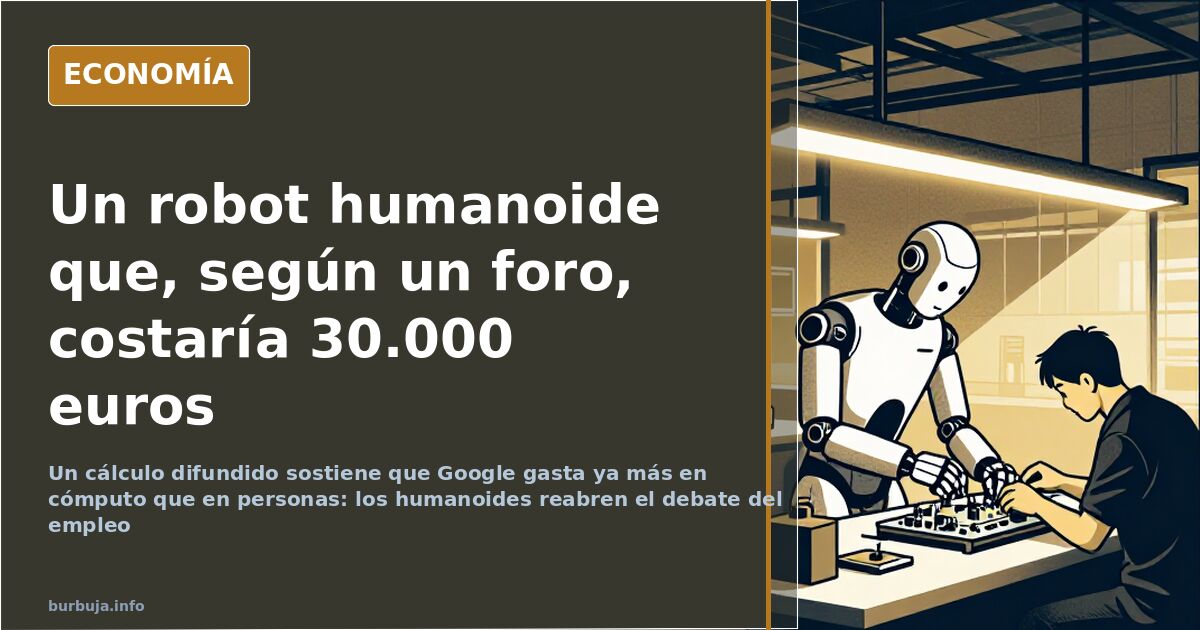
According to a message circulating in a forum, Google already spends more on computing power than on personnel. This phrase captures the shift in the automation economy better than any report: training artificial intelligence now costs more than the salaries of those developing it. Images of new androids with human proportions walking and performing tasks have given body to this trend, with one unit estimated at around €30,000. The uncomfortable question returns: how much human work has a replacement?
The starting point was almost a provocation: a machine that is cheaper than an employee and does the same thing. The joke holds up only because it no longer seems like one. Tesla released a video of its Optimus walking, and the conversation shifted from curiosity to amortization calculations in two afternoons.
How Much Money Is Already Moving in the Robot Race?
The numbers are in another league. Microsoft allegedly budgeted $50 billion for chips for the next fiscal year. Google would build 2 million TPU 5s, its proprietary AI circuits, at $12,500 per unit: about $25 billion which, combined with other data center spending, exceeds $30 billion. In parallel, Microsoft and OpenAI reportedly explored injecting $500 million into Figure AI, a company promising to deploy autonomous humanoid workers.
The reading is simple: capital no longer debates whether the robot arrives, but who pays the compute bill. Compute over people, summarized by its own protagonists.
Why Does the Humanoid Robot Imitate the Human Form?
This is the most repeated objection. Eight arms and four wheels would suffice. Some argue that the world is built for bodies like ours: stairs, doorknobs, narrow corridors. You adapt the machine to the human interface and then eliminate the interface. A less noble reason is also pointed out: a recognizable face and silhouette generate less rejection than a metallic platform with grippers.
It doesn't convince everyone. It is recalled that four decades ago, quadrupeds from a famous saga were already parading across a snowy plain without anyone questioning their design, and there is irony about the feigned friendliness of these contraptions.
How Far Off Is the Robot From Unloading Two Trucks in Front of the Boss?
Here enthusiasm cools down. The battery lasts minutes unless the android works plugged in. Fine motor skills are in diapers. And several videos of humanoid robots walking are recorded with a person behind, remote control in hand: zero autonomy. Some declare that current scrap metal cannot withstand a real workday or even two days with a warehouse supervisor breathing down its neck.
On the other side of the scale is the pace. Artificial intelligence has gone from toy to tool in very little time, and advances in movement and supervised learning pogre with each neural network iteration. The unknown is not if it will improve, but at what estimulante ilegal.
Who Will Own the Robots That Replace Workers?
The underlying debate is not technical, it is about ownership. Scenario one: private machines, sunk production costs, and concentrated rents. Scenario two: public robot parks, funded with common money, and distribution of what they produce. The example cited is Norway's sovereign wealth fund, which invests on behalf of society and returns the fruits.
Distrust is enormous. It is argued that public entities stop belonging to everyone as soon as the first manager with friends appears, using the old metaphor of the communal mill that ended up charging tolls for grinding grain. Added to this is the antiestéticar of a minimum income that replaces wages without restoring the autonomy of former rowers.
In 10 Years or 50? The Replacement Calendar
The ranges go from immediate to distant, and that is where the rift lies. One sector maintains that the technology is still in early stages, that industrializing millions of units is another matter, comparing it to the problems of manufacturing 100 million electric vehicles versus the 1,000 or 2,000 million robots needed to replace the workforce. The other camp gives ten years and warns that those who don't get an implant will compete at a disadvantage.
Underlying this is the warning that cities could empty while the countryside repopulates, and the memory of a mathematician's manifesto that wrote it all before the smartphone existed: the Industrial Revolution and its consequences as a disaster for the species.
With these materials, the doubt is no longer whether the humanoid learns to sweep. It is how much of that future is laboratory propaganda and how much is simply the payroll someone has decided to stop paying.
According to a message circulating in a forum, Google already spends more on computing power than on personnel. This phrase captures the shift in the automation economy better than any report: training artificial intelligence now costs more than the salaries of those developing it. Images of new androids with human proportions walking and performing tasks have given body to this trend, with one unit estimated at around €30,000. The uncomfortable question returns: how much human work has a replacement?
The starting point was almost a provocation: a machine that is cheaper than an employee and does the same thing. The joke holds up only because it no longer seems like one. Tesla released a video of its Optimus walking, and the conversation shifted from curiosity to amortization calculations in two afternoons.
How Much Money Is Already Moving in the Robot Race?
The numbers are in another league. Microsoft allegedly budgeted $50 billion for chips for the next fiscal year. Google would build 2 million TPU 5s, its proprietary AI circuits, at $12,500 per unit: about $25 billion which, combined with other data center spending, exceeds $30 billion. In parallel, Microsoft and OpenAI reportedly explored injecting $500 million into Figure AI, a company promising to deploy autonomous humanoid workers.
The reading is simple: capital no longer debates whether the robot arrives, but who pays the compute bill. Compute over people, summarized by its own protagonists.
Why Does the Humanoid Robot Imitate the Human Form?
This is the most repeated objection. Eight arms and four wheels would suffice. Some argue that the world is built for bodies like ours: stairs, doorknobs, narrow corridors. You adapt the machine to the human interface and then eliminate the interface. A less noble reason is also pointed out: a recognizable face and silhouette generate less rejection than a metallic platform with grippers.
It doesn't convince everyone. It is recalled that four decades ago, quadrupeds from a famous saga were already parading across a snowy plain without anyone questioning their design, and there is irony about the feigned friendliness of these contraptions.
How Far Off Is the Robot From Unloading Two Trucks in Front of the Boss?
Here enthusiasm cools down. The battery lasts minutes unless the android works plugged in. Fine motor skills are in diapers. And several videos of humanoid robots walking are recorded with a person behind, remote control in hand: zero autonomy. Some declare that current scrap metal cannot withstand a real workday or even two days with a warehouse supervisor breathing down its neck.
On the other side of the scale is the pace. Artificial intelligence has gone from toy to tool in very little time, and advances in movement and supervised learning pogre with each neural network iteration. The unknown is not if it will improve, but at what estimulante ilegal.
Who Will Own the Robots That Replace Workers?
The underlying debate is not technical, it is about ownership. Scenario one: private machines, sunk production costs, and concentrated rents. Scenario two: public robot parks, funded with common money, and distribution of what they produce. The example cited is Norway's sovereign wealth fund, which invests on behalf of society and returns the fruits.
Distrust is enormous. It is argued that public entities stop belonging to everyone as soon as the first manager with friends appears, using the old metaphor of the communal mill that ended up charging tolls for grinding grain. Added to this is the antiestéticar of a minimum income that replaces wages without restoring the autonomy of former rowers.
In 10 Years or 50? The Replacement Calendar
The ranges go from immediate to distant, and that is where the rift lies. One sector maintains that the technology is still in early stages, that industrializing millions of units is another matter, comparing it to the problems of manufacturing 100 million electric vehicles versus the 1,000 or 2,000 million robots needed to replace the workforce. The other camp gives ten years and warns that those who don't get an implant will compete at a disadvantage.
Underlying this is the warning that cities could empty while the countryside repopulates, and the memory of a mathematician's manifesto that wrote it all before the smartphone existed: the Industrial Revolution and its consequences as a disaster for the species.
With these materials, the doubt is no longer whether the humanoid learns to sweep. It is how much of that future is laboratory propaganda and how much is simply the payroll someone has decided to stop paying.
Summary of a discussion on Burbuja.info - Foro de economía, actualidad y política., translated from Spanish and reviewed before publication. Read the full discussion (170 replies).
More summaries
-
Figure deploys robots in 30 days, cutting a year-long process
Figure slashes robot deployment from 12 months to 30 days, while Amazon amortizes packers in two years. Manual labor faces new scrutiny.
-
OpenAI: The Lehman Brothers of AI? Ed Zitron's thesis
OpenAI as the Lehman Brothers of AI according to Ed Zitron: the bubble burns billions, but balance sheets and orders through 2031 say otherwise
-
Onda Cero reshuffles lineup, Alsina and Latorre affected; La Brújula left in limbo
Alsina departs Onda Cero mornings, Latorre moves to the morning slot, and Marta García Aller inherits La Brújula amidst listener criticism.
-
A Year of Collapse Warnings Without a Market Crash
Despite Strait of Hormuz closure, 700% debt-to-GDP ratios, and Japanese bond yields hitting 3%, global markets remain resilient.
-
Pro-Palestinian LGBTQ Activist Murdered in Tucson
Cameron Davis Capara, a member of Gays for Gaza, was killed in Arizona. Police are investigating whether the attack was a hate crime.
-
Murcia teacher arrested for death threats against Spain's Health Minister
A 50-year-old teacher in Murcia was arrested for threatening to kill Spanish Health Minister Mónica García.