
Forum user: Mining Criptonight dropped from €3 to €1 per day
A forum user reports that mining Criptonight profitability fell from €3 to €1 daily. The crypto market boomed in 2017, exceeding $103 billion, but many bets failed to pay off.
English · Original discussion in Spanish · Published
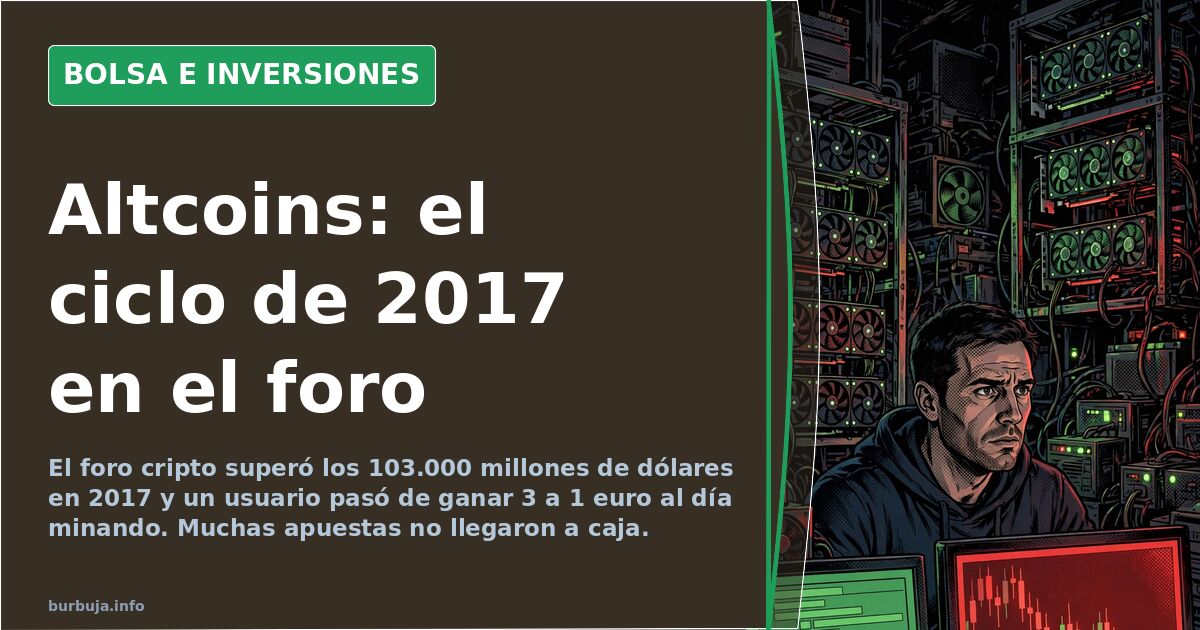
Altcoins: Mining Criptonight dropped from three euros a day to one
Can you lose money speculating in a rising market? Yes, and 2017 proved it. Between June and October of that year, the combined value of the crypto market surpassed $103 billion, countless ICOs were launched, and many forum users became convinced they had found the coin that would multiply their investment tenfold. Several of those bets didn't make it to the finish line, as acknowledged by those who had entered at peak prices.
The June crash: Iconomi, Bancor, and the buyback fund
The cycle began with a general downturn. While Litecoin held its ground, Iconomi corrected after a surge and stabilized around $0.001723, roughly where it had stopped the previous night. Some invested heavily, convinced there was still room for growth. One user recounted entering at 1020, seeing it double, but not selling any along the way: when it was still at 1300, their conclusion was that every buy order should be accompanied by its staggered sell orders.
According to a forum member, Bancor had a reserve fund to repurchase tokens at the exit price of 0.01 ETH. Their argument was that things would have to go very wrong for that reserve to be depleted, and that a more user-friendly interface and listing on more exchanges were expected. The skeptical response was swift: if this guaranteed buyback was true, the logical outcome would be for the token to crash even sooner than anticipated. Don Blas de Lezo observed discreet debuts for Bancor and SONM—the latter trading near its ICO price, almost below it—and cooled the idea that every launch would take off meteorically.
Mining stopped being profitable in a matter of weeks
The home mining craze had its own trajectory. The sale of graphics cards—the famous 470 and 480 from ATI—skyrocketed, and everyone from gamers to administrators using available resources jumped on board. According to a forum user, almost everyone wanted euros, not bitcoins, so they had no qualms about selling cheaply.
The figures discussed were telling: a setup based on an AMD Ryzen 1700 at 3600 MHz mining Criptonight via CPU went from yielding €3 per day to €1 per day within a month, consuming about 100 W/h. At the same time, the mining power for the coins they were interested in tripled in a week, and profitability dropped to a third. It was noted that using ASICs and the scrypt algorithm was more profitable, albeit with 90-day guarantees working 24 hours. A forum user concluded they were selling the computer because it would yield more profit elsewhere.
The August 1st fork and the market preparing for the blow
With the Bitcoin fork on the horizon, a forum user summarized the theory that money leaves a market when it senses uncertainty. The circulating scenario spoke of one chain settling around $1,000 and another in the $300 range. Hence, the price was considered inflated around $2,800. The recurring recommendation for those who had already cashed out was: take your profits.
That episode offered a lesson about market ownership. A forum user argued that the thesis that weak hands drive the top ten coins to the moon doesn't hold up: behind those market caps are strong interests, not a few clueless individuals. What had changed compared to the origins, according to another participant, was the correlation: what were once independent assets began to move as a block, driven by market maker bots.
PIVX, the coin that couldn't get going
PIVX concentrated the hopes and disappointments of the cycle. According to a forum member, it had strong support in the 35,000 satoshis area, a good entry point, but with such a clear downward trend line that anyone seeing it return to 50,000 should consider cashing out. It was trading at $3.17 and its dependence on a single major exchange was almost total: Bittrex accounted for around 97% of all its trading volume.
The project's community organized a proposal to get listed on a new exchange, with Hitbtc, Binance, and a Korean operator in consideration. Meanwhile, staking was explained with a calculator: below 500 coins, rewards are so sporadic they aren't worth it, and from 10,000 coins upwards, a masternode could be set up. A forum user ironically noted that at one dollar per coin every two months, PIVX would need 25 years to reach certain prices.
Crypto cards: Dash, TenX, Monaco, and TokenCard
The other major talking point was debit cards linked to cryptocurrencies. The Dash card was supported by Payza, with promotion by Charlie Shrem, and the idea was to load crypto balances to pay in euros at any merchant. The forum speculated about conditions with no annual fee, fixed expenses of $19.95, and commissions from 3% downwards depending on whether the limit exceeded 660 euros.
The problem arose when TenX announced that cards without European holders would cease functioning, coinciding with a sharp drop in its price. First TokenCard, then Monaco, and then TenX: three projects, three setbacks. A forum user offered an optimistic interpretation: these cards are the decisive step for ordinary people to use crypto without complications, even if, for now, they are more expensive than a regular bank card.
The entire market awaited Ethereum's October 17th update
A significant portion of the conversation revolved around a single event: Ethereum's update scheduled for October 17th, with Metropolis on the horizon and doubts about Raiden, Casper, or Sharding. The repeated thesis was that until ETH made its move, ERC-20 tokens—TenX, Gamecredits, Golem, and others—would continue to accumulate sideways movement and declines from their peaks.
In contrast, Dash announced its Evolution for June of the trinc year, with a testnet replica before year-end, which surprised those who believed it would align with Ethereum. Meanwhile, Gamecredits published an announcement about an SDK for Unity developers. The underlying question was whether gaming and payments would be the real catalyst or just another promise.
China, Tether, and the safe-haven narrative
The Chinese ICO ban was dismissed as smoke by a forum user. Tether, meanwhile, sparked an interesting debate: with a market cap of $380 million, it was accused of fractional reserve banking, essentially doing what banks do. The underlying argument, according to the proposer, was that tokenizing capital and committing to repurchase it is equivalent to creating parallel currencies outside the control of central banks.
Some also sought political correlations: Bitcoin's rise coinciding with the Catalan sovereignty process fueled the safe-haven theory. The skeptical response was blunt: you cannot predict the value of a cryptocurrency because the determining variables—technology, competition, sociology—lie in the future, not in any model. A forum user advised moving on if someone claims to be "scientific" and mentions prediction in the same breath.
The closing: the x10 nobody cashed in
Four months of conversation paint an uncomfortable picture. The market multiplied, ICOs numbered in the hundreds, and trading tools—exchanges, wallets, paper wallets—were recurring topics. The dominant narratives are those of entries at 1020 that remained at 1300 without selling, coins that hit bubble highs and deflated hopelessly, and home miners who considered shutting down their equipment. Speculating with altcoins required, according to the participants themselves, taking profits on time.
Can you lose money speculating in a rising market? Yes, and 2017 proved it. Between June and October of that year, the combined value of the crypto market surpassed $103 billion, countless ICOs were launched, and many forum users became convinced they had found the coin that would multiply their investment tenfold. Several of those bets didn't make it to the finish line, as acknowledged by those who had entered at peak prices.
The June crash: Iconomi, Bancor, and the buyback fund
The cycle began with a general downturn. While Litecoin held its ground, Iconomi corrected after a surge and stabilized around $0.001723, roughly where it had stopped the previous night. Some invested heavily, convinced there was still room for growth. One user recounted entering at 1020, seeing it double, but not selling any along the way: when it was still at 1300, their conclusion was that every buy order should be accompanied by its staggered sell orders.
According to a forum member, Bancor had a reserve fund to repurchase tokens at the exit price of 0.01 ETH. Their argument was that things would have to go very wrong for that reserve to be depleted, and that a more user-friendly interface and listing on more exchanges were expected. The skeptical response was swift: if this guaranteed buyback was true, the logical outcome would be for the token to crash even sooner than anticipated. Don Blas de Lezo observed discreet debuts for Bancor and SONM—the latter trading near its ICO price, almost below it—and cooled the idea that every launch would take off meteorically.
Mining stopped being profitable in a matter of weeks
The home mining craze had its own trajectory. The sale of graphics cards—the famous 470 and 480 from ATI—skyrocketed, and everyone from gamers to administrators using available resources jumped on board. According to a forum user, almost everyone wanted euros, not bitcoins, so they had no qualms about selling cheaply.
The figures discussed were telling: a setup based on an AMD Ryzen 1700 at 3600 MHz mining Criptonight via CPU went from yielding €3 per day to €1 per day within a month, consuming about 100 W/h. At the same time, the mining power for the coins they were interested in tripled in a week, and profitability dropped to a third. It was noted that using ASICs and the scrypt algorithm was more profitable, albeit with 90-day guarantees working 24 hours. A forum user concluded they were selling the computer because it would yield more profit elsewhere.
The August 1st fork and the market preparing for the blow
With the Bitcoin fork on the horizon, a forum user summarized the theory that money leaves a market when it senses uncertainty. The circulating scenario spoke of one chain settling around $1,000 and another in the $300 range. Hence, the price was considered inflated around $2,800. The recurring recommendation for those who had already cashed out was: take your profits.
That episode offered a lesson about market ownership. A forum user argued that the thesis that weak hands drive the top ten coins to the moon doesn't hold up: behind those market caps are strong interests, not a few clueless individuals. What had changed compared to the origins, according to another participant, was the correlation: what were once independent assets began to move as a block, driven by market maker bots.
PIVX, the coin that couldn't get going
PIVX concentrated the hopes and disappointments of the cycle. According to a forum member, it had strong support in the 35,000 satoshis area, a good entry point, but with such a clear downward trend line that anyone seeing it return to 50,000 should consider cashing out. It was trading at $3.17 and its dependence on a single major exchange was almost total: Bittrex accounted for around 97% of all its trading volume.
The project's community organized a proposal to get listed on a new exchange, with Hitbtc, Binance, and a Korean operator in consideration. Meanwhile, staking was explained with a calculator: below 500 coins, rewards are so sporadic they aren't worth it, and from 10,000 coins upwards, a masternode could be set up. A forum user ironically noted that at one dollar per coin every two months, PIVX would need 25 years to reach certain prices.
Crypto cards: Dash, TenX, Monaco, and TokenCard
The other major talking point was debit cards linked to cryptocurrencies. The Dash card was supported by Payza, with promotion by Charlie Shrem, and the idea was to load crypto balances to pay in euros at any merchant. The forum speculated about conditions with no annual fee, fixed expenses of $19.95, and commissions from 3% downwards depending on whether the limit exceeded 660 euros.
The problem arose when TenX announced that cards without European holders would cease functioning, coinciding with a sharp drop in its price. First TokenCard, then Monaco, and then TenX: three projects, three setbacks. A forum user offered an optimistic interpretation: these cards are the decisive step for ordinary people to use crypto without complications, even if, for now, they are more expensive than a regular bank card.
The entire market awaited Ethereum's October 17th update
A significant portion of the conversation revolved around a single event: Ethereum's update scheduled for October 17th, with Metropolis on the horizon and doubts about Raiden, Casper, or Sharding. The repeated thesis was that until ETH made its move, ERC-20 tokens—TenX, Gamecredits, Golem, and others—would continue to accumulate sideways movement and declines from their peaks.
In contrast, Dash announced its Evolution for June of the trinc year, with a testnet replica before year-end, which surprised those who believed it would align with Ethereum. Meanwhile, Gamecredits published an announcement about an SDK for Unity developers. The underlying question was whether gaming and payments would be the real catalyst or just another promise.
China, Tether, and the safe-haven narrative
The Chinese ICO ban was dismissed as smoke by a forum user. Tether, meanwhile, sparked an interesting debate: with a market cap of $380 million, it was accused of fractional reserve banking, essentially doing what banks do. The underlying argument, according to the proposer, was that tokenizing capital and committing to repurchase it is equivalent to creating parallel currencies outside the control of central banks.
Some also sought political correlations: Bitcoin's rise coinciding with the Catalan sovereignty process fueled the safe-haven theory. The skeptical response was blunt: you cannot predict the value of a cryptocurrency because the determining variables—technology, competition, sociology—lie in the future, not in any model. A forum user advised moving on if someone claims to be "scientific" and mentions prediction in the same breath.
The closing: the x10 nobody cashed in
Four months of conversation paint an uncomfortable picture. The market multiplied, ICOs numbered in the hundreds, and trading tools—exchanges, wallets, paper wallets—were recurring topics. The dominant narratives are those of entries at 1020 that remained at 1300 without selling, coins that hit bubble highs and deflated hopelessly, and home miners who considered shutting down their equipment. Speculating with altcoins required, according to the participants themselves, taking profits on time.
Summary of a discussion on Burbuja.info - Foro de economía, actualidad y política., translated from Spanish and reviewed before publication. Read the full discussion (4480 replies).
More summaries
-
Altcoins 2017: From x13 Gains with Factom to Ethereum's Collapse
In 2017, one investor turned 1 BTC into 13 with Factom, while Ethereum struggled and regulators shut down anonymous cards. Anatomy of...
-
Gold stuck at 0.382 as bitcoin takes the spotlight
Gold stuck at 0.382 and unable to recover while bitcoin hits 6.000 dollars; thresholds at 1.250 and 1.050 set the scene.
-
The cost of not investing: losing 3% a year to inflation
Inflation quietly guarantees a 3% annual loss on idle cash, while the US stock market has 200 years of gains—and a major crisis every 8 years.
-
Extra virgin olive oil falls to €6.35 a litre at Mercadona
Extra virgin olive oil is now €6.35/litre at Mercadona, down from €6.75 months ago, while the origin price of picual is €4.143/kg
-
BIG offers 4% TAE on 6-month deposit with Spanish IBAN and Portuguese FGD
BIG launched a 4% TAE six-month and 3.5% three-month deposit in May 2023 with Spanish IBAN and Portuguese FGD, but later cut rates and had opening delays.
-
Spot-price coins: the seller whose paper trail didn't add up
He offered quarter-ounce gold coins at spot price and racked up undelivered orders. Buyers cross-checked his details and several got their money back.