
Forum user claims DANA misinformation hindered Valencia firefighters
A forum post argues that viral rumors about water cuts, Forata dam, and emergency lines disrupted rescue operations during the DANA disaster in Spain.
English · Original discussion in Spanish · Published
Forum user claims DANA misinformation hindered Valencia firefighters
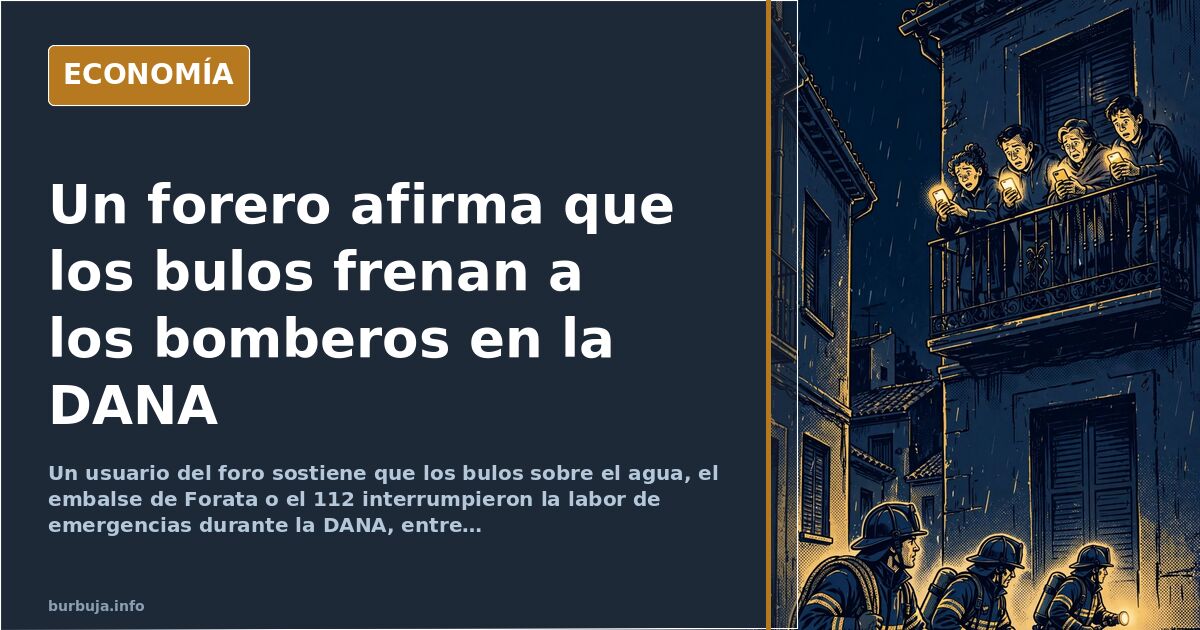
How much can a forwarded WhatsApp message cost? The DANA storm that devastated Valencia province left dozens missing, towns without power or water, and overwhelmed emergency teams. Amid the chaos, a forum user argued that the mass spread of hoaxes "significantly interrupted emergency services." This is not an excuse but a recurring pattern in disasters, now backed by names, dates, and official denials.
What hoaxes circulated during the DANA
The most widespread was a supposed water cut in Valencia. A viral WhatsApp message claimed Aguas de Valencia would stop supply or make water undrinkable. Global Omnium denied this: no city-wide cuts were planned, though some provincial areas faced issues. The irony is stark: while capital supply was guaranteed, Chiva or Paiporta—the epicenter—had no electricity.
The second major hoax was the breach of the Forata reservoir. The Júcar Hydrographic Confederation confirmed it was "completely false" and urged using only official channels. Third: claims that 112 had crashed. Valencian Community Emergency Services clarified the line remained active; the issue was call volume. Fourth: imminent evacuation in Paiporta, denied by Carlos Mazón. Fifth: reports that the AEMET radar failed, despite being operational since October 28.
Why hoaxes are an operational, not just informational, problem
Each denial consumes resources. An emergency team handling calls about a non-existent dam breach isn't rescuing those actually trapped. The forum user stated plainly: misinformation forces them to stop, verify, and respond. Some argue the core issue is the lack of fast, credible official channels. Counterarguments note that no channel prevents a WhatsApp message from reaching ten thousand people in ten minutes.
The debate shifted to emergency efficiency. One view suggests fire crews spend most time on office shifts and are overwhelmed by catastrophes. Another recalls coordination failures in the Campanar neighborhood fire. A third points to uncomfortable truths: these disasters generate overtime hours, which some perceive as profit opportunities.
The word "hoax" as a political battleground
Here, the discussion becomes toxic. Some claim every mention of "hoax" hides inconvenient truths: that evacuations did happen, supply cuts occurred, and people lacked aid. Others argue conflating rumors with verified facts enables hoax propagation. Defining what constitutes a hoax has become another front in polarization.
Meanwhile, undisputed data remains: dozens missing and entire towns without basic services. Hoaxes don't kill directly, but they consume time from those who could be saving lives. In an emergency, that is real damage.
Ultimately, the conclusion is familiar: hoaxes are the tax we pay for free WhatsApp. Unfortunately, this tax is collected in lost rescue hours.
How much can a forwarded WhatsApp message cost? The DANA storm that devastated Valencia province left dozens missing, towns without power or water, and overwhelmed emergency teams. Amid the chaos, a forum user argued that the mass spread of hoaxes "significantly interrupted emergency services." This is not an excuse but a recurring pattern in disasters, now backed by names, dates, and official denials.
What hoaxes circulated during the DANA
The most widespread was a supposed water cut in Valencia. A viral WhatsApp message claimed Aguas de Valencia would stop supply or make water undrinkable. Global Omnium denied this: no city-wide cuts were planned, though some provincial areas faced issues. The irony is stark: while capital supply was guaranteed, Chiva or Paiporta—the epicenter—had no electricity.
The second major hoax was the breach of the Forata reservoir. The Júcar Hydrographic Confederation confirmed it was "completely false" and urged using only official channels. Third: claims that 112 had crashed. Valencian Community Emergency Services clarified the line remained active; the issue was call volume. Fourth: imminent evacuation in Paiporta, denied by Carlos Mazón. Fifth: reports that the AEMET radar failed, despite being operational since October 28.
Why hoaxes are an operational, not just informational, problem
Each denial consumes resources. An emergency team handling calls about a non-existent dam breach isn't rescuing those actually trapped. The forum user stated plainly: misinformation forces them to stop, verify, and respond. Some argue the core issue is the lack of fast, credible official channels. Counterarguments note that no channel prevents a WhatsApp message from reaching ten thousand people in ten minutes.
The debate shifted to emergency efficiency. One view suggests fire crews spend most time on office shifts and are overwhelmed by catastrophes. Another recalls coordination failures in the Campanar neighborhood fire. A third points to uncomfortable truths: these disasters generate overtime hours, which some perceive as profit opportunities.
The word "hoax" as a political battleground
Here, the discussion becomes toxic. Some claim every mention of "hoax" hides inconvenient truths: that evacuations did happen, supply cuts occurred, and people lacked aid. Others argue conflating rumors with verified facts enables hoax propagation. Defining what constitutes a hoax has become another front in polarization.
Meanwhile, undisputed data remains: dozens missing and entire towns without basic services. Hoaxes don't kill directly, but they consume time from those who could be saving lives. In an emergency, that is real damage.
Ultimately, the conclusion is familiar: hoaxes are the tax we pay for free WhatsApp. Unfortunately, this tax is collected in lost rescue hours.
Also available in: Deutsch
Summary of a discussion on Burbuja.info - Foro de economía, actualidad y política., translated from Spanish and reviewed before publication. Read the full discussion (171 replies).
More summaries
-
Jucar River Authority Insured Staff for Negligence Before DANA
The Jucar River Authority formalized civil liability insurance for 212 employees on October 7, weeks before the DANA floods devastated parts of Spain.
-
198 emails from Júcar River Authority missed mobile alert window
The Júcar River Authority sent 198 emails to emergency services, but the mobile alert arrived two hours too late, raising questions about the communication system.
-
Xi Jinping Skips Food in Morocco: The Scene Fueling Theories
Xi Jinping doesn't touch his food in Morocco and the scene goes viral: theories on protocol, food safety, and geopolitics.
-
Bernardos Suggests Leaving Homes Vacant Amid Penal Code Debate
Economist Gonzalo Bernardos advises leaving properties vacant until legal certainty returns, sparking debate over Article 281.1 of the Spanish Penal Code.
-
Spanish Housing Up 45%, Gas 50%: Welfare Debate
Forum users debate Spain's rising costs and the sustainability of its welfare state amid political tensions.
-
Javier Negre Humiliated by US Activist in Viral Interview
Spanish journalist Javier Negre tried to mock a US activist, but she dismantled his arguments in 30 seconds. The video he posted went viral.