
Forum user claims 80-90% of Ukrainian troops are non-professional
Ukrainian forum users estimate that 80-90% of frontline soldiers are no longer professional, citing 120,000 casualties.
English · Original discussion in Spanish · Published
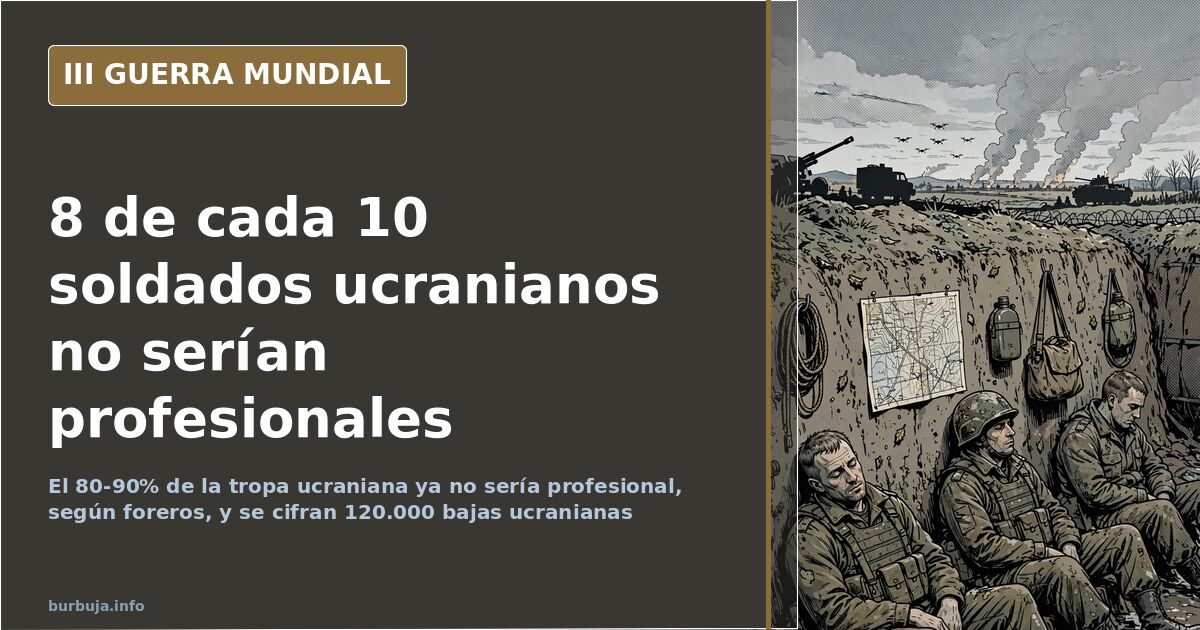
80-90% of the Ukrainian army is no longer professional
According to calculations circulating in online debates, eight or nine out of ten Ukrainian soldiers on the front line are no longer professionals. The starting point—a participant's estimate—relies on uncomfortable arithmetic: if the army had 200,000 men at the start of the conflict and half were professionals, claiming today that only 10 or 20% retain that status implies the trained core has almost completely dissolved. The proportion would have inverted. An army of cadres would have become an army of replacements.
The claim is not presented as a closed certainty but as a hypothesis backed by numbers. Its corollary goes in two directions. On one hand, it is argued that Russia has not even used 25% of its capacity, keeping its military industry intact and reserving modern equipment while sending 1960s tanks to the front. On the other, that Ukraine fills gaps with civilians mobilized in haste. Two narratives that clash head-on and have remained unresolved for months.
From 200,000 soldiers with half a professional army to 10 or 20%
The reasoning starts from a fixed snapshot. If Ukraine began with 200,000 personnel and half had professional training, the current percentage would imply a loss of cadres difficult to hide. The figures handled suggest that Russia never exceeded Ukrainian troop numbers, which, according to this reading, leaves room to double its contingent—by 40 or 50%—without needing conscription. This is the thesis of the crushing blow held in reserve.
Doubt creeps in from the other end. There are estimates reducing the Ukrainian army to tens of thousands of soldiers. Colonel Douglas MacGregor, cited in the thread, dropped a repeated phrase: Ukraine has between 40,000 and 60,000 soldiers, and the supposed great lie will eventually come to light. If that figure were true, the front map would not hold much longer. And there the problem begins.
The counteroffensive that dismantles the attrition thesis
Because the terrain tells another story. The Ukrainian army has recovered territory in Kherson and Kharkiv, forcing an explanation of how a supposedly decimated force keeps pushing. The most repeated answer is that it is a Russian tactical retreat: yielding ground to regroup and strike later. The second is that this army is no longer what it was, but an amalgam of replacements sustained from outside.
Neither can be verified from behind a screen. What is observed is the temporal paradox: the thesis of Ukrainian exhaustion was formulated months ago, and since then, Ukraine has advanced on two fronts. Either the diagnosis was premature, or the gained ground does not reflect real combat capability. The analysis gets stuck exactly there.
The casualty count nobody reconciles
Ukrainian losses are the crux of the discussion. One forum user puts Ukrainian casualties at 120,000 among dead, wounded, and prisoners. Another assures that the Ukrainian president would have acknowledged around 2,500 daily casualties. And a detail appears cited as visual proof: videos of men aged 50 and 60 in lines.
On paper, the arithmetic works. In practice, nobody agrees. Some reply that Russian losses are equally severe—or greater—and that the Russian advance has slowed precisely because of that. The figure thus becomes a tug-of-war: each side uses it to support the opposite view. And neither publishes their own.
Can you turn a civilian into a soldier in two months?
Here the analysis breaks into two schools. One argues that training a replacement barely needs about three months of basic instruction, and that a non-professional acquires in two minutes of combat the experience of years for a veteran. The other doubts it harshly: good soldiers are not manufactured in two months, physically or psychologically, especially when defending under fire.
In the middle remains the criterion hardly anyone disputes: the decisive factor is selecting intermediate commanders well, rescuing former professionals and the sharpest from each replacement batch. As proof that this is not new, history is invoked: the resistance of Napoleonic infantry, charges at Gettysburg, or trenches at the Somme. Books like John Keegan's The Face of Battle are cited to ask how many current soldiers would endure hours in tight formation while being shelled next to them. The answer, it is suggested, is uncomfortable.
The weariness belongs to the observer too
The conversation is not just military. There is a cost sneaking in through the back door: diesel, gas, and sustained support for arms shipments. Part of the debate argues that many who support these shipments would declare themselves conscientious objectors if called up someday, and that the energy bill ends up in the citizen's pocket. The discussion on war drifts toward the discussion on who bears the price.
And in the final stretch, fatigue appears. One of the most persistent participants announces they are leaving the topic: the war drives me crazy, admits, acknowledging they have lost the thread. It is the symptom of a debate too long. With Kherson and Kharkiv recovered and a Russian withdrawal in between, the question hangs in the air: if the Ukrainian troops are no longer professional, where do the forces to advance come from; and if they are, where do the casualty figures come from? There, and nowhere else, everything gets stuck.
According to calculations circulating in online debates, eight or nine out of ten Ukrainian soldiers on the front line are no longer professionals. The starting point—a participant's estimate—relies on uncomfortable arithmetic: if the army had 200,000 men at the start of the conflict and half were professionals, claiming today that only 10 or 20% retain that status implies the trained core has almost completely dissolved. The proportion would have inverted. An army of cadres would have become an army of replacements.
The claim is not presented as a closed certainty but as a hypothesis backed by numbers. Its corollary goes in two directions. On one hand, it is argued that Russia has not even used 25% of its capacity, keeping its military industry intact and reserving modern equipment while sending 1960s tanks to the front. On the other, that Ukraine fills gaps with civilians mobilized in haste. Two narratives that clash head-on and have remained unresolved for months.
From 200,000 soldiers with half a professional army to 10 or 20%
The reasoning starts from a fixed snapshot. If Ukraine began with 200,000 personnel and half had professional training, the current percentage would imply a loss of cadres difficult to hide. The figures handled suggest that Russia never exceeded Ukrainian troop numbers, which, according to this reading, leaves room to double its contingent—by 40 or 50%—without needing conscription. This is the thesis of the crushing blow held in reserve.
Doubt creeps in from the other end. There are estimates reducing the Ukrainian army to tens of thousands of soldiers. Colonel Douglas MacGregor, cited in the thread, dropped a repeated phrase: Ukraine has between 40,000 and 60,000 soldiers, and the supposed great lie will eventually come to light. If that figure were true, the front map would not hold much longer. And there the problem begins.
The counteroffensive that dismantles the attrition thesis
Because the terrain tells another story. The Ukrainian army has recovered territory in Kherson and Kharkiv, forcing an explanation of how a supposedly decimated force keeps pushing. The most repeated answer is that it is a Russian tactical retreat: yielding ground to regroup and strike later. The second is that this army is no longer what it was, but an amalgam of replacements sustained from outside.
Neither can be verified from behind a screen. What is observed is the temporal paradox: the thesis of Ukrainian exhaustion was formulated months ago, and since then, Ukraine has advanced on two fronts. Either the diagnosis was premature, or the gained ground does not reflect real combat capability. The analysis gets stuck exactly there.
The casualty count nobody reconciles
Ukrainian losses are the crux of the discussion. One forum user puts Ukrainian casualties at 120,000 among dead, wounded, and prisoners. Another assures that the Ukrainian president would have acknowledged around 2,500 daily casualties. And a detail appears cited as visual proof: videos of men aged 50 and 60 in lines.
On paper, the arithmetic works. In practice, nobody agrees. Some reply that Russian losses are equally severe—or greater—and that the Russian advance has slowed precisely because of that. The figure thus becomes a tug-of-war: each side uses it to support the opposite view. And neither publishes their own.
Can you turn a civilian into a soldier in two months?
Here the analysis breaks into two schools. One argues that training a replacement barely needs about three months of basic instruction, and that a non-professional acquires in two minutes of combat the experience of years for a veteran. The other doubts it harshly: good soldiers are not manufactured in two months, physically or psychologically, especially when defending under fire.
In the middle remains the criterion hardly anyone disputes: the decisive factor is selecting intermediate commanders well, rescuing former professionals and the sharpest from each replacement batch. As proof that this is not new, history is invoked: the resistance of Napoleonic infantry, charges at Gettysburg, or trenches at the Somme. Books like John Keegan's The Face of Battle are cited to ask how many current soldiers would endure hours in tight formation while being shelled next to them. The answer, it is suggested, is uncomfortable.
The weariness belongs to the observer too
The conversation is not just military. There is a cost sneaking in through the back door: diesel, gas, and sustained support for arms shipments. Part of the debate argues that many who support these shipments would declare themselves conscientious objectors if called up someday, and that the energy bill ends up in the citizen's pocket. The discussion on war drifts toward the discussion on who bears the price.
And in the final stretch, fatigue appears. One of the most persistent participants announces they are leaving the topic: the war drives me crazy, admits, acknowledging they have lost the thread. It is the symptom of a debate too long. With Kherson and Kharkiv recovered and a Russian withdrawal in between, the question hangs in the air: if the Ukrainian troops are no longer professional, where do the forces to advance come from; and if they are, where do the casualty figures come from? There, and nowhere else, everything gets stuck.
Also available in: Deutsch
Summary of a discussion on Burbuja.info - Foro de economía, actualidad y política., translated from Spanish and reviewed before publication. Read the full discussion (129 replies).
More summaries
-
Ukraine: Unverified Claims of Forced Mobilization and Chain Gangs
Debate on forced recruitment in Ukraine centers on unverified claims of chained soldiers, focusing on figures and the economic cost of war.
-
Desertion in Ukraine: 5 years of prison or returning to the trenches
A 28-year-old Ukrainian soldier living in hiding faces two choices: five years of incarceration for desertion, or returning to the front line with no guaranteed exit date.
-
Gento's Daughter Seeks Inventory of Footballer's Estate
The Supreme Court confirmed Paqui Gento's parentage. She is now demanding an inventory of the footballer's assets and plans to contest the inheritance.
-
Russia claims 560 Ukrainian casualties in southern counterattack
Russian Defense Ministry reports 560 losses in Mykolaiv and Kherson. Kyiv has not confirmed the figures.
-
Unverified Claim of 200 Ukraine War Dead in Trenches
A viral claim asserts over 200 soldiers died in a trench complex, but the only two photos show just two bodies.
-
BRICS Trap Thesis: US Economy Shrinks, China Grows
US GDP fell 1.6% in Q1 2022 while China grew 4.8%, fueling theories that NATO has fallen into a BRICS economic trap.