
Forum user charged €50 to replace the battery in a €120 G-Shock
A user reports that El Corte Inglés quoted him €50 to replace the battery and keep his €120 G-Shock waterproof. At Casio's official service center in Madrid…
English · Original discussion in Spanish · Published
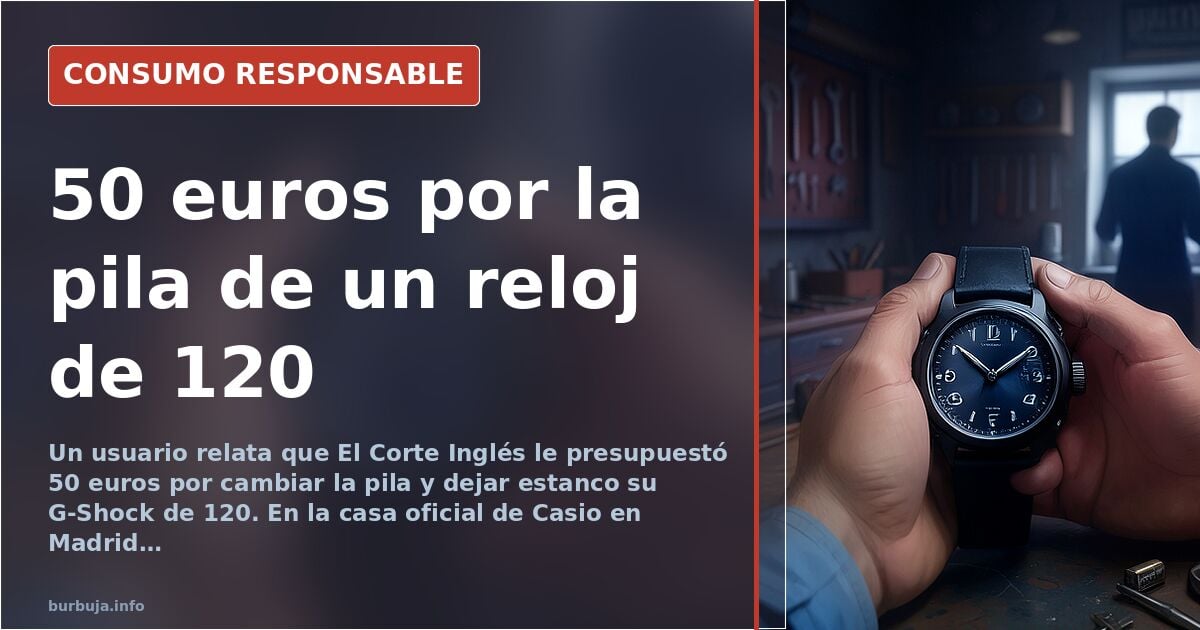
€50 to replace the battery in a G-Shock that costs €120
A customer walks into El Corte Inglés with a Casio G-Shock whose battery has died. The watchmaker quotes him €50 to make it water-resistant again. The watch cost €120. The math makes no sense, and that's where one of those conversations begins — the kind that explains better than any report how the maintenance business works in Spain.
The breakdown given by the official service center is always the same: battery replacement, replacement of the O-ring gasket, and a water-resistance test. That last word, water-resistance, is what justifies the price. Without it, the watch works again but is no longer safe to submerge. With it, the customer pays almost half of what the watch cost to keep a antiestéticature he may never use.
What a G-Shock battery replacement actually involves
The job is not a simple swap. On a G-Shock you have to open the case back, remove the metal clip holding the battery, replace it without touching the contacts with your fingers, press the reset point marked AC, and re-grease the rubber gasket before closing it up. Any neighborhood watch shop without a pressure-testing machine refuses to take on the risk. And the ones that do accept it warn you: if the gasket isn't replaced, the watch can handle splashes but not immersion.
Some argue that the water-resistance test is a mechanical procedure done dry, without getting the watch wet, and that its real cost is under ten euros. Against that stands the argument that the workshop takes on liability: if the watch floods afterwards, the customer comes back with the invoice. The official service center settles it with a clause that infuriates more than a few: the test is charged, but if the watch fails afterwards, the workshop takes no responsibility.
The alternative: doing it yourself for five euros
The battery itself costs around five euros. The silicone grease for the gasket, about the same. With a precision screwdriver, some latex gloves and a metal clip for the reset, anyone with patience can have the watch running again in twenty minutes. The question is whether it will still be water-resistant. The honest answer is that it probably will, if the gasket isn't deformed and is properly greased, but nobody will put that in writing.
That's where the business lies. You're not paying for the battery. You're paying for the uncertainty. And when the watch is worth €120, the uncertainty costs €50.
Why a €120 watch generates a €50 bill
The calculation that circulates among enthusiasts is simple: if maintenance costs more than 30% of the item's value, the rational decision is not to do it. In this case, €50 on €120 works out at 41%. Many conclude that the G-Shock, marketed as an indestructible watch, has an ownership cost that doesn't appear on the price tag.
Comparison with other models is inevitable. A Casio F91W costs less than €20, its battery lasts ten years, and nobody thinks of taking it in for service. An entry-level automatic Seiko, around €200, needs no battery. And solar models, which recharge with light, eliminate the operation for years. The question that remains hanging is why the watch most sold as an adventure tool is also the most expensive to maintain.
The debate isn't settled. Some defend €50 as a fair price for a professional service with a warranty. Others point out that at Casio's official service center in Madrid the same job costs €12. The difference, according to the first group, is that El Corte Inglés is not a specialized workshop but a middleman. And middlemen, in this as in everything, charge for the convenience of not having to look around.
Also available in: Deutsch
Summary of a discussion on Burbuja.info - Foro de economía, actualidad y política., translated from Spanish and reviewed before publication. Read the full discussion (37 replies).
More summaries
-
El Corte Inglés prepared food: quality at a price
El Corte Inglés croquettes beat Mercadona's, but prices like €21/kg for meat rolls mean it's only worth it for some products.
-
Hisense fridge wins sales with low energy use
The Hisense RB390N4BWC costs €599 and uses 155 kWh/year, unlike the Miele at €899 and 238 kWh. Durability remains uncertain.
-
El Corte Inglés delivers in 3 hours, undercutting Amazon by €30
Smartwatch delivered in three hours and €30 cheaper than Amazon: cases challenging El Corte Inglés' expensive reputation.
-
Pétanque Ball Finishes: Laser Etching vs. Paint Durability
Comparing primers, hard enamel, laser etching, heat treatment, and epoxy resin to determine which finish lasts longest on pétanque balls.
-
No more ads and AI summaries: uBlock Origin filters
uBlock Origin lets you remove ads, pop-ups and the AI summaries some sites place after the first post without breaking the page.
-
Night swimming under a moonless sky: the experience the daytime beach can't match
Discover why swimming in the sea at night with no moon is a unique experience, far from the daytime crowds. The threat of regulation looming over this pleasure.