
Forum user argues supermarket ready meals are cheaper than cooking
A shopper claims prepared food beats home cooking on cost; others counter with calculations, sparking a debate on price and convenience.
English · Original discussion in Spanish · Published
Forum user argues supermarket ready meals are cheaper than cooking
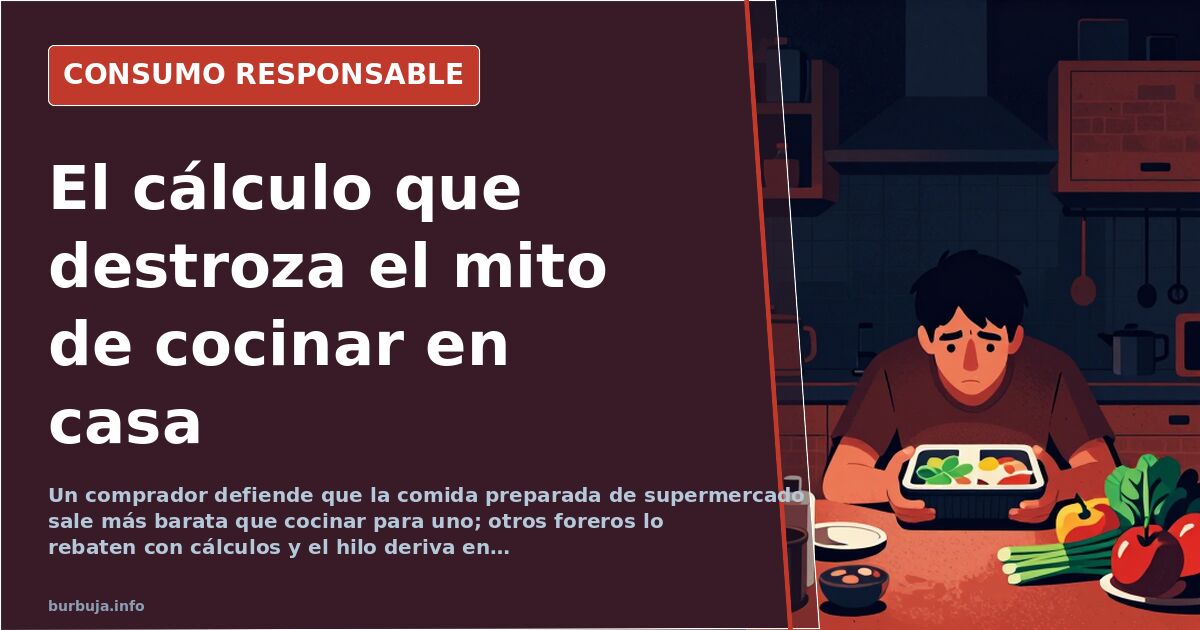
A 300-gram pasta dish for €1.80. Plain rice for €1.50. Paella for €1.70. Second courses by weight around €2.50. And a whole roast chicken for €5.80. These are the prices of ready meals at a supermarket chain presented by a shopper with an uncomfortable thesis: if you add up the meat tray, the kilo of rice or pasta, condiments, and electricity for the hob, I doubt it’s worth it to make it yourself. The claim, launched in a consumer forum, has triggered a debate thread and a war of numbers that still has no winner.
The calculation for roast chicken and meat trays
The initial argument is not a joke. The author admits their culinary skills are limited and insists that even a poor-quality industrial paella turns out better than theirs. Their economic argument is more solid than it seems: if they cook pasta, they have to buy bolognese sauce or tomatoes, onions, garlic, and meat, and none of those options are cheaper than paying €1.80 for a ready-made dish, especially when living alone. They add that the meat is the same as buying it raw.
The counterattack came with figures. One participant calculates that for €1.80 you can make pasta five times, and lean pork costs about €5 per kilo, so €8 covers another five servings. Their conclusion is blunt: it’s not cheap, it’s convenient. Another contributor raises the stakes with pressure cookers and sous-vide cooking: a whole chicken at €2.45 per kilo, pulled meat for a battalion, and cheap cuts that become tender through temperature and cooking time. Practice, they insist, is what leads to excellence: once you do it three times, it tastes better than the industrial version.
Cooking for one: the batch cooking problem
Here the debate gets interesting. The defense of ready meals relies not just on price, but on domestic economies of scale. Cooking for several people offsets time and condiment costs; cooking for one becomes monotonous because nobody makes a sauce reduction with a thousand vegetables for a single serving. Batch cooking, that mantra of weekly organization, is unviable for a single person unless it’s rice, pasta, and grilled breast. If you make bolognese or carbonara for multiple servings, you either eat the same thing every day or it spoils.
Home cooks respond that time is also money. Preparing everything for the week and cooking one morning, with frozen broth always available, is just a matter of organization. Some go further: if the time you don’t spend cooking is wasted at the casino or inhaling substances, better to cook. Hygiene, however, is not the only open front.
The nutritional war: broccoli vs xanthan gum
The health angle is the loudest. One faction dismisses ready meals as putting crap into your body, while another responds that broccoli comes full of fertilizers, hard-boiled eggs carry salmonella risks at every step, and tuna contains lead and mercury. The discussion shifts to additives: xanthan gum, citric acid, polyphosphates, sunflower oil. The chemical defense is that these substances are present in living beings and that the body itself produces citric acid. If you think carotenes are harmful, don’t eat carrots, summarizes one participant.
There is an uncomfortable point of consensus: given equal quality, cooking is cheaper. The nuance comes from those who recall that ready meal portions are small and don’t taste the same, and that knowing how to cook is a plus appreciated in digestion. The discussion closes, for now, without agreement on what exactly constitutes equal quality.
The supermarket dining area and buffet tourism
The conversation drifts into unexpected territories. One suggests going to the nearest supermarket for cutlery and using the microwave, and if you get used to having dinner at eight, doing lunch and dinner in the dining area. Another boasts about trips costing less than €12 a day with breakfast, lunch, dinner, and hotel included, and an all-inclusive in Torremolinos that works out cheaper than living in Madrid. The response doesn’t take long: those packages are heavily subsidized and accepted by hoteliers because they guarantee occupancy during bad months.
The thread fills with anecdotes about buffets and groups of older travelers. A recurring story: the man preparing a bowl of jelly with cream, chocolate, and cookie while his vvife scolds him, and he replies that at home he wouldn’t eat it even tied down. The scene illustrates a more serious idea: low price doesn’t always buy quality, sometimes it just buys the feeling of getting a deal.
Tupperware logistics and the price of comfort
Against the supermarket appears another route: websites delivering ready meals. For €5 or €8 per dish, depending on the case, you receive decently made containers, far above the average restaurant menu and plastic supermarket prep. They last two weeks or can be frozen, and are solved in three minutes in the microwave. One user calculates that €90 covers two weeks of lunches and some dinners. The trap is the same as ever: the price per portion rises, but the recovered time is also valuable.
The provisional conclusion of the thread does not close the issue. Ready meals win on time and convenience, and probably on price for those who live alone and lack cooking skills. Home cooking wins on control, quality, and cost per portion when there is a pressure cooker and some practice. What nobody has yet managed to prove is that one of the two options is cheaper in all scenarios.
A 300-gram pasta dish for €1.80. Plain rice for €1.50. Paella for €1.70. Second courses by weight around €2.50. And a whole roast chicken for €5.80. These are the prices of ready meals at a supermarket chain presented by a shopper with an uncomfortable thesis: if you add up the meat tray, the kilo of rice or pasta, condiments, and electricity for the hob, I doubt it’s worth it to make it yourself. The claim, launched in a consumer forum, has triggered a debate thread and a war of numbers that still has no winner.
The calculation for roast chicken and meat trays
The initial argument is not a joke. The author admits their culinary skills are limited and insists that even a poor-quality industrial paella turns out better than theirs. Their economic argument is more solid than it seems: if they cook pasta, they have to buy bolognese sauce or tomatoes, onions, garlic, and meat, and none of those options are cheaper than paying €1.80 for a ready-made dish, especially when living alone. They add that the meat is the same as buying it raw.
The counterattack came with figures. One participant calculates that for €1.80 you can make pasta five times, and lean pork costs about €5 per kilo, so €8 covers another five servings. Their conclusion is blunt: it’s not cheap, it’s convenient. Another contributor raises the stakes with pressure cookers and sous-vide cooking: a whole chicken at €2.45 per kilo, pulled meat for a battalion, and cheap cuts that become tender through temperature and cooking time. Practice, they insist, is what leads to excellence: once you do it three times, it tastes better than the industrial version.
Cooking for one: the batch cooking problem
Here the debate gets interesting. The defense of ready meals relies not just on price, but on domestic economies of scale. Cooking for several people offsets time and condiment costs; cooking for one becomes monotonous because nobody makes a sauce reduction with a thousand vegetables for a single serving. Batch cooking, that mantra of weekly organization, is unviable for a single person unless it’s rice, pasta, and grilled breast. If you make bolognese or carbonara for multiple servings, you either eat the same thing every day or it spoils.
Home cooks respond that time is also money. Preparing everything for the week and cooking one morning, with frozen broth always available, is just a matter of organization. Some go further: if the time you don’t spend cooking is wasted at the casino or inhaling substances, better to cook. Hygiene, however, is not the only open front.
The nutritional war: broccoli vs xanthan gum
The health angle is the loudest. One faction dismisses ready meals as putting crap into your body, while another responds that broccoli comes full of fertilizers, hard-boiled eggs carry salmonella risks at every step, and tuna contains lead and mercury. The discussion shifts to additives: xanthan gum, citric acid, polyphosphates, sunflower oil. The chemical defense is that these substances are present in living beings and that the body itself produces citric acid. If you think carotenes are harmful, don’t eat carrots, summarizes one participant.
There is an uncomfortable point of consensus: given equal quality, cooking is cheaper. The nuance comes from those who recall that ready meal portions are small and don’t taste the same, and that knowing how to cook is a plus appreciated in digestion. The discussion closes, for now, without agreement on what exactly constitutes equal quality.
The supermarket dining area and buffet tourism
The conversation drifts into unexpected territories. One suggests going to the nearest supermarket for cutlery and using the microwave, and if you get used to having dinner at eight, doing lunch and dinner in the dining area. Another boasts about trips costing less than €12 a day with breakfast, lunch, dinner, and hotel included, and an all-inclusive in Torremolinos that works out cheaper than living in Madrid. The response doesn’t take long: those packages are heavily subsidized and accepted by hoteliers because they guarantee occupancy during bad months.
The thread fills with anecdotes about buffets and groups of older travelers. A recurring story: the man preparing a bowl of jelly with cream, chocolate, and cookie while his vvife scolds him, and he replies that at home he wouldn’t eat it even tied down. The scene illustrates a more serious idea: low price doesn’t always buy quality, sometimes it just buys the feeling of getting a deal.
Tupperware logistics and the price of comfort
Against the supermarket appears another route: websites delivering ready meals. For €5 or €8 per dish, depending on the case, you receive decently made containers, far above the average restaurant menu and plastic supermarket prep. They last two weeks or can be frozen, and are solved in three minutes in the microwave. One user calculates that €90 covers two weeks of lunches and some dinners. The trap is the same as ever: the price per portion rises, but the recovered time is also valuable.
The provisional conclusion of the thread does not close the issue. Ready meals win on time and convenience, and probably on price for those who live alone and lack cooking skills. Home cooking wins on control, quality, and cost per portion when there is a pressure cooker and some practice. What nobody has yet managed to prove is that one of the two options is cheaper in all scenarios.
Summary of a discussion on Burbuja.info - Foro de economía, actualidad y política., translated from Spanish and reviewed before publication. Read the full discussion (176 replies).
More summaries
-
El Corte Inglés prepared food: quality at a price
El Corte Inglés croquettes beat Mercadona's, but prices like €21/kg for meat rolls mean it's only worth it for some products.
-
Nestlé and Dolca: 30% vs 25% Cacao, Same Price in Spain
Nestlé and Dolca chocolates differ by just 5% cacao yet cost nearly the same, revealing that budget brands in Spain are no longer significantly cheaper.
-
80s Hi-Fi Revival: Connect Vintage Amps with Cheap RCA Cables
A €3-6 minijack-to-RCA cable revives 1980s amplifiers, connecting modern phones to vintage speakers while revealing common mechanical failures.
-
RX 570 at €140 reignites GPU price debate
The RX 570 sells for €140, making the upgrade from a used GTX 1050 Ti cost only about €20 net.
-
Dating red flags: tattoos, pets and family filters
Tattoos, dogs, cats or feminism: dating 'red flags' are so exhaustive that almost no one passes the filter before a first date.
-
Offal: From Smell Aversion to Culinary Revival
Liver, tripe, brains and trotters: offal is rejected by some for its smell but championed by others for its price and whole-animal utilization.