
RX 570 at €140 reignites GPU price debate
The RX 570 sells for €140, making the upgrade from a used GTX 1050 Ti cost only about €20 net.
English · Original discussion in Spanish · Published
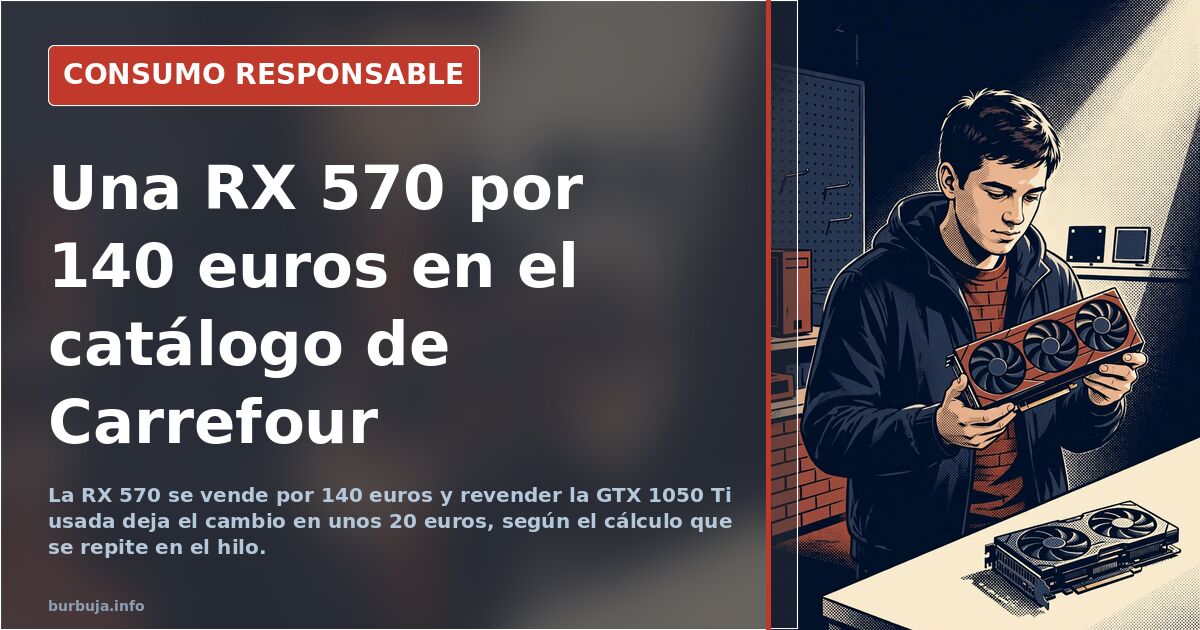
RX 570 at €140: Upgrading from a GTX 1050 Ti for just €20
How much does it take to see a real performance jump in a graphics card? The recurring data point is that a RX 570 can be found on Carrefour's online catalog for €140. By selling an old second-hand GTX 1050 Ti for between €100 and €130, the extra outlay comes down to a handful of euros. This calculation reopens the eternal discussion: when to switch GPUs and what price the market is willing to keep paying for new ones. The comparison is made without mincing words: the 570 doesn't play in the same league as the 1050 Ti.
Does the user notice the jump from a GTX 1050 Ti to an RX 570?
Yes, according to testimonials comparing both cards. The difference is described as 55% more performance for barely €20 in net cost after reselling the old one, a calculation made by the thread starter. Examples cite demanding games of the era running at 60 frames per second on high or ultra settings, a bar the 1050 Ti couldn't reach. But there are nuances worth noting: in specific titles like GTA 5 or Blur, the 570 performs below the 1050 Ti, something deemed inexplicable. The general rule favors the AMD card, but not across all game engines.
The GTX 1050 Ti has the advantage of being cool and compact, as defended in the conversation itself. It consumes little power, rarely causes driver issues, and fits into systems with modest power supplies. Its problem isn't performance; it's price: it's considered inflated, with a fair value well below what is asked for it.
What’s the difference between the RX 570, 580, and 560?
Less than the numbers suggest. The RX 570 and RX 580 share the Polaris 20 chip; what changes is the frequency: 1168 MHz on the 570 versus 1257 MHz on the 580, and memory, which goes from 7000 to 8000 MHz. Manufacturers compensate for this extra effort by expanding the PCB surface area to separate hotspots and cool them better. The RX 560, however, uses a different chip —the Polaris 11— with fewer processing units, and there the step down is real.
That technical closeness explains why some buyers recommend stretching to an 8 GB 580 or waiting for a slightly cheaper 590. The single-fan, compact-format 570 is presented as the only one fitting small cases, with performance comparable to the GTX 1060 3GB.
The second-hand market: Aliexpress, Wallapop, and mining cards
The real savings are outside the store. Second-hand RX 580s on Aliexpress are cited for around €80, and auctions show similar figures. The warning is unanimous: many come from cryptocurrency mining farms, have worked hard, and need new thermal paste and pads. Some report game crashes and missing drivers after purchase, while others claim opening the card and replacing those components solves most failures. The repeated advice is not to pay more than €100 for a used card in this range.
For those preferring warranty, a broad price comparison circulates: RX 470 4GB for €89.95, 570 8GB for €170, 580 8GB for €199. Free games —RE2, DMC 5, and The Division 2— change the equation depending on individual interest, and some admit that just one of them would be enough to decide on the purchase.
Is my PSU enough and can the RX 570 handle temperatures?
The card requires a TDP of 150 watts and a six-pin connector, though some models add an eight-pin. That figure is at the limit of what many consider reasonable. A budget 500-watt PSU is cited as sufficient if the processor doesn't demand too much —an FX 6300, it is argued, won't push it to its limits— but upgrading to 650 watts is recommended if the budget allows.
Heat is the other front. Some view 80 degrees Celsius as excessive, while others argue 65 is normal under load. The pointed cause is that manufacturers let fans start late. The solution involves manually configuring the fan curve with utilities like MSI Afterburner, scaling the RPM percentage based on temperature to improve cooling earlier.
The underlying question remains: do these prices make sense for the market? The buyer's answer is a simple line: don't pay more than €200 for a card and wait. Meanwhile, supply continues and figures fluctuate on their own.
How much does it take to see a real performance jump in a graphics card? The recurring data point is that a RX 570 can be found on Carrefour's online catalog for €140. By selling an old second-hand GTX 1050 Ti for between €100 and €130, the extra outlay comes down to a handful of euros. This calculation reopens the eternal discussion: when to switch GPUs and what price the market is willing to keep paying for new ones. The comparison is made without mincing words: the 570 doesn't play in the same league as the 1050 Ti.
Does the user notice the jump from a GTX 1050 Ti to an RX 570?
Yes, according to testimonials comparing both cards. The difference is described as 55% more performance for barely €20 in net cost after reselling the old one, a calculation made by the thread starter. Examples cite demanding games of the era running at 60 frames per second on high or ultra settings, a bar the 1050 Ti couldn't reach. But there are nuances worth noting: in specific titles like GTA 5 or Blur, the 570 performs below the 1050 Ti, something deemed inexplicable. The general rule favors the AMD card, but not across all game engines.
The GTX 1050 Ti has the advantage of being cool and compact, as defended in the conversation itself. It consumes little power, rarely causes driver issues, and fits into systems with modest power supplies. Its problem isn't performance; it's price: it's considered inflated, with a fair value well below what is asked for it.
What’s the difference between the RX 570, 580, and 560?
Less than the numbers suggest. The RX 570 and RX 580 share the Polaris 20 chip; what changes is the frequency: 1168 MHz on the 570 versus 1257 MHz on the 580, and memory, which goes from 7000 to 8000 MHz. Manufacturers compensate for this extra effort by expanding the PCB surface area to separate hotspots and cool them better. The RX 560, however, uses a different chip —the Polaris 11— with fewer processing units, and there the step down is real.
That technical closeness explains why some buyers recommend stretching to an 8 GB 580 or waiting for a slightly cheaper 590. The single-fan, compact-format 570 is presented as the only one fitting small cases, with performance comparable to the GTX 1060 3GB.
The second-hand market: Aliexpress, Wallapop, and mining cards
The real savings are outside the store. Second-hand RX 580s on Aliexpress are cited for around €80, and auctions show similar figures. The warning is unanimous: many come from cryptocurrency mining farms, have worked hard, and need new thermal paste and pads. Some report game crashes and missing drivers after purchase, while others claim opening the card and replacing those components solves most failures. The repeated advice is not to pay more than €100 for a used card in this range.
For those preferring warranty, a broad price comparison circulates: RX 470 4GB for €89.95, 570 8GB for €170, 580 8GB for €199. Free games —RE2, DMC 5, and The Division 2— change the equation depending on individual interest, and some admit that just one of them would be enough to decide on the purchase.
Is my PSU enough and can the RX 570 handle temperatures?
The card requires a TDP of 150 watts and a six-pin connector, though some models add an eight-pin. That figure is at the limit of what many consider reasonable. A budget 500-watt PSU is cited as sufficient if the processor doesn't demand too much —an FX 6300, it is argued, won't push it to its limits— but upgrading to 650 watts is recommended if the budget allows.
Heat is the other front. Some view 80 degrees Celsius as excessive, while others argue 65 is normal under load. The pointed cause is that manufacturers let fans start late. The solution involves manually configuring the fan curve with utilities like MSI Afterburner, scaling the RPM percentage based on temperature to improve cooling earlier.
The underlying question remains: do these prices make sense for the market? The buyer's answer is a simple line: don't pay more than €200 for a card and wait. Meanwhile, supply continues and figures fluctuate on their own.
Summary of a discussion on Burbuja.info - Foro de economía, actualidad y política., translated from Spanish and reviewed before publication. Read the full discussion (173 replies).
More summaries
-
Carrefour’s 1973 prices and the trap of comparing them
A 1973 Carrefour leaflet shows DYC at 82 cents, but pay was around 4.000 pesetas and inflation topped 10%
-
Mercadona salmon rip-off: tray fillets cost up to 78% more
Mercadona charges up to €25/kg for salmon tray fillets while a whole salmon costs €11/kg. Data and tips to save.
-
Game, Leroy Merlin and the quiet war on cash
In Spain, retailers and banks push digital payments by reducing staffed counters. While law mandates accepting cash, practice makes it increasingly difficult.
-
Doctor's €21,000 Bike Sparks Debate on Spanish Consumerism
A doctor showcases a €21,000 Colnago bike, reigniting discussions on luxury consumption and social status in Spain.
-
Lard vs. Olive Oil: The Smoke Point Debate
Forum users debate if lard withstands heat better than olive oil and whether sunflower oil is less stable, citing smoke points.
-
Peanut Butter: Cheap, High-Protein Health Food?
Peanut butter offers 28% protein and healthy fats at low cost. We analyze if it truly is the top superfood its nutritional data suggests.