
Dating red flags: tattoos, pets and family filters
Tattoos, dogs, cats or feminism: dating 'red flags' are so exhaustive that almost no one passes the filter before a first date.
English · Original discussion in Spanish · Published
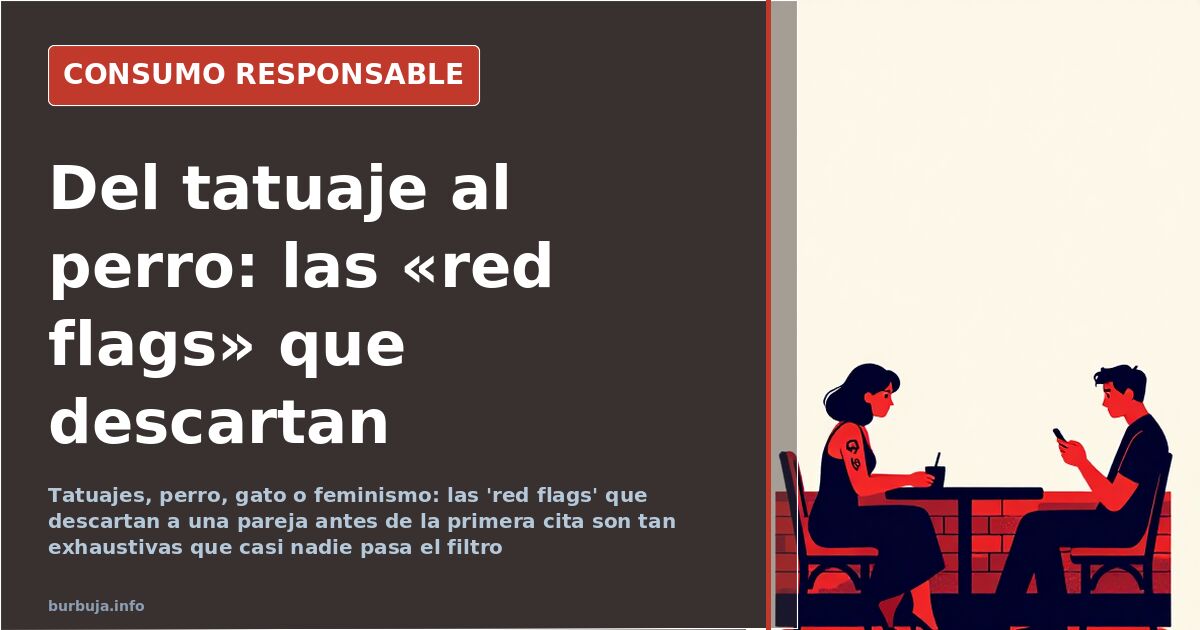
The "red flags" that rule out a partner before the first date
What makes someone a candidate who gets discarded before the first date? The answer repeated in the longest discussion on the subject is uncomfortable: almost anything. Tattoos, dogs, cats, feminism, travel addiction, bad relationships with parents or too good ones. The catalog of red flags—alarm signals that make people flee—has become so exhaustive that, applied in reverse, it would exclude a large part of candidates. In the background looms something less folkloric: the growing difficulty of finding a partner.
What does it miccionan for something to be a red flag?
A red flag is an alarm signal: a trait or behavior interpreted as an indication of future problems, enough to not proceed. Enough, and there lies the issue, with very little. The starting question, openly launched at women, asked exactly that: what is a red flag and what is a green flag. The example proposed as a start was extreme: a partner doing cocaine without disguise in front of you.
What is striking is not the list, but the imbalance. Almost no one describes positive signals; almost everyone lists discards. The conversation lengthens and along that path goes from physical criteria to family ones, from habits to character. The definition has been infected by recruitment language: filters, checklists and discards in the first screening.
Tattoos, dogs and family: the most repeated filters
The physical filter heads the lists. One requires a body mass index under 26 and less than 10 cm² of tattoo, with express prohibition of ink on face and neck. Another adds piercings, cosmetic surgery and flashy social media photos. Tattoos, in general, appear as the most cited signal: on arms and thighs they are tolerated; on the chest they are directly a pavor.
The second family of discards is cohabitation. Having more than one dog living alone is marked as a red line; also the cat, especially if it sleeps in the room. Some argue that those who let their pet lick their face are not fit to kiss anyone due to infection risk, a thesis others refute by recalling that the human mouth is not cleaner than the canine one.
And there is the family of origin. Getting along badly with parents is read as one of the worst signals, and the best, according to several answers, is the opposite: a healthy relationship with the family. Some interventions go further and argue that those coming from a dysfunctional home carry hard-to-correct habits, focus on the here and now, and contempt for commitment. The generalization, recognized as such, divides respondents.
The chorizo smell that ruined a perfect courtship
Not everything is lists. One response tells a story with a sarracena. An acquaintance of a friend's partner liked all her Instagram photos and deployed a textbook courtship: compliments, attentions, weeks of conversation, the opposite of his ex-partner. The first date, at the trendy restaurant, went smoothly until, at the bar, waiting for a table, an intense chorizo smell invaded the atmosphere. The anecdote summarizes better than any statistic how fragile the threshold is: no character defect was needed, a sausage was enough.
Why does a single detail become definitive?
One of the explanations pointed out does not talk about dogs or tattoos, but context. According to that diagnosis, most marked signals are traits that many women consider positive, and that dissonance would reveal growing polarization: when the starting point is singleness, any discrepancy is lived as definitive, while in a context where pairing up was normal, minimal affinity sufficed. The diagnosis is that the bar has not become higher, but more rigid.
Against this, some voice proposes a single criterion that summarizes all: tranquility. The partner who generates no noise, who is good and simple people, would be worth more than any impeccable resume. It is sustained, however, with the warning that this is learned late: "when young, nothing is valued".
Can a relationship be measured with a list of filters?
The conversation itself offers the answer. Lists grow, refine and contradict each other: those who demand the dog out, those who demand it in. And although almost all criteria are negative—what is discarded—the only repeated positive one is the hardest to measure: that the other person brings calm. A trait that does not fit in any checklist.
With these thresholds, finding a partner resembles passing a competitive exam with the syllabus changing every call. There always remains lowering the bar. Or, since we are at it, applying the lesson: few escape being someone else's red flag.
What makes someone a candidate who gets discarded before the first date? The answer repeated in the longest discussion on the subject is uncomfortable: almost anything. Tattoos, dogs, cats, feminism, travel addiction, bad relationships with parents or too good ones. The catalog of red flags—alarm signals that make people flee—has become so exhaustive that, applied in reverse, it would exclude a large part of candidates. In the background looms something less folkloric: the growing difficulty of finding a partner.
What does it miccionan for something to be a red flag?
A red flag is an alarm signal: a trait or behavior interpreted as an indication of future problems, enough to not proceed. Enough, and there lies the issue, with very little. The starting question, openly launched at women, asked exactly that: what is a red flag and what is a green flag. The example proposed as a start was extreme: a partner doing cocaine without disguise in front of you.
What is striking is not the list, but the imbalance. Almost no one describes positive signals; almost everyone lists discards. The conversation lengthens and along that path goes from physical criteria to family ones, from habits to character. The definition has been infected by recruitment language: filters, checklists and discards in the first screening.
Tattoos, dogs and family: the most repeated filters
The physical filter heads the lists. One requires a body mass index under 26 and less than 10 cm² of tattoo, with express prohibition of ink on face and neck. Another adds piercings, cosmetic surgery and flashy social media photos. Tattoos, in general, appear as the most cited signal: on arms and thighs they are tolerated; on the chest they are directly a pavor.
The second family of discards is cohabitation. Having more than one dog living alone is marked as a red line; also the cat, especially if it sleeps in the room. Some argue that those who let their pet lick their face are not fit to kiss anyone due to infection risk, a thesis others refute by recalling that the human mouth is not cleaner than the canine one.
And there is the family of origin. Getting along badly with parents is read as one of the worst signals, and the best, according to several answers, is the opposite: a healthy relationship with the family. Some interventions go further and argue that those coming from a dysfunctional home carry hard-to-correct habits, focus on the here and now, and contempt for commitment. The generalization, recognized as such, divides respondents.
The chorizo smell that ruined a perfect courtship
Not everything is lists. One response tells a story with a sarracena. An acquaintance of a friend's partner liked all her Instagram photos and deployed a textbook courtship: compliments, attentions, weeks of conversation, the opposite of his ex-partner. The first date, at the trendy restaurant, went smoothly until, at the bar, waiting for a table, an intense chorizo smell invaded the atmosphere. The anecdote summarizes better than any statistic how fragile the threshold is: no character defect was needed, a sausage was enough.
Why does a single detail become definitive?
One of the explanations pointed out does not talk about dogs or tattoos, but context. According to that diagnosis, most marked signals are traits that many women consider positive, and that dissonance would reveal growing polarization: when the starting point is singleness, any discrepancy is lived as definitive, while in a context where pairing up was normal, minimal affinity sufficed. The diagnosis is that the bar has not become higher, but more rigid.
Against this, some voice proposes a single criterion that summarizes all: tranquility. The partner who generates no noise, who is good and simple people, would be worth more than any impeccable resume. It is sustained, however, with the warning that this is learned late: "when young, nothing is valued".
Can a relationship be measured with a list of filters?
The conversation itself offers the answer. Lists grow, refine and contradict each other: those who demand the dog out, those who demand it in. And although almost all criteria are negative—what is discarded—the only repeated positive one is the hardest to measure: that the other person brings calm. A trait that does not fit in any checklist.
With these thresholds, finding a partner resembles passing a competitive exam with the syllabus changing every call. There always remains lowering the bar. Or, since we are at it, applying the lesson: few escape being someone else's red flag.
Summary of a discussion on Burbuja.info - Foro de economía, actualidad y política., translated from Spanish and reviewed before publication. Read the full discussion (173 replies).
More summaries
-
Tinder warning: the cost of paying for dinners and digital tributes
Paid dinners with no return and profiles that, according to circulating stories, charge at least 500 euros a month for digital attention: the cost of dating on apps
-
100 saving and self-sufficiency measures for the family budget
A hundred household saving measures: bono social, draught excluder, €54 pet food, renegotiating your mortgage. The list to stretch your pay to month's end.
-
Family Feud Over €30,000: Who's Right When Parents Favor One Child?
A father-in-law gives €30,000 to one son and refuses to match the other. The clash between equal distribution and helping those in need, with inheritance in the background.
-
Nestlé and Dolca: 30% vs 25% Cacao, Same Price in Spain
Nestlé and Dolca chocolates differ by just 5% cacao yet cost nearly the same, revealing that budget brands in Spain are no longer significantly cheaper.
-
Linux Mint: The Windows Alternative for Non-Experts
Linux Mint ranks #2 on Distrowatch. Users find it easy to install, reliable, and free of glitches after six months.
-
Maria Cookie: Spain's Divisive Sweet
The Maria cookie divides Spain between nostalgia and disdain, with declining quality post-pandemic.