
Forum Proposes Spain Invade Russia with 8,000 Troops
A user suggests invading Russia with 8,000 Spanish troops in 72 hours; replies cite NATO constraints and lack of resources.
English · Original discussion in Spanish · Published
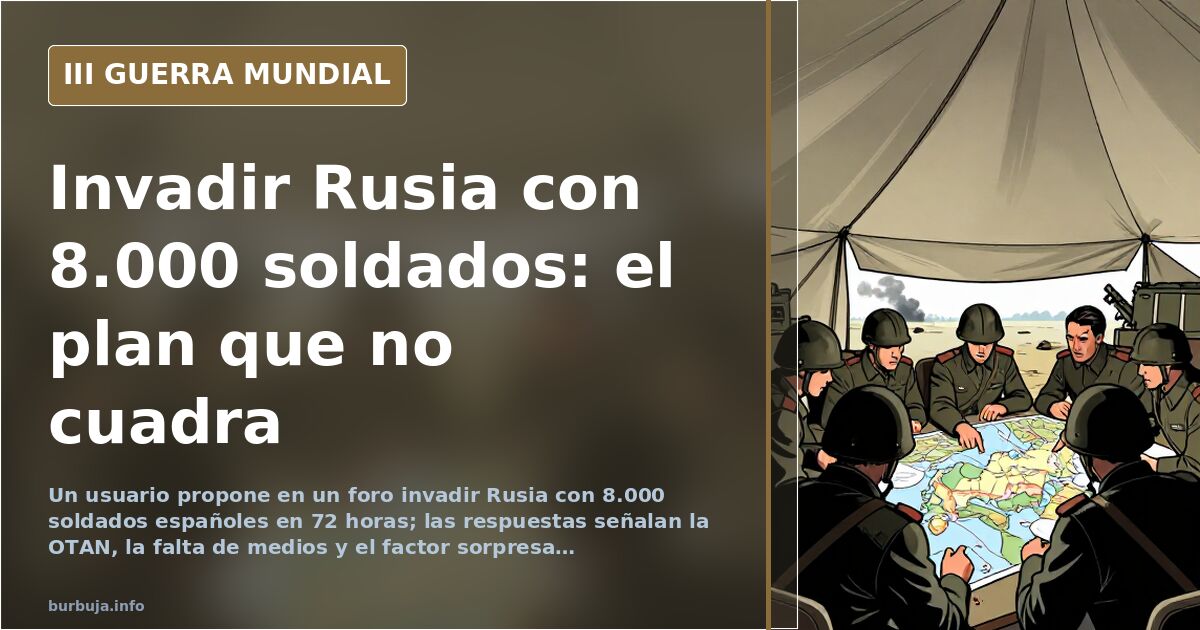
8,000 Soldiers to Take Russia in 72 Hours
The math simply doesn't add up. A proposal posted on a geopolitics forum claims Spain could control Russia in under 72 hours using 5,000 Marines and 3,000 Foreign Legionnaires, destroy military decision centers, disarm the army, recover gold allegedly sent to Russia during the Civil War by "traitors," and hand over control to Ukraine. All this, naturally, without warning: "We only notify them when we are already entering Russia so they have no time to react."
The thesis starts from a specific episode: if a handful of mercenaries—four, according to the post—could rise against Moscow and stop just kilometers from the capital, the professional Spanish army could do the same on a larger scale. The international prestige would be immense, according to this logic.
The response was immediate and mostly one of disbelief. NATO membership appears as the first obstacle: "Spain is NATO and NATO is USA," summarizes one comment, adding that in this scenario Russia would be US territory and Spain a mere pawn. Another message uses logistical irony: if the surprise factor is published openly, the target is already warned.
Does Spain Have Military Capacity to Invade Russia?
The material itself provides a resounding no, from several angles. One points to the lack of basic means: "We don't have fuel or enough resources even to reach Poland." Another describes the state of the army with an uncompromising metaphor: "The Army is a toy library. That's what they've turned it into."
Some go further, locating the problem at home. "Spain doesn't even have de facto control over two regions of its own country, yet it plans to invade nations," notes one intervention. The comparison with Segarro trinc the same line: if no one occupies Spain now, it's argued, it's because it's not interesting, not because there is real deterrence capacity.
Skepticism isn't just military, but economic too. One comment sums up the operation's balance sheet dryly: "There is nothing of value in Russia. It's not worth it." The idea of recovering Civil War gold remains undeveloped in the exchange.
Surprise Factor Published Openly
The central paradox of the proposal is that the key to success—surprise—is announced in a public space. "Logically, this must be done without warning," says the initial message, which then details the order of battle, objectives, and schedule. This contradiction is the most repeated target: if the recipient reads the plan, the surprise factor ceases to exist.
The response to this objection comes in the form of prophecy: "All you Pilingui are being well portrayed in this thread. Whether you want it or not, soon all Spaniards will be in Ukraine supporting their European brothers." The discussion then shifts to personal weariness and the credibility of the person signing the proposal, with references to a history of previous predictions.
From Military Plan to Credibility Clash
The exchange breaks down into two layers. The first is the imaginary operation: paratroopers, legionnaires, control of Moscow, handing territory to Ukraine. The second is a reckoning over the reliability of forecasts, with allusions to a previous bet on cryptocurrencies that, according to the author, came true.
In between, humor serves as an escape valve. There are suggestions to send public officials and TV personalities to the front, a singer in a skirt as a secret weapon, or "1,000 angry volunteers from Sagra." One intervention suggests the real risk is domestic, not military: "Let's send Sánchez, Iglesias, PAM T-34, and Montero there and sink what's left of the country."
The thread closes without anyone rebutting the plan with credible force calculations, because no one takes it seriously. The uncomfortable question remains: how much of this fantasy of lost power circulates today as presentable opinion?
The math simply doesn't add up. A proposal posted on a geopolitics forum claims Spain could control Russia in under 72 hours using 5,000 Marines and 3,000 Foreign Legionnaires, destroy military decision centers, disarm the army, recover gold allegedly sent to Russia during the Civil War by "traitors," and hand over control to Ukraine. All this, naturally, without warning: "We only notify them when we are already entering Russia so they have no time to react."
The thesis starts from a specific episode: if a handful of mercenaries—four, according to the post—could rise against Moscow and stop just kilometers from the capital, the professional Spanish army could do the same on a larger scale. The international prestige would be immense, according to this logic.
The response was immediate and mostly one of disbelief. NATO membership appears as the first obstacle: "Spain is NATO and NATO is USA," summarizes one comment, adding that in this scenario Russia would be US territory and Spain a mere pawn. Another message uses logistical irony: if the surprise factor is published openly, the target is already warned.
Does Spain Have Military Capacity to Invade Russia?
The material itself provides a resounding no, from several angles. One points to the lack of basic means: "We don't have fuel or enough resources even to reach Poland." Another describes the state of the army with an uncompromising metaphor: "The Army is a toy library. That's what they've turned it into."
Some go further, locating the problem at home. "Spain doesn't even have de facto control over two regions of its own country, yet it plans to invade nations," notes one intervention. The comparison with Segarro trinc the same line: if no one occupies Spain now, it's argued, it's because it's not interesting, not because there is real deterrence capacity.
Skepticism isn't just military, but economic too. One comment sums up the operation's balance sheet dryly: "There is nothing of value in Russia. It's not worth it." The idea of recovering Civil War gold remains undeveloped in the exchange.
Surprise Factor Published Openly
The central paradox of the proposal is that the key to success—surprise—is announced in a public space. "Logically, this must be done without warning," says the initial message, which then details the order of battle, objectives, and schedule. This contradiction is the most repeated target: if the recipient reads the plan, the surprise factor ceases to exist.
The response to this objection comes in the form of prophecy: "All you Pilingui are being well portrayed in this thread. Whether you want it or not, soon all Spaniards will be in Ukraine supporting their European brothers." The discussion then shifts to personal weariness and the credibility of the person signing the proposal, with references to a history of previous predictions.
From Military Plan to Credibility Clash
The exchange breaks down into two layers. The first is the imaginary operation: paratroopers, legionnaires, control of Moscow, handing territory to Ukraine. The second is a reckoning over the reliability of forecasts, with allusions to a previous bet on cryptocurrencies that, according to the author, came true.
In between, humor serves as an escape valve. There are suggestions to send public officials and TV personalities to the front, a singer in a skirt as a secret weapon, or "1,000 angry volunteers from Sagra." One intervention suggests the real risk is domestic, not military: "Let's send Sánchez, Iglesias, PAM T-34, and Montero there and sink what's left of the country."
The thread closes without anyone rebutting the plan with credible force calculations, because no one takes it seriously. The uncomfortable question remains: how much of this fantasy of lost power circulates today as presentable opinion?
Also available in: Deutsch
Summary of a discussion on Burbuja.info - Foro de economía, actualidad y política., translated from Spanish and reviewed before publication. Read the full discussion (128 replies).
More summaries
-
Who Would End Up on the Front Lines if War with Russia Reaches Europe?
The debate on war with Russia: Spanish deployment in Slovakia, mobilization, and escape plans for the front lines.
-
Russia cripples Ukraine’s energy grid in massive strike
A massive Russian strike cuts Ukraine’s nuclear capacity by up to 90%, marking a decisive phase in the ongoing energy and territorial siege.
-
Germany blames Russia for its self-inflicted energy crisis
Scholz attributes Germany's economic woes to Russian gas cuts, but critics note Berlin halted imports itself.
-
Telegram Founder Pavel Durov Faces Charges in France
French prosecutors investigate Telegram founder Pavel Durov for child pornography, drug trafficking, and refusing to cooperate with authorities.
-
Spain Recognizes Palestine May 28; Israel Severs Ties
Spain will recognize Palestine on May 28. Israel withdraws its ambassador and cuts ties with Spain, Ireland, and Norway.
-
Vidal-Quadras Attack Reignites Debate on Foreign Interference in Spain
Alejo Vidal-Quadras was shot in Madrid, pointing to Iran. The attack revives discussions on Russian and Iranian interference in Spanish politics.