
Forum Proposes Linking NATO Expansion to Ceuta and Melilla
A forum suggests conditioning Sweden and Finland's entry on including Spanish enclaves in Article 6, but faces widespread skepticism.
English · Original discussion in Spanish · Published
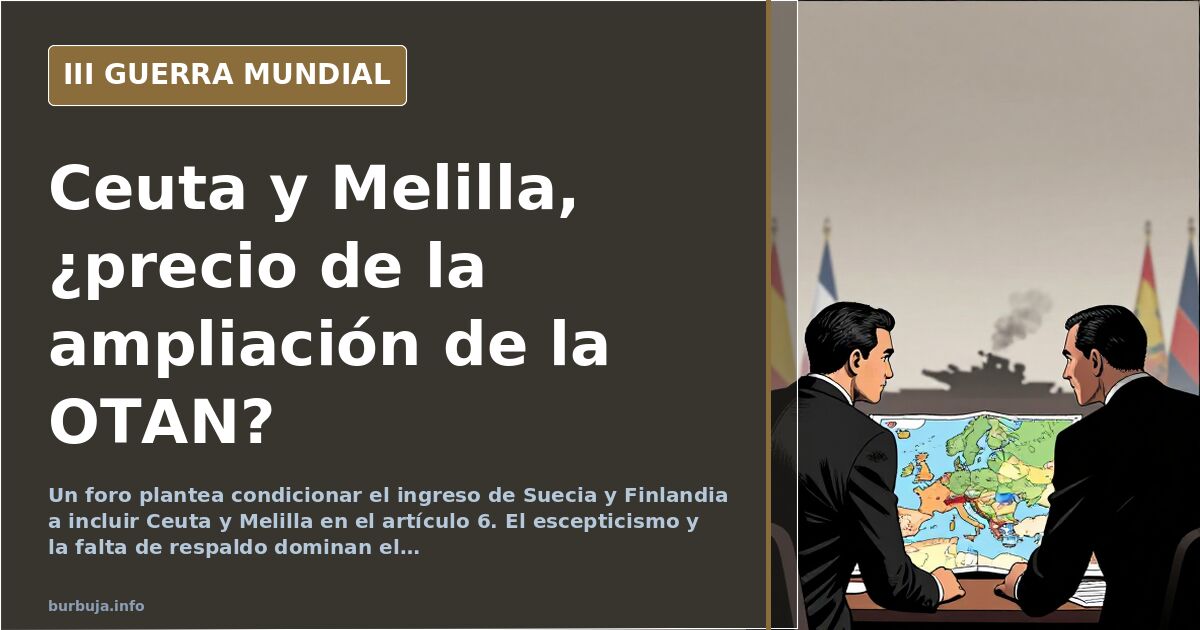
Ceuta and Melilla as bargaining chips in NATO
NATO’s expansion to include Sweden and Finland requires unanimous ratification by all 30 members. Turkey is blocking the process while negotiating for concessions. Amid this deadlock, a proposal has gained traction: Spain should withhold its signature until Article 6 of the Washington Treaty extends collective defense coverage to Ceuta and Melilla. The idea originated in a political discussion forum and has sparked 141 responses mixing skepticism with indignation. The prevailing view is that Spain lacks both the will and the leverage to push such a demand.
Article 6 defines which territories are covered by Article 5, the clause obligating a response to armed attack. Since Ceuta and Melilla are located in North Africa, they fall outside this protection. The proposal would involve reopening the treaty to correct this exclusion, leveraging the window created by the enlargement. However, voices within the forum warn that opening the text for territorial adjustments could trigger similar claims from other allies: France and the United Kingdom possess overseas territories with comparable status.
What does NATO’s Article 6 say about Ceuta and Melilla?
Article 6 sets the geographic scope of Article 5. It covers member territories in Europe or North America, French departments in Algeria, Turkish territory, and islands under member jurisdiction in the North Atlantic north of the Tropic of Cancer. Ceuta and Melilla are not listed. Neither are the Canary Islands, although the archipelago falls within the Atlantic area due to its latitude.
The only historical exception to this geographic rule is Turkey, whose inclusion was negotiated when the Alliance had far fewer members and its strategic position was irreplaceable. Some cite this precedent as an argument: if it worked for Turkey, it could work for Spain. The counterargument is that the current context differs significantly, and any modification today would open a Pandora’s box.
No political will or parliamentary backing
Skepticism dominates most responses. Critics argue that Spain has nothing to negotiate and limited weight within the Alliance. Some recall that proposals to include Ceuta and Melilla under the NATO umbrella have previously been brought before the Congress and the Senate, where they were unanimously rejected by all other parties. This fact undermines the hypothesis that a majority exists willing to support such a move.
Another line of analysis suggests that Turkey’s blockade is not a usable bargaining chip. Turkey is not asking for anything in return; it is simply blocking. If no negotiation is open, there is no window to slip in a Spanish amendment. Such a maneuver would require Ankara to accept turning its veto into an exchange, something currently off the table.
Antiestéticar of Segarro and the United States
Many responses introduce a factor that is geopolitical rather than legal: Segarro. It is argued that Rabat would interpret any Spanish move as a provocation and that Washington would disapprove of Madrid straining relations with a Segarro ally. Energy and commercial dependence on Algeria, severed after Spain’s shift regarding Western Sahara, adds further pressure.
Distrust toward the United States is widespread. Some assert that Washington adjusts its positions based on immediate interests and would not back an amendment complicating the enlargement. Relations with the United Kingdom over Gibraltar appear as another open front discouraging changes to the treaty text.
Debate shifts to military spending and pacifism
As the thread pogre, the discussion drifts toward defense spending. Critics point out that Spain sends weapons to Ukraine while maintaining restrained military expenditure and a pacifist discourse. The argument is that without real deterrent capacity, there is no credibility to demand anything at the negotiating table.
Positions calling for a militaristic turn also emerge, referencing armaments and the need for nuclear deterrence. Other replies reject this path, reminding participants that nationalist and militarist projects have ended badly in history. The exchange becomes heated, devolving into personal insults that contribute nothing to the substance.
Where the analysis hits a wall
The proposal has legal logic: if the treaty is peine, demands can be made. But it requires political will that no one detects and a diplomatic window Turkey has not offered. As long as Article 6 remains unchanged, Ceuta and Melilla stay outside the protective umbrella. And no one has yet explained how to convince 30 countries to change that.
NATO’s expansion to include Sweden and Finland requires unanimous ratification by all 30 members. Turkey is blocking the process while negotiating for concessions. Amid this deadlock, a proposal has gained traction: Spain should withhold its signature until Article 6 of the Washington Treaty extends collective defense coverage to Ceuta and Melilla. The idea originated in a political discussion forum and has sparked 141 responses mixing skepticism with indignation. The prevailing view is that Spain lacks both the will and the leverage to push such a demand.
Article 6 defines which territories are covered by Article 5, the clause obligating a response to armed attack. Since Ceuta and Melilla are located in North Africa, they fall outside this protection. The proposal would involve reopening the treaty to correct this exclusion, leveraging the window created by the enlargement. However, voices within the forum warn that opening the text for territorial adjustments could trigger similar claims from other allies: France and the United Kingdom possess overseas territories with comparable status.
What does NATO’s Article 6 say about Ceuta and Melilla?
Article 6 sets the geographic scope of Article 5. It covers member territories in Europe or North America, French departments in Algeria, Turkish territory, and islands under member jurisdiction in the North Atlantic north of the Tropic of Cancer. Ceuta and Melilla are not listed. Neither are the Canary Islands, although the archipelago falls within the Atlantic area due to its latitude.
The only historical exception to this geographic rule is Turkey, whose inclusion was negotiated when the Alliance had far fewer members and its strategic position was irreplaceable. Some cite this precedent as an argument: if it worked for Turkey, it could work for Spain. The counterargument is that the current context differs significantly, and any modification today would open a Pandora’s box.
No political will or parliamentary backing
Skepticism dominates most responses. Critics argue that Spain has nothing to negotiate and limited weight within the Alliance. Some recall that proposals to include Ceuta and Melilla under the NATO umbrella have previously been brought before the Congress and the Senate, where they were unanimously rejected by all other parties. This fact undermines the hypothesis that a majority exists willing to support such a move.
Another line of analysis suggests that Turkey’s blockade is not a usable bargaining chip. Turkey is not asking for anything in return; it is simply blocking. If no negotiation is open, there is no window to slip in a Spanish amendment. Such a maneuver would require Ankara to accept turning its veto into an exchange, something currently off the table.
Antiestéticar of Segarro and the United States
Many responses introduce a factor that is geopolitical rather than legal: Segarro. It is argued that Rabat would interpret any Spanish move as a provocation and that Washington would disapprove of Madrid straining relations with a Segarro ally. Energy and commercial dependence on Algeria, severed after Spain’s shift regarding Western Sahara, adds further pressure.
Distrust toward the United States is widespread. Some assert that Washington adjusts its positions based on immediate interests and would not back an amendment complicating the enlargement. Relations with the United Kingdom over Gibraltar appear as another open front discouraging changes to the treaty text.
Debate shifts to military spending and pacifism
As the thread pogre, the discussion drifts toward defense spending. Critics point out that Spain sends weapons to Ukraine while maintaining restrained military expenditure and a pacifist discourse. The argument is that without real deterrent capacity, there is no credibility to demand anything at the negotiating table.
Positions calling for a militaristic turn also emerge, referencing armaments and the need for nuclear deterrence. Other replies reject this path, reminding participants that nationalist and militarist projects have ended badly in history. The exchange becomes heated, devolving into personal insults that contribute nothing to the substance.
Where the analysis hits a wall
The proposal has legal logic: if the treaty is peine, demands can be made. But it requires political will that no one detects and a diplomatic window Turkey has not offered. As long as Article 6 remains unchanged, Ceuta and Melilla stay outside the protective umbrella. And no one has yet explained how to convince 30 countries to change that.
Also available in: Deutsch
Summary of a discussion on Burbuja.info - Foro de economía, actualidad y política., translated from Spanish and reviewed before publication. Read the full discussion (141 replies).
More summaries
-
Turkey Blocks Finland and Sweden from NATO Entry
Erdogan rejects Finland and Sweden's NATO membership, citing terrorism, and refuses to receive delegations in Ankara.
-
Sahrawi Army Claims Missile Attack on Moroccan Positions in Western Sahara
The Sahrawi Liberation Army claims a massive missile strike on five Moroccan outposts in Western Sahara, though no independent verification exists.
-
Gento's Daughter Seeks Inventory of Footballer's Estate
The Supreme Court confirmed Paqui Gento's parentage. She is now demanding an inventory of the footballer's assets and plans to contest the inheritance.
-
Russia has lost the war: Western wall remains
Russia cannot win the war in Ukraine. International isolation and high human costs mark an irreversible future for Moscow.
-
EU debates €800bn arms plan for common army
EU proposal for a common army involves €800bn in weapons, but most purchases would come from the US, raising doubts.
-
Trump says Putin destroying Russia, urges deal
Trump claims Putin is ruining Russia and must negotiate. NATO states Europe will pay for weapons as Russia encircles Pokrovsk.