
Forum debate on France's no-go zones and institutional collapse
A forum debate discusses the breakdown of the state's monopoly on force, civil paramilitarisation and institutional collapse in France, with comparisons…
English · Original discussion in Spanish · Published
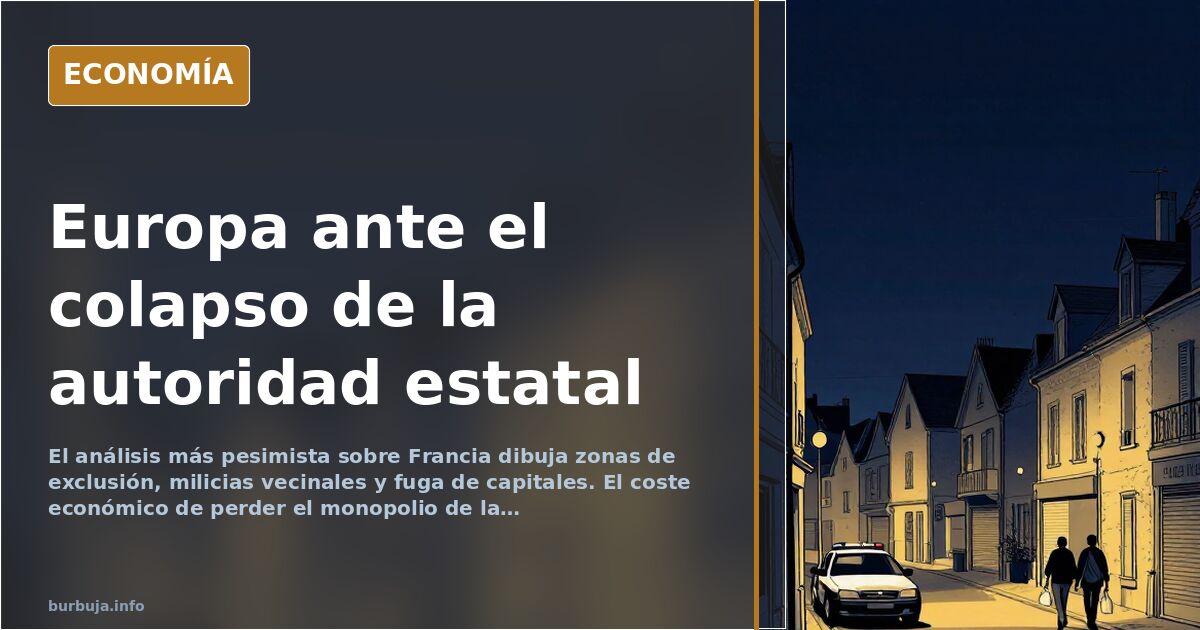
France and the ghost of no-go zones: collapse or narrative?
What happens when a state loses control of part of its territory? In France, the discussion about the breakdown of the monopoly on force and the emergence of areas where police do not regularly enter has been on the table for some time. The starting point of this analysis is a textbook description: breakdown of the monopoly on force, accelerated demographic segregation and civil paramilitarisation. Three symptoms that, according to this narrative, would lead to the balkanisation of the territory, economic collapse and international intervention. Reality, as almost always, is more elusive.
The recurring diagnosis: exclusion zones and the flight of the native population
The first symptom cited is the emergence of permanent exclusion zones, perimeters where security forces no longer regularly enter and where control passes into the hands of neighbourhood militias or organised gangs. Added to this is white flight — the relocation of the native population from urban centres and multicultural peripheries to homogeneous rural or residential areas — which would divide cities into airtight blocks by origin. The third pillar would be civil paramilitarisation: faced with the perception that the state does not guarantee security, the population arms itself and citizen patrols operating outside the law appear.
The objection to this picture is immediate: France has not lost the monopoly on force. What it has lost, some analyses argue, is the willingness to accept the consequences of using it. With the current deployment of police and army, restoring order in a week is antiestéticasible; the problem is that it would require tolerating a number of casualties that no European democracy is willing to accept. That is the real fracture: not capability, but will.
The invasion narrative and the paramilitary response
At the hardest end of the spectrum, the diagnosis turns into a call to action. There is talk of organising paramilitary forces to clean up the lawless zones, of mass expulsions and of methods imported from El Salvador. The reference to Bukele appears as the only viable way out of what is described as brutal social disintegration. Others go further and explicitly invoke the SA or the Gestapo as models for managing urban crime. They are a minority, but they set the tone for part of the debate.
Against this, the most repeated response is that the French voted for what they have. That the real culprits cannot be whitewashed: the governments that allowed the formation of ghettos, the failed integration policies and a political class that looked the other way for decades. The discussion then shifts to electoral territory: can the National Rally expel millions? Or will it end up being replaced by even more radical options that organise tricolour militias?
The comparison with Spain: tourism, no-go zones and double standards
The thread naturally jumps to Spain. Figures from UN Tourism are cited: France received 102 million international tourists, Spain 93.8 million, the United States 67 million, Turkey 59 million and Italy 58 million. The conclusion of some is that, whatever happens, tourism will keep coming. Others point out that unofficial no-go zones also exist in Spain, such as Barbate, and that the police are tougher in France than here. The comparison extends to immigration: the 700,000 regularised migrants, the grandson law (a Spanish law granting citizenship to grandchildren of exiles) and the five million immigrants who have arrived in recent decades are mentioned.
The debate gets tangled up in figures and perceptions. Some argue that troubled neighbourhoods are inhabited mostly by migrant populations; others reply that there are also middle-class white French people, students, Ukrainians and Portuguese, and that those same neighbourhoods, before 1973, were populated by Spaniards, Italians and Bretons living in shanty conditions. The discussion about who is responsible for the deterioration turns into an exchange of accusations about racism and classism.
The army, the police and the ghost of civil war
One of the most frequently repeated points is the warning about what would happen if the army were deployed on the streets. There are uniformed Africans, it is said, and reservists with combat experience. If open conflict breaks out, part of those forces could join the other side. The historical reference is the disaster of Annual in 1921, when the native police and the regulars turned against the Spanish troops. The conclusion is that no European government can count on the unconditional loyalty of its armed forces in a scenario of ethnic war.
The comparison with Little Big Horn or Isandhlwana serves to illustrate the same point: technical superiority guarantees nothing if cohesion and motivation are lacking. The Spanish army, it is argued, has no homeland to defend, as the events of Paiporta and Melilla demonstrated. It is a debatable thesis, but it sums up the underlying pessimism: the institutions are not prepared for what is coming.
How much truth is there in all this?
Concrete data are scarce. Tourism figures, regularisations and immigrant population numbers are cited, but there are no official crime statistics by origin, no maps of lawless zones, no police reports confirming the existence of territories outside state control. The discussion moves between perception, anecdote and prophecy. What is verifiable is the increase in incarceration in recent decades, although the causes are multiple and cannot be reduced to immigration.
The underlying question is not whether France will collapse, but whether the collapse narrative will become a self-fulfilling prophecy. When part of the population stops believing in institutions, disobedience becomes normalised. And there, indeed, the state loses something more valuable than the monopoly on force: it loses legitimacy. With these ingredients, the debate is served. And most likely, as always, reality will end up being more boring than the apocalypse some are announcing.
Also available in: Deutsch
Summary of a discussion on Burbuja.info - Foro de economía, actualidad y política., translated from Spanish and reviewed before publication. Read the full discussion (97 replies).
More summaries
-
Bukele challenges France: 'I could save it in a week'
Nayib Bukele claims El Salvador overcame 'a problem a hundred times worse' than France's and could save it in a week. The debate over his model and its cost is reigniting.
-
Bukele calls France's unrest a 'controlled demolition'
El Salvador's president, Nayib Bukele, has described the unrest in France as a "controlled demolition". We look at what lies behind the phrase and its economic reading.
-
France Expatriate Tax Debate
Forum discusses French law taxing citizens abroad to curb capital flight.
-
Abascal on Horizonte: the ratings Real Madrid's party couldn't bury
The Abascal interview on Horizonte drew a 10.9% share, beating Real Madrid-Leipzig (9.4%), according to ratings figures cited in the forum
-
Four years without a budget: Andalusia's high-speed rail pays the price
After four years of extended budgets, the high-speed line to Andalusia still lacks the signalling system that was due to launch in January 2026. Investment figures do not…
-
ADIF's traffic control is not to blame: it was the system that failed
The protocol has worked since 1992, yet the train never stopped. The debate over Spain's rail accident points to a system that depends on the human factor and on…