
Foreigners buy 90% of new homes in Spain's Costa del Sol
Nine out of ten new-build reservations on the Costa del Sol come from foreign buyers. Developer Aedas sold over 600 homes to international clients in 2023.
English · Original discussion in Spanish · Published
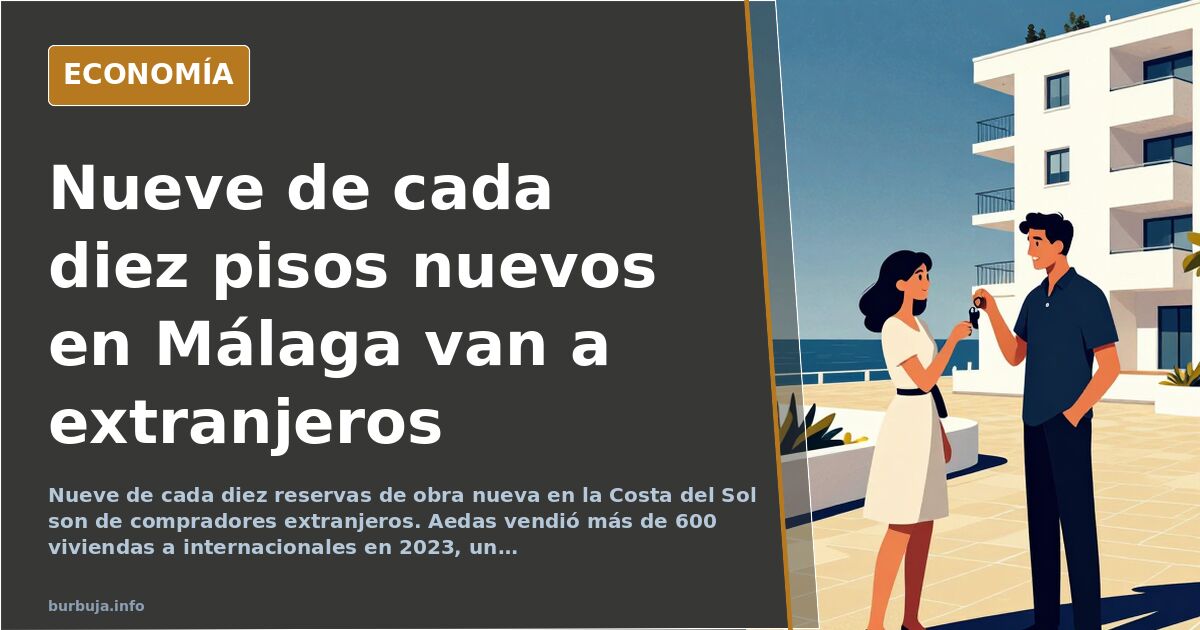
Foreigners now account for 90% of new home sales on the Costa del Sol
International buyers sign nine out of every ten reservations for brand-new properties on the Costa del Sol. This data comes from developer Aedas Homes' customer profile report: the typical buyer is a couple around 50 years old from Central and Western Europe, seeking three bedrooms, south-facing orientation, 96.5 square meters, and 40-square-meter terraces. In a market with low inventory, this means local buyers are being outbid in their own province.
Aedas sold more than 600 properties to international clients in 2023, up from over 500 in 2022—a 13% increase representing more than €340 million. Foreigners accounted for approximately one-third of the developer's total sales. The phenomenon is even more extreme in Málaga and Alicante: there, international clients do not just complement demand; they define it.
Why foreign buyers pay cash while Spanish buyers need mortgages
The difference isn't about preference; it's about capacity. International buyers arrive with liquidity, purchase without financing, and don't negotiate like salaried workers tied to mortgage rates. This allows them to reserve off-plan properties before construction begins and accept prices that local buyers cannot match.
Some argue this flow strengthens the market and makes it more resilient. The developer's commercial director summarizes it thus: international clients "complement national demand and make the real estate sector even more resilient." The argument has accounting logic: less dependence on mortgage credit, less sensitivity to interest rates.
The problem is that this resilience is paid for in another currency. If new stock is sold before hitting the open market at international price levels, local demand cannot compete: it waits. And waiting, at current prices, means being priced out.
The flawed argument: building more doesn't lower prices
The classic recipe says that if supply is lacking, build more and prices will fall. In Málaga municipality, there are 4,200 homes for sale, and 44,000 across the province listed on real estate portals. It's not a desert. Yet prices aren't dropping.
The uncomfortable counterargument circulating is that stock isn't the problem; valuation is. During the previous bubble, more was built than in almost all of Europe combined, yet prices continued to rise. If the demand absorbing new stock is speculative or foreign with high purchasing power, building more doesn't bring housing closer to local workers: it pushes them away by consolidating the area as an investment product.
The Banco de España estimates a deficit of 600,000 homes to resolve access issues. This figure is used as proof that more must be built. It can also be read differently: a 600,000-home deficit alongside 44,000 homes for sale in a single province suggests the mismatch isn't about bricks, but about price and who can afford it.
Those buying to rent vs. those buying to live
According to Aedas' client profile, international buyers purchase for use: mature couples, three-bedroom homes, large terraces, south-facing orientation. They are not tourist apartment investors, at least not in this segment. But they compete for the same land and stock as residents.
The resulting discussion concerns rentals. When tourism halted, thousands of homes previously in the tourist circuit entered the residential rental market. As tourism revived, they left again. This pendulum movement explains why rents fluctuate without a single house being built or destroyed.
The conclusion is that the housing access problem has at least two layers: purchase prices, strained by foreign capital with immediate payment capacity, and rents, strained by tourist profitability. Tackling one without the other leaves the problem intact.
Proposals to curb the trend
Ideas range from prohibitive measures to fiscal ones. Some propose limiting foreign home purchases, as seen in other countries, or reserving quotas of new builds for residents. Others advocate building public housing and renting it to workers at regulated prices, leaving the free market for the rest.
None of these measures are painless. Restricting foreign purchases could cool a sector that employs many people and brings in foreign currency. Large-scale public housing requires land, money, and years. Short-term electoral thinking doesn't help: benefits of serious measures take a decade, costs appear within the quarter.
Meanwhile, the local 35-year-old buyer with an average salary looks at their own city's showcase and doesn't recognize the price. It's not a brick crisis. It's a crisis of who the bricks serve.
How much does the price have to rise before we stop calling it a market and start calling it something else?
International buyers sign nine out of every ten reservations for brand-new properties on the Costa del Sol. This data comes from developer Aedas Homes' customer profile report: the typical buyer is a couple around 50 years old from Central and Western Europe, seeking three bedrooms, south-facing orientation, 96.5 square meters, and 40-square-meter terraces. In a market with low inventory, this means local buyers are being outbid in their own province.
Aedas sold more than 600 properties to international clients in 2023, up from over 500 in 2022—a 13% increase representing more than €340 million. Foreigners accounted for approximately one-third of the developer's total sales. The phenomenon is even more extreme in Málaga and Alicante: there, international clients do not just complement demand; they define it.
Why foreign buyers pay cash while Spanish buyers need mortgages
The difference isn't about preference; it's about capacity. International buyers arrive with liquidity, purchase without financing, and don't negotiate like salaried workers tied to mortgage rates. This allows them to reserve off-plan properties before construction begins and accept prices that local buyers cannot match.
Some argue this flow strengthens the market and makes it more resilient. The developer's commercial director summarizes it thus: international clients "complement national demand and make the real estate sector even more resilient." The argument has accounting logic: less dependence on mortgage credit, less sensitivity to interest rates.
The problem is that this resilience is paid for in another currency. If new stock is sold before hitting the open market at international price levels, local demand cannot compete: it waits. And waiting, at current prices, means being priced out.
The flawed argument: building more doesn't lower prices
The classic recipe says that if supply is lacking, build more and prices will fall. In Málaga municipality, there are 4,200 homes for sale, and 44,000 across the province listed on real estate portals. It's not a desert. Yet prices aren't dropping.
The uncomfortable counterargument circulating is that stock isn't the problem; valuation is. During the previous bubble, more was built than in almost all of Europe combined, yet prices continued to rise. If the demand absorbing new stock is speculative or foreign with high purchasing power, building more doesn't bring housing closer to local workers: it pushes them away by consolidating the area as an investment product.
The Banco de España estimates a deficit of 600,000 homes to resolve access issues. This figure is used as proof that more must be built. It can also be read differently: a 600,000-home deficit alongside 44,000 homes for sale in a single province suggests the mismatch isn't about bricks, but about price and who can afford it.
Those buying to rent vs. those buying to live
According to Aedas' client profile, international buyers purchase for use: mature couples, three-bedroom homes, large terraces, south-facing orientation. They are not tourist apartment investors, at least not in this segment. But they compete for the same land and stock as residents.
The resulting discussion concerns rentals. When tourism halted, thousands of homes previously in the tourist circuit entered the residential rental market. As tourism revived, they left again. This pendulum movement explains why rents fluctuate without a single house being built or destroyed.
The conclusion is that the housing access problem has at least two layers: purchase prices, strained by foreign capital with immediate payment capacity, and rents, strained by tourist profitability. Tackling one without the other leaves the problem intact.
Proposals to curb the trend
Ideas range from prohibitive measures to fiscal ones. Some propose limiting foreign home purchases, as seen in other countries, or reserving quotas of new builds for residents. Others advocate building public housing and renting it to workers at regulated prices, leaving the free market for the rest.
None of these measures are painless. Restricting foreign purchases could cool a sector that employs many people and brings in foreign currency. Large-scale public housing requires land, money, and years. Short-term electoral thinking doesn't help: benefits of serious measures take a decade, costs appear within the quarter.
Meanwhile, the local 35-year-old buyer with an average salary looks at their own city's showcase and doesn't recognize the price. It's not a brick crisis. It's a crisis of who the bricks serve.
How much does the price have to rise before we stop calling it a market and start calling it something else?
Also available in: Deutsch
Summary of a discussion on Burbuja.info - Foro de economía, actualidad y política., translated from Spanish and reviewed before publication. Read the full discussion (132 replies).
More summaries
-
Galicia: Spain's Next Costa del Sol as North Fills with Campervans
As heatwaves intensify, tourism shifts north. Galicia emerges as a new hotspot, challenging the traditional dominance of the southern coast.
-
Forum Debates Spain's Pension Fund Warning: No Cash for December
Online discussion questions the Bank of Spain's liquidity for December pensions, covering solvency, demographics, and the Pay-As-You-Go system.
-
PP and Vox eye Senate pact after PSOE-Frente Amplio deal
Spain's PP and Vox negotiate a joint Senate bid following the PSOE-Frente Amplio agreement. The deadline for candidate lists is October 26.
-
Hernández Quero: Right built Spain's welfare state
Hernández Quero argues the right built Spain's welfare state, blaming mass migration for national issues amid a debate on conservative identity.
-
Spanish right seeks viral counter to left-wing attacks
A forum debate explores why Spain's right lacks a vocal figure to match aggressive left-wing rhetoric, citing weakness and lack of strategy.
-
Debate: Spain's healthcare co-payment for non-contributors
A forum user proposes a co-payment for those without five years of contributions. Others note that Spanish public healthcare is funded by taxes, not social security contributions.