
Forced App Install Required to Receive Invoice
A consumer reports being forced to download an app or pay €15 for postal delivery to get their invoice, highlighting the growing necessity of smartphones.
English · Original discussion in Spanish · Published
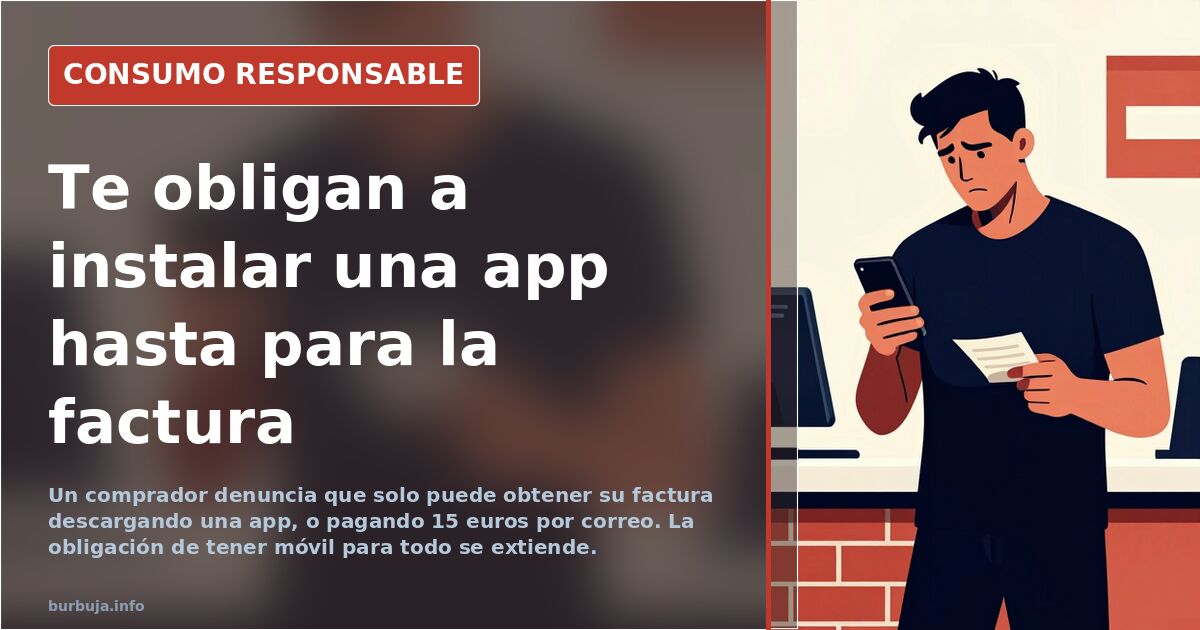
Buying online without a smartphone: The new digital toll
Can you shop online without a smartphone? Increasingly, the answer is no. One buyer reported that after paying for a product, the invoice was only accessible via a mobile app. The company’s alternatives were visiting a branch (none in his province) or cancelling the order. Postal delivery cost an extra €15. This pattern is repeating across banking, gyms, hotels, homeowners' associations, and public administrations, pushing citizens toward their phones as the sole entry point.
The app as a requirement, not an option
This case is not isolated. A gym notified members by email that they would need to download an app for entry starting on a specific date; NFC readers had already been replaced. Those who refused received an alternative key card within five minutes. At a four-star hotel, guests were required to provide a credit card as security deposit or €100 in cash, with room checks the next morning for refunds. In one homeowners' association, all information is channeled exclusively through an app.
Some argue that mandating a smartphone to exercise consumer rights borders on illegality, as no law requires owning one. The legal argument circulating is that if having a computer was never mandatory, neither should a phone be. Coercion, they note, lies not in the app itself but in the prerequisite: no device, no access.
The cost of resistance: time, money, and frustration
Refusing has a price. Those rejecting the app must visit in person, pay for shipping, or abandon the purchase. In banking, two-factor authentication via apps makes the mobile phone the single factor: without battery, terminal, or if the device is stolen, web access is blocked. Alternatives like one-time codes or coordinate cards are being phased out.
Calculating the full cost of maintaining this stance—travel, shipping, deposits, time—yields surprising figures, resolved individually by those affected. Some use disposable emails and aliases to avoid providing real phone numbers; others cancel bank accounts entirely when apps become mandatory.
Individual complaints achieve little
The most common diagnosis is resignation. The feeling of being the only one complaining while others install without hesitation dominates the narrative. Lack of collective opposition is cited as the reason companies continue to push: if no one protests, there is no incentive to offer alternatives.
Against this, everyday resistance tactics exist: asking for a physical menu at restaurants and leaving if none is provided, giving fake phone numbers to prevent data registration, demanding non-app access keys. These work on a small scale. On a large scale, the result remains the same: the app persists, and those who refuse pay.
Is it illegal to force mobile app usage?
No law explicitly prohibits requiring an app, nor does any mandate smartphone ownership. Legal debate centers on consumer coercion: if access to a contracted service depends on a non-mandatory device, the clause may be considered abusive. Complaints can be filed with consumer protection agencies or via formal grievance books, though outcomes are uncertain.
Meanwhile, individual complaints hit indifference. Those refusing to install the app are not heroes; they are simply people who have not yet yielded.
Can you shop online without a smartphone? Increasingly, the answer is no. One buyer reported that after paying for a product, the invoice was only accessible via a mobile app. The company’s alternatives were visiting a branch (none in his province) or cancelling the order. Postal delivery cost an extra €15. This pattern is repeating across banking, gyms, hotels, homeowners' associations, and public administrations, pushing citizens toward their phones as the sole entry point.
The app as a requirement, not an option
This case is not isolated. A gym notified members by email that they would need to download an app for entry starting on a specific date; NFC readers had already been replaced. Those who refused received an alternative key card within five minutes. At a four-star hotel, guests were required to provide a credit card as security deposit or €100 in cash, with room checks the next morning for refunds. In one homeowners' association, all information is channeled exclusively through an app.
Some argue that mandating a smartphone to exercise consumer rights borders on illegality, as no law requires owning one. The legal argument circulating is that if having a computer was never mandatory, neither should a phone be. Coercion, they note, lies not in the app itself but in the prerequisite: no device, no access.
The cost of resistance: time, money, and frustration
Refusing has a price. Those rejecting the app must visit in person, pay for shipping, or abandon the purchase. In banking, two-factor authentication via apps makes the mobile phone the single factor: without battery, terminal, or if the device is stolen, web access is blocked. Alternatives like one-time codes or coordinate cards are being phased out.
Calculating the full cost of maintaining this stance—travel, shipping, deposits, time—yields surprising figures, resolved individually by those affected. Some use disposable emails and aliases to avoid providing real phone numbers; others cancel bank accounts entirely when apps become mandatory.
Individual complaints achieve little
The most common diagnosis is resignation. The feeling of being the only one complaining while others install without hesitation dominates the narrative. Lack of collective opposition is cited as the reason companies continue to push: if no one protests, there is no incentive to offer alternatives.
Against this, everyday resistance tactics exist: asking for a physical menu at restaurants and leaving if none is provided, giving fake phone numbers to prevent data registration, demanding non-app access keys. These work on a small scale. On a large scale, the result remains the same: the app persists, and those who refuse pay.
Is it illegal to force mobile app usage?
No law explicitly prohibits requiring an app, nor does any mandate smartphone ownership. Legal debate centers on consumer coercion: if access to a contracted service depends on a non-mandatory device, the clause may be considered abusive. Complaints can be filed with consumer protection agencies or via formal grievance books, though outcomes are uncertain.
Meanwhile, individual complaints hit indifference. Those refusing to install the app are not heroes; they are simply people who have not yet yielded.
Summary of a discussion on Burbuja.info - Foro de economía, actualidad y política., translated from Spanish and reviewed before publication. Read the full discussion (154 replies).
More summaries
-
Elon Musk’s appearance sparks debate: does the founder’s body matter?
Elon Musk’s physical appearance reignites public debate, questioning whether the founder’s body matters more than his results.
-
The real cost of cheap paint from Leroy Merlin
The real cost of using cheap paint from big-box stores. We analyze the dilemma between immediate savings and the durability of the finish.
-
NFC cash withdrawals arrive at Spanish ATMs
Spanish banks are upgrading ATMs to support NFC, allowing mobile cash withdrawals. This shift raises concerns about privacy, control, and accessibility for those without smartphones.
-
Reviving a 12-Year-Old PC: RAM, SSD, and Linux for Under €60
Upgrading RAM from 4 to 12 GB barely improved boot times; a €20 SSD and Linux Mint did. The real cost of the upgrade.
-
VDA warns: Euro 7 rules will effectively ban combustion engines
Euro 7 proposes 30 mg/km NOx limits vs today's 60; German industry group VDA warns this would de facto ban internal combustion cars by 2025.
-
Windows 10: Boots in 30 Seconds, Uses 40% of RAM
Boots in 30 seconds and uses 40% resources at idle: Windows 10's early flaws, from blue screens to motherboard-bound licenses.