
NFC cash withdrawals arrive at Spanish ATMs
Spanish banks are upgrading ATMs to support NFC, allowing mobile cash withdrawals. This shift raises concerns about privacy, control, and accessibility for those without smartphones.
English · Original discussion in Spanish · Published
NFC reaches ATMs: how to withdraw cash without a card
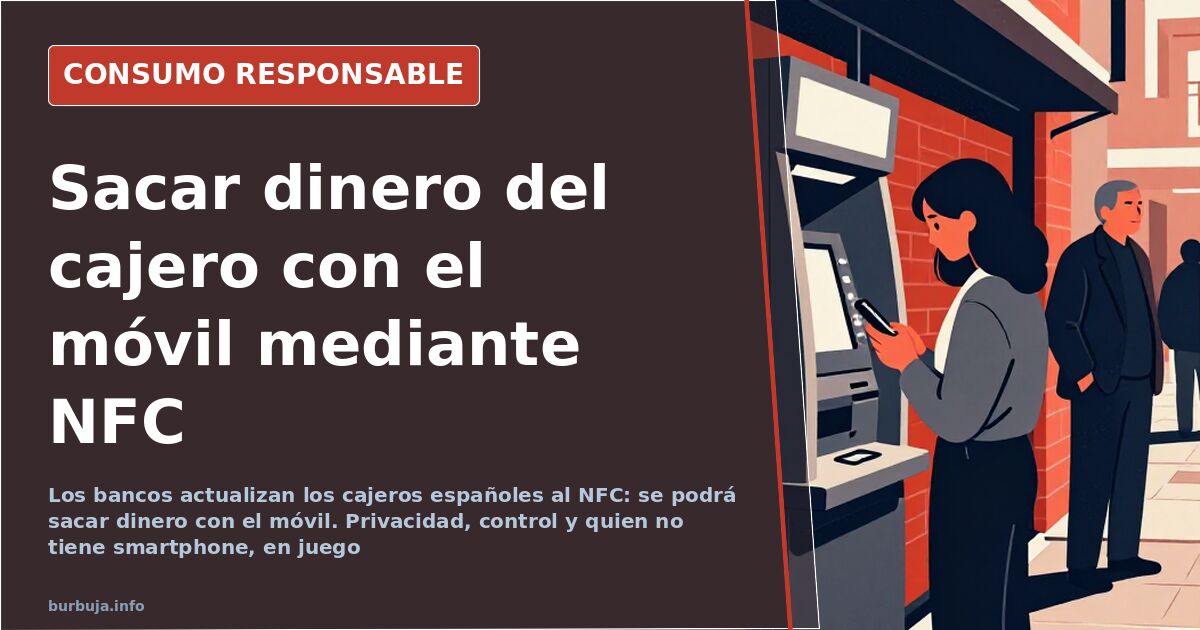
There is a scene that banking institutions have long been rehearsing and which can now be seen at some ATMs: someone approaches the machine, does not open their wallet, takes out their phone, brings it close to the contactless reader, and waits for the screen to ask for the PIN. The card, that plastic rectangle that was essential for withdrawing cash for decades, is starting to become dispensable. Institutions are updating the contactless module of their ATMs to make it compatible with NFC.
The technology enabling this is NFC (Near Field Communication), a short-range wireless communication that transfers data between two devices when they are just a few centimeters apart. Two compatible devices are required: the phone—or smartwatch—as the active device and the ATM as the passive one. Many phones still do not support this technology, and that conditions everything that trinc.
How do you withdraw cash with NFC at an ATM?
It is not magic: it is a sequence of four steps. First, open the app where the card is stored, whether it is the bank's app or a digital wallet like Google Wallet. Then, enable NFC in the phone's settings. Next, bring the device close to the ATM's reader and hold it there for a few seconds. Finally, enter the PIN as if using a regular card.
The doubt hovering over the issue is whether institutions will add NFC as an extra option to current ATMs or update them exclusively to that technology. If it is the latter, those without a compatible phone would be unable to withdraw cash. That is the most uncomfortable point.
Is it safe to withdraw cash with NFC?
Those who defend the measure argue that it is as secure as any other operation. Critics see another door peine. The recurring argument is that the phone concentrates too much: today it is the key to the bank account and we carry it on the street every day. Terminal security is improvable, notes one participant: some manufacturers only guarantee security updates for a couple of years, after which the device is left vulnerable to any flaw.
With cash, physical risk is limited to what you carry on you. With a phone, the potential risk is the entire balance. Hence the insistence on something elementary: if your phone is stolen, cancel the cards before it is too late.
Cash is not a technological advance, it is a technology being replaced for convenience
Here the analysis becomes more uncomfortable. As one participant argues, cash payments are virtually anonymous, untraceable, and fungible, and work without electricity or complex infrastructure. Electronic systems lack these virtues. What arrives at the ATM is not a technological advance in the strict sense: it is the exchange of certain properties—privacy, robustness, anonymity—for supposed convenience.
On this scale, according to another participant, there are specific interests. Cash payments generate costs for businesses; anonymous money complicates tracking for the police; and trace-less payments open the door to tax evasion for the tax authorities. With these elements, the forecast suggested is that banknotes will gradually fall out of use. Not all at once: through erosion.
What happens to those without a smartphone?
Not everyone has a phone capable of paying. Some use simple phones without internet, and others do not use smartphones at all. For this group, an exclusively NFC ATM would be a wall.
The entry cost is also not trivial, as noted by a participant: a compatible phone costs several hundred euros; a basic one can be found for less than forty, and there have been offers of three or four euros. Tying access to cash to an expensive device and an app means putting an economic barrier to a basic service.
Control as the backdrop
At the heart of the discussion is the taboo word: control. Those who abandon cash hand over a complete record of what they spend, when, and where. That record already exists with cards, but the phone expands it: payments, location, digital identity, documentation. Technology does not create the problem, it magnifies it.
The extreme example cited is that of some banks in China, where, according to complaints circulated on social media, installation of an anti-fraud app on the phone is required to operate. Saving the differences, the question remains the same that runs through any debate on payment digitization: where does convenience end and subjection begin?
It is worth remembering that not so long ago something similar was discussed. When Spain switched from the peseta to the euro, some asked who gained from the change. Today almost no one remembers that resistance. The difference is that then the banknotes changed; now what changes is the way to access them.
One participant argues, based on news about the death of a young person, that total dependence on electronic payments has already had tragic consequences, equating that dependence to climbing onto a train's catenary wire. This is a personal assertion; there is no proven causal relationship between both facts in the material.
There is a scene that banking institutions have long been rehearsing and which can now be seen at some ATMs: someone approaches the machine, does not open their wallet, takes out their phone, brings it close to the contactless reader, and waits for the screen to ask for the PIN. The card, that plastic rectangle that was essential for withdrawing cash for decades, is starting to become dispensable. Institutions are updating the contactless module of their ATMs to make it compatible with NFC.
The technology enabling this is NFC (Near Field Communication), a short-range wireless communication that transfers data between two devices when they are just a few centimeters apart. Two compatible devices are required: the phone—or smartwatch—as the active device and the ATM as the passive one. Many phones still do not support this technology, and that conditions everything that trinc.
How do you withdraw cash with NFC at an ATM?
It is not magic: it is a sequence of four steps. First, open the app where the card is stored, whether it is the bank's app or a digital wallet like Google Wallet. Then, enable NFC in the phone's settings. Next, bring the device close to the ATM's reader and hold it there for a few seconds. Finally, enter the PIN as if using a regular card.
The doubt hovering over the issue is whether institutions will add NFC as an extra option to current ATMs or update them exclusively to that technology. If it is the latter, those without a compatible phone would be unable to withdraw cash. That is the most uncomfortable point.
Is it safe to withdraw cash with NFC?
Those who defend the measure argue that it is as secure as any other operation. Critics see another door peine. The recurring argument is that the phone concentrates too much: today it is the key to the bank account and we carry it on the street every day. Terminal security is improvable, notes one participant: some manufacturers only guarantee security updates for a couple of years, after which the device is left vulnerable to any flaw.
With cash, physical risk is limited to what you carry on you. With a phone, the potential risk is the entire balance. Hence the insistence on something elementary: if your phone is stolen, cancel the cards before it is too late.
Cash is not a technological advance, it is a technology being replaced for convenience
Here the analysis becomes more uncomfortable. As one participant argues, cash payments are virtually anonymous, untraceable, and fungible, and work without electricity or complex infrastructure. Electronic systems lack these virtues. What arrives at the ATM is not a technological advance in the strict sense: it is the exchange of certain properties—privacy, robustness, anonymity—for supposed convenience.
On this scale, according to another participant, there are specific interests. Cash payments generate costs for businesses; anonymous money complicates tracking for the police; and trace-less payments open the door to tax evasion for the tax authorities. With these elements, the forecast suggested is that banknotes will gradually fall out of use. Not all at once: through erosion.
What happens to those without a smartphone?
Not everyone has a phone capable of paying. Some use simple phones without internet, and others do not use smartphones at all. For this group, an exclusively NFC ATM would be a wall.
The entry cost is also not trivial, as noted by a participant: a compatible phone costs several hundred euros; a basic one can be found for less than forty, and there have been offers of three or four euros. Tying access to cash to an expensive device and an app means putting an economic barrier to a basic service.
Control as the backdrop
At the heart of the discussion is the taboo word: control. Those who abandon cash hand over a complete record of what they spend, when, and where. That record already exists with cards, but the phone expands it: payments, location, digital identity, documentation. Technology does not create the problem, it magnifies it.
The extreme example cited is that of some banks in China, where, according to complaints circulated on social media, installation of an anti-fraud app on the phone is required to operate. Saving the differences, the question remains the same that runs through any debate on payment digitization: where does convenience end and subjection begin?
It is worth remembering that not so long ago something similar was discussed. When Spain switched from the peseta to the euro, some asked who gained from the change. Today almost no one remembers that resistance. The difference is that then the banknotes changed; now what changes is the way to access them.
One participant argues, based on news about the death of a young person, that total dependence on electronic payments has already had tragic consequences, equating that dependence to climbing onto a train's catenary wire. This is a personal assertion; there is no proven causal relationship between both facts in the material.
Summary of a discussion on Burbuja.info - Foro de economía, actualidad y política., translated from Spanish and reviewed before publication. Read the full discussion (149 replies).
More summaries
-
Tinder warning: the cost of paying for dinners and digital tributes
Paid dinners with no return and profiles that, according to circulating stories, charge at least 500 euros a month for digital attention: the cost of dating on apps
-
Automatic cars now dominate in Spain: from 3% to 59%
In 2001, 97% of new cars in Spain were manual; by 2024, automatics reached 59%. The 2019 driving license change and pricing explain this shift.
-
KFC sells 22 chicken wings for 9 euros, less than 50 cents each
22 KFC chicken wings for 9 euros cost less than 50 cents each. Details and terms of the limited-time offer in Spain.
-
Garage sends you to scrapyard for part: fair or rip-off?
A 2003 car, a discontinued part, and a garage sending the customer to a scrapyard. This is how repair works when official spares are gone.
-
Combustion cars decline: European gas stations lose 2.5 million customers
European gas stations lost 2.5 million customers in a year as Brent stays at $60. EVs grow, but the used market and subsidies remain key factors.
-
Fedora vs. Beret: Hats for Bald Men That Avoid Gangster Vibes
From wide-brimmed fedoras to grandpa's berets, discover which hat covers baldness without looking like a movie gangster.