
Football Betting vs. Stock Market: The 44% Gain That Doesn't Add Up
A €1,000 bet on Real Madrid yielded a 44% return in 90 minutes. But the fine print reveals odds, taxes, account limits, and a high loss rate.
English · Original discussion in Spanish · Published
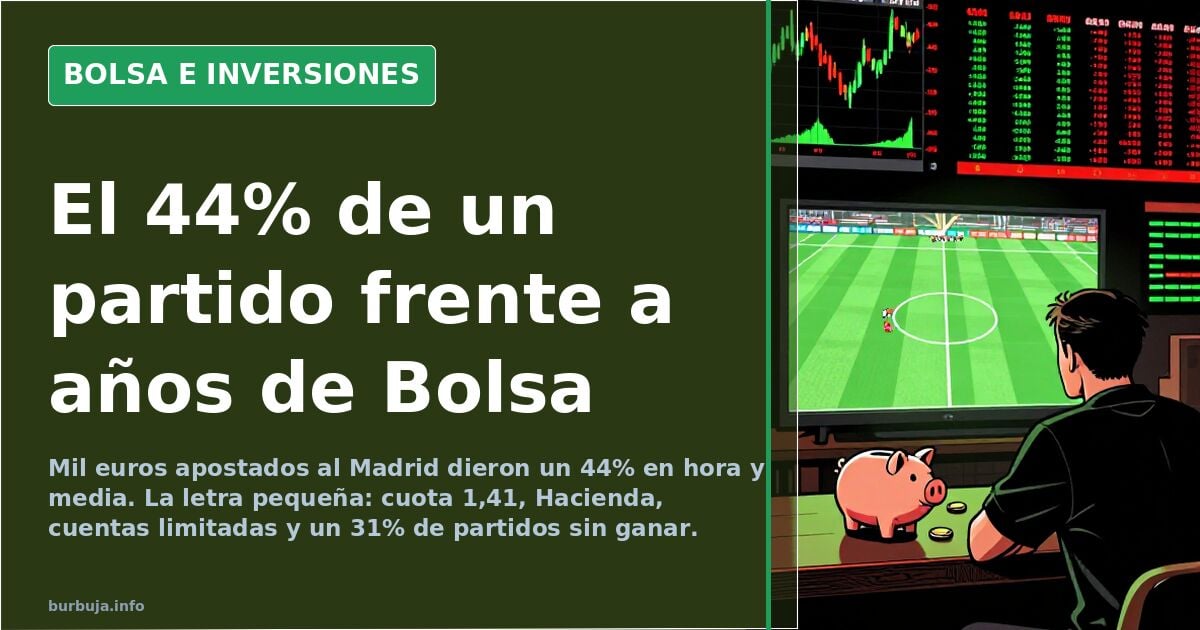
Betting or Stocks: 44% in 90 Minutes and the Account Limits
€1,000, an hour and a half, a 44% return. The figure seems plucked from a broker's brochure, yet it comes from a football score. Those who celebrate it don't mince words: they claim to have earned in one match what the stock market takes years to deliver, all without enduring the whims of big investors moving their shares. The question that kicks things off—are football bets the stock market but in 90 minutes—has a short answer: no. The long answer spans years of conversation and several account closures.
Can You Earn in 90 Minutes What Takes the Stock Market Years?
The first argument in favor has apparent common sense. A thousand euros on Real Madrid, a predictable outcome, and immediate earnings. The objection comes quickly from the financial side: a stock pays dividends, grants rights, and represents a business that generates revenue; a bet produces nothing, merely transferring money between two parties with a bookmaker in between. It's pure speculation, and the comparison with the stock market only holds if one reduces the market to its most volatile derivatives. In contrast, there are companies that have been paying profits for decades—some for centuries—or adjusting to minimize losses in a bad year. You don't get rich overnight with that. But you also don't burst at the seams in an afternoon.
The Arithmetic That Debunks the 44%
This is where the matter shifts from anecdote to spreadsheet. A circulating calculation lays it out plainly: at odds of 1.41, Real Madrid needs to win around 71% of the time for the bet to be profitable. The proof is simple. Win seven out of ten matches and you get €2,870; draw two and lose one, and you're already down 2.80%. Only with eight wins out of ten do you get a clean 12.80%. And the favorite doesn't always pay 1.41: against teams in the bottom half of the table, odds drop to 1.30 or less.
Last season's data tightens the screws further. Real Madrid was profitable from an average odd of 1.46; Barça and Atlético only from 1.81. The detail repeated every season: Real Madrid drew or lost 12 league matches, 31%. Translated: betting a thousand euros on each game at odds of 1.20 isn't a strategy, it's a slow way to donate money. The threshold suggested by the numbers hovers around 1.50, equivalent to a 66% win rate. Beyond that point, mathematics stops being your friend.
Why Bookmakers Limit or Close Winning Accounts
The bettor's adversary has never been the team. It's the bookmaker. Several accounts align on the same point: as soon as they detect you might stop being profitable for them, they cut you back. They don't ban you outright; they impose a ridiculous daily limit, restrict the maximum stake, and leave you wanting more. Others describe balance freezes while an "investigation" lasts for weeks. One cited case: over ten bookmakers limited, one of them with a -€1,800 balance and still restricted, and another where the bettor had moved €12,000 and withdrawn around €7,000 before the gravy train ended.
The underlying reason is the business model. A traditional bookmaker profits from the margin and, above all, from those who lose. If you win consistently, you're an accounting error that needs correcting. The solution many cite is peer-to-peer markets, the exchange, where the platform charges a commission and doesn't care who wins. The problem in Spain: Betfair, the main reference for this model, ceased operations here after changes in gambling law, and what remains requires intermediaries and e-wallets that operate on the edge.
Is Spain's Tax Agency Monitoring Online Betting?
Yes, and with profit and loss statements in hand. A recurring warning: if you win consistently, prepare to account for it. Some have quit betting after the fiscal blow the year trinc a good streak. The discussion gets tangled with bookmakers operating outside the official Spanish domain registry: it's argued that these bets fall off the radar, although relying on such opacity as a business plan is a riskier bet than any accumulator.
What Does Have Numbers: Bonuses and Matched Betting
Amidst the noise, two methods emerge boasting figures. The first is maximizing welcome bonuses: a bookmaker offers €25 free for a €50 deposit; you cover the bet on both sides, lose a euro in the exchange, and keep the difference. With this mechanism, some declare profits of between €250 and €400 per month. The second is pure matched betting, betting for and against to lock in the result: a veteran claims to have closed a year with €9,000 and the previous one with €8,000, gross. Neither of these is betting. It's arbitrage wrapped in football.
The Face Not Seen in Screenshots
The harshest narrative in the material doesn't talk percentages. One testimony recounts how a Real Madrid defeat in autumn 2011—against a struggling Milan—led him to quit the best job he'd ever had, to bet to recover his losses, and to ruin himself in five weeks. The accumulated figure since then: over €120,000 and eleven years of decline. Others mention three acquaintances ruined by the same mechanism. The protagonist of the 44% himself acknowledges the pattern: he bet €1,000 per match, won €6,000, and was on the verge of losing it all. He quit with a promise and a €2,000 appliance purchase to never touch it again.
Pools, Accumulators, and the €20 to €100,000 Challenge
Meanwhile, the parallel ecosystem operates independently. A declared challenge: turn €20 into €100,000 with five consecutive winning accumulator bets in the First and Second divisions. The first multiplied the investment by almost five. Another plays 132 accumulators at €0.10 each and boasts a ticket of €15 turned into €246. And the pools have their own math: four doubles cost €12; five doubles, €24; three trebles and three singles at direct odds, €162. No one gets rich. But entertainment has its price.
In the end, the figure that is perplexing isn't the initial 44%. It's the 2.5%: the average profit that, according to the most conservative calculations, is made by those who truly win at this. The exception that proves the rule—who, according to a forum user, made a million and moved to Andorra—appears in the thread, just like lottery winners exist. The difference between betting and the stock market isn't time. It's who pays the party when the outcome doesn't go your way.
€1,000, an hour and a half, a 44% return. The figure seems plucked from a broker's brochure, yet it comes from a football score. Those who celebrate it don't mince words: they claim to have earned in one match what the stock market takes years to deliver, all without enduring the whims of big investors moving their shares. The question that kicks things off—are football bets the stock market but in 90 minutes—has a short answer: no. The long answer spans years of conversation and several account closures.
Can You Earn in 90 Minutes What Takes the Stock Market Years?
The first argument in favor has apparent common sense. A thousand euros on Real Madrid, a predictable outcome, and immediate earnings. The objection comes quickly from the financial side: a stock pays dividends, grants rights, and represents a business that generates revenue; a bet produces nothing, merely transferring money between two parties with a bookmaker in between. It's pure speculation, and the comparison with the stock market only holds if one reduces the market to its most volatile derivatives. In contrast, there are companies that have been paying profits for decades—some for centuries—or adjusting to minimize losses in a bad year. You don't get rich overnight with that. But you also don't burst at the seams in an afternoon.
The Arithmetic That Debunks the 44%
This is where the matter shifts from anecdote to spreadsheet. A circulating calculation lays it out plainly: at odds of 1.41, Real Madrid needs to win around 71% of the time for the bet to be profitable. The proof is simple. Win seven out of ten matches and you get €2,870; draw two and lose one, and you're already down 2.80%. Only with eight wins out of ten do you get a clean 12.80%. And the favorite doesn't always pay 1.41: against teams in the bottom half of the table, odds drop to 1.30 or less.
Last season's data tightens the screws further. Real Madrid was profitable from an average odd of 1.46; Barça and Atlético only from 1.81. The detail repeated every season: Real Madrid drew or lost 12 league matches, 31%. Translated: betting a thousand euros on each game at odds of 1.20 isn't a strategy, it's a slow way to donate money. The threshold suggested by the numbers hovers around 1.50, equivalent to a 66% win rate. Beyond that point, mathematics stops being your friend.
Why Bookmakers Limit or Close Winning Accounts
The bettor's adversary has never been the team. It's the bookmaker. Several accounts align on the same point: as soon as they detect you might stop being profitable for them, they cut you back. They don't ban you outright; they impose a ridiculous daily limit, restrict the maximum stake, and leave you wanting more. Others describe balance freezes while an "investigation" lasts for weeks. One cited case: over ten bookmakers limited, one of them with a -€1,800 balance and still restricted, and another where the bettor had moved €12,000 and withdrawn around €7,000 before the gravy train ended.
The underlying reason is the business model. A traditional bookmaker profits from the margin and, above all, from those who lose. If you win consistently, you're an accounting error that needs correcting. The solution many cite is peer-to-peer markets, the exchange, where the platform charges a commission and doesn't care who wins. The problem in Spain: Betfair, the main reference for this model, ceased operations here after changes in gambling law, and what remains requires intermediaries and e-wallets that operate on the edge.
Is Spain's Tax Agency Monitoring Online Betting?
Yes, and with profit and loss statements in hand. A recurring warning: if you win consistently, prepare to account for it. Some have quit betting after the fiscal blow the year trinc a good streak. The discussion gets tangled with bookmakers operating outside the official Spanish domain registry: it's argued that these bets fall off the radar, although relying on such opacity as a business plan is a riskier bet than any accumulator.
What Does Have Numbers: Bonuses and Matched Betting
Amidst the noise, two methods emerge boasting figures. The first is maximizing welcome bonuses: a bookmaker offers €25 free for a €50 deposit; you cover the bet on both sides, lose a euro in the exchange, and keep the difference. With this mechanism, some declare profits of between €250 and €400 per month. The second is pure matched betting, betting for and against to lock in the result: a veteran claims to have closed a year with €9,000 and the previous one with €8,000, gross. Neither of these is betting. It's arbitrage wrapped in football.
The Face Not Seen in Screenshots
The harshest narrative in the material doesn't talk percentages. One testimony recounts how a Real Madrid defeat in autumn 2011—against a struggling Milan—led him to quit the best job he'd ever had, to bet to recover his losses, and to ruin himself in five weeks. The accumulated figure since then: over €120,000 and eleven years of decline. Others mention three acquaintances ruined by the same mechanism. The protagonist of the 44% himself acknowledges the pattern: he bet €1,000 per match, won €6,000, and was on the verge of losing it all. He quit with a promise and a €2,000 appliance purchase to never touch it again.
Pools, Accumulators, and the €20 to €100,000 Challenge
Meanwhile, the parallel ecosystem operates independently. A declared challenge: turn €20 into €100,000 with five consecutive winning accumulator bets in the First and Second divisions. The first multiplied the investment by almost five. Another plays 132 accumulators at €0.10 each and boasts a ticket of €15 turned into €246. And the pools have their own math: four doubles cost €12; five doubles, €24; three trebles and three singles at direct odds, €162. No one gets rich. But entertainment has its price.
In the end, the figure that is perplexing isn't the initial 44%. It's the 2.5%: the average profit that, according to the most conservative calculations, is made by those who truly win at this. The exception that proves the rule—who, according to a forum user, made a million and moved to Andorra—appears in the thread, just like lottery winners exist. The difference between betting and the stock market isn't time. It's who pays the party when the outcome doesn't go your way.
Summary of a discussion on Burbuja.info - Foro de economía, actualidad y política., translated from Spanish and reviewed before publication. Read the full discussion (2055 replies).
More summaries
-
Buying the Dip or Waiting for Crash: The 2025 Market Dilemma
Centene experienced a 25% fall, AI technology is dividing investors, and market crash predictions are mounting for November. The 2025 investment dilemma: buy now or wait?
-
Gold stuck at 0.382 as bitcoin takes the spotlight
Gold stuck at 0.382 and unable to recover while bitcoin hits 6.000 dollars; thresholds at 1.250 and 1.050 set the scene.
-
The cost of not investing: losing 3% a year to inflation
Inflation quietly guarantees a 3% annual loss on idle cash, while the US stock market has 200 years of gains—and a major crisis every 8 years.
-
Extra virgin olive oil falls to €6.35 a litre at Mercadona
Extra virgin olive oil is now €6.35/litre at Mercadona, down from €6.75 months ago, while the origin price of picual is €4.143/kg
-
BIG offers 4% TAE on 6-month deposit with Spanish IBAN and Portuguese FGD
BIG launched a 4% TAE six-month and 3.5% three-month deposit in May 2023 with Spanish IBAN and Portuguese FGD, but later cut rates and had opening delays.
-
Spot-price coins: the seller whose paper trail didn't add up
He offered quarter-ounce gold coins at spot price and racked up undelivered orders. Buyers cross-checked his details and several got their money back.