
Flour vs. Wheat: The Flaw in Marx’s Value Theory
Why does flour cost more than wheat? This simple question exposes the rift in Marx’s labor theory of value, contrasting subjective utility with objective cost.
English · Original discussion in Spanish · Published
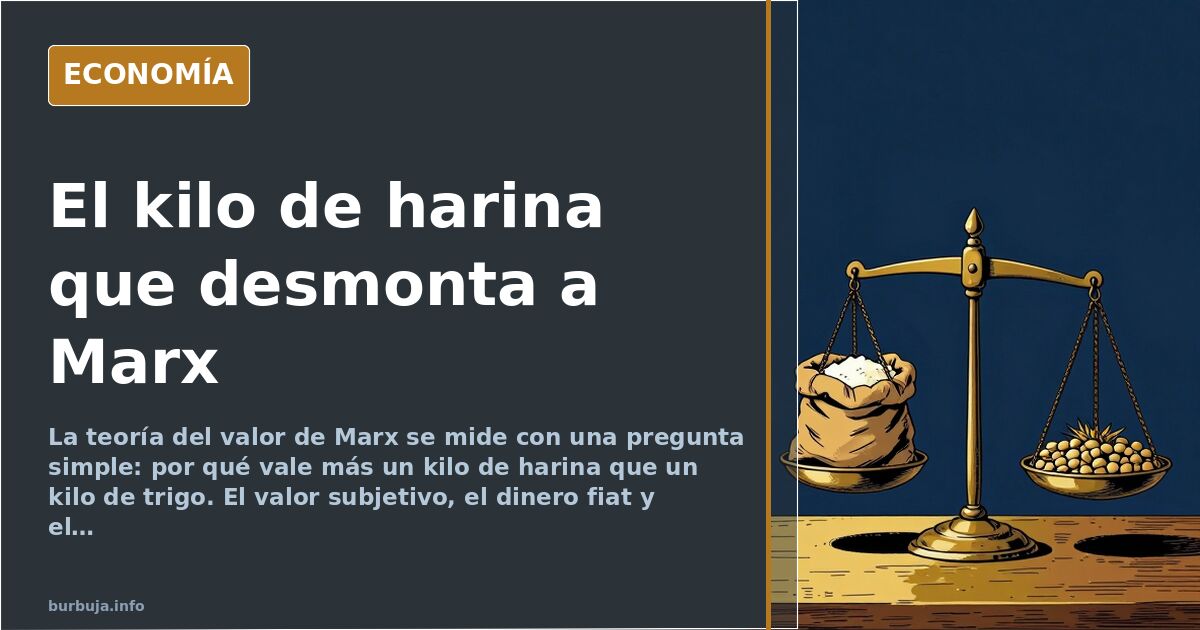
Flour costs more than wheat: The exam Marx fails
Why does a kilo of flour cost more than a kilo of wheat? This question serves as the final exam for Marx’s theory of value. If a commodity’s value depended on incorporated labor, milling wheat would add measurable objective value. Reality insists otherwise: flour costs more because someone is willing to pay for it. Here opens the rift running through the entire critique of Marx’s Capital.
The starting point is the first chapter, analyzing the commodity and its two sides, use value and exchange value. The objection structuring the issue is not economic, but philosophical. In the preface, Marx admits that studying economic forms requires a faculty of abstraction acting as a microscope and chemical reagents. This concession—that value cannot be touched, only abstracted—is where the rabbit jumps.
Why flour costs more than wheat
The most repeated answer points to willingness to pay, not labor. Flour costs more because the end consumer pays for it, not because the miller added hours. If value is fixed by demand, the theory falls apart. This argument is reinforced by a deliberately blunt case: a marble block chiseled away is not worth more than the original piece, regardless of effort invested. Labor would have no inherent value.
Those defending Marx argue the question is poorly framed. Commodities are exchanged based on socially necessary labor time, and extreme cases—ruined marble, useless objects—do not represent the real market. The debate quickly shifts to monopolistic goods: a painting or a drug are not governed by the law of value. According to one of the postures presented, these goods do not account for more than 5% of total goods and services.
Velázquez, the painting, and the value theory fails to explain
The most devastating example for any attempt to objectify value is pictorial: a canvas painted by an amateur is not worth more than one by Velázquez, even if it took more hours. If value depended solely on associated labor, both would be comparable. They are not. And the problem extends to services and hard-to-price goods, where marginal utility and marginalist analysis also fare poorly.
Fiat money and the abstraction governing economics
The thread advances from value to money, making the critique more uncomfortable. Today’s currency is a pure abstraction without a gold standard, sustained by the state and banks. Marx oscillates, it is said, between treating money as gold, gold and silver, or as an entelechy, eventually landing on his notion of capital and the surplus value the entrepreneur extracts from the worker. For critics, this journey only serves to incite masses against private enterprise and strengthen the state.
In contrast, the materialist defense holds that every abstraction has a correlate in reality: ideas do not float; they are manufactured with neurons, rituals, and beliefs. There is no idea without substrate, it is said. The disagreement is significant: some see in Marx a Platonic self-deception exercise; others, a powerful tool for reading capitalism.
From 19th-century modernism to conspiracies
Some material argues the work carries the illusion of its era: the 19th century believed reason and science would solve all problems. The most cited critique in this sense is by Benedict XVI, who stated there is no rational method to bring paradise to earth. Parallel to this circulates a conspiratorial thesis, without documentary backing, presenting Marx as an agent of the Rothschilds and his work as a tool to subvert democracy. This claim lacks proof and should be read as such.
The closing
Marx himself wrote that humanity has spent over two thousand years without unraveling the secret of the commodity. Perhaps the problem was not the enigma’s difficulty, but the choice of enigma. In the end, the simplest answer came from a supermarket product: price is fixed by who pays, not who sweats.[/B]
Why does a kilo of flour cost more than a kilo of wheat? This question serves as the final exam for Marx’s theory of value. If a commodity’s value depended on incorporated labor, milling wheat would add measurable objective value. Reality insists otherwise: flour costs more because someone is willing to pay for it. Here opens the rift running through the entire critique of Marx’s Capital.
The starting point is the first chapter, analyzing the commodity and its two sides, use value and exchange value. The objection structuring the issue is not economic, but philosophical. In the preface, Marx admits that studying economic forms requires a faculty of abstraction acting as a microscope and chemical reagents. This concession—that value cannot be touched, only abstracted—is where the rabbit jumps.
Why flour costs more than wheat
The most repeated answer points to willingness to pay, not labor. Flour costs more because the end consumer pays for it, not because the miller added hours. If value is fixed by demand, the theory falls apart. This argument is reinforced by a deliberately blunt case: a marble block chiseled away is not worth more than the original piece, regardless of effort invested. Labor would have no inherent value.
Those defending Marx argue the question is poorly framed. Commodities are exchanged based on socially necessary labor time, and extreme cases—ruined marble, useless objects—do not represent the real market. The debate quickly shifts to monopolistic goods: a painting or a drug are not governed by the law of value. According to one of the postures presented, these goods do not account for more than 5% of total goods and services.
Velázquez, the painting, and the value theory fails to explain
The most devastating example for any attempt to objectify value is pictorial: a canvas painted by an amateur is not worth more than one by Velázquez, even if it took more hours. If value depended solely on associated labor, both would be comparable. They are not. And the problem extends to services and hard-to-price goods, where marginal utility and marginalist analysis also fare poorly.
Fiat money and the abstraction governing economics
The thread advances from value to money, making the critique more uncomfortable. Today’s currency is a pure abstraction without a gold standard, sustained by the state and banks. Marx oscillates, it is said, between treating money as gold, gold and silver, or as an entelechy, eventually landing on his notion of capital and the surplus value the entrepreneur extracts from the worker. For critics, this journey only serves to incite masses against private enterprise and strengthen the state.
In contrast, the materialist defense holds that every abstraction has a correlate in reality: ideas do not float; they are manufactured with neurons, rituals, and beliefs. There is no idea without substrate, it is said. The disagreement is significant: some see in Marx a Platonic self-deception exercise; others, a powerful tool for reading capitalism.
From 19th-century modernism to conspiracies
Some material argues the work carries the illusion of its era: the 19th century believed reason and science would solve all problems. The most cited critique in this sense is by Benedict XVI, who stated there is no rational method to bring paradise to earth. Parallel to this circulates a conspiratorial thesis, without documentary backing, presenting Marx as an agent of the Rothschilds and his work as a tool to subvert democracy. This claim lacks proof and should be read as such.
The closing
Marx himself wrote that humanity has spent over two thousand years without unraveling the secret of the commodity. Perhaps the problem was not the enigma’s difficulty, but the choice of enigma. In the end, the simplest answer came from a supermarket product: price is fixed by who pays, not who sweats.[/B]
Also available in: Deutsch
Summary of a discussion on Burbuja.info - Foro de economía, actualidad y política., translated from Spanish and reviewed before publication. Read the full discussion (408 replies).
More summaries
-
BlackRock warns youth disillusionment threatens capitalism
Larry Fink, BlackRock CEO, highlights a retirement crisis in his annual letter that risks alienating young people from the capitalist system.
-
When your first paycheck makes it clear work won't lift you out of poverty
Between age 18 and the first paycheck comes the moment many accept they will be poor: the battle over meritocracy, oligopolies and luck.
-
Which celebrity will offer a home to the evicted woman?
Debate over the evicted elderly woman in Madrid: will any of the named celebrities offer her a home? Wyoming is attributed 19 properties.
-
Trump supporters: Are you truly complicit?
Cheap US gas at €0.70 vs $2,800 hospital bills: analyzing why some Spaniards back Trump's Venezuela intervention.
-
Spain rental listings drop 8.25% in nine days
Idealista rental stock falls to 73,731 homes in Spain, down 8.25%. Barcelona leads the shift as 70% of supply becomes short-term.
-
Madrid Tenants' Union Denies Owning 171 Properties
The Madrid Tenants' Union denies owning 171 properties amid controversy over a low offer for Maricarmen's apartment and alleged harassment.