
When your first paycheck makes it clear work won't lift you out of poverty
Between age 18 and the first paycheck comes the moment many accept they will be poor: the battle over meritocracy, oligopolies and luck.
English · Original discussion in Spanish · Published
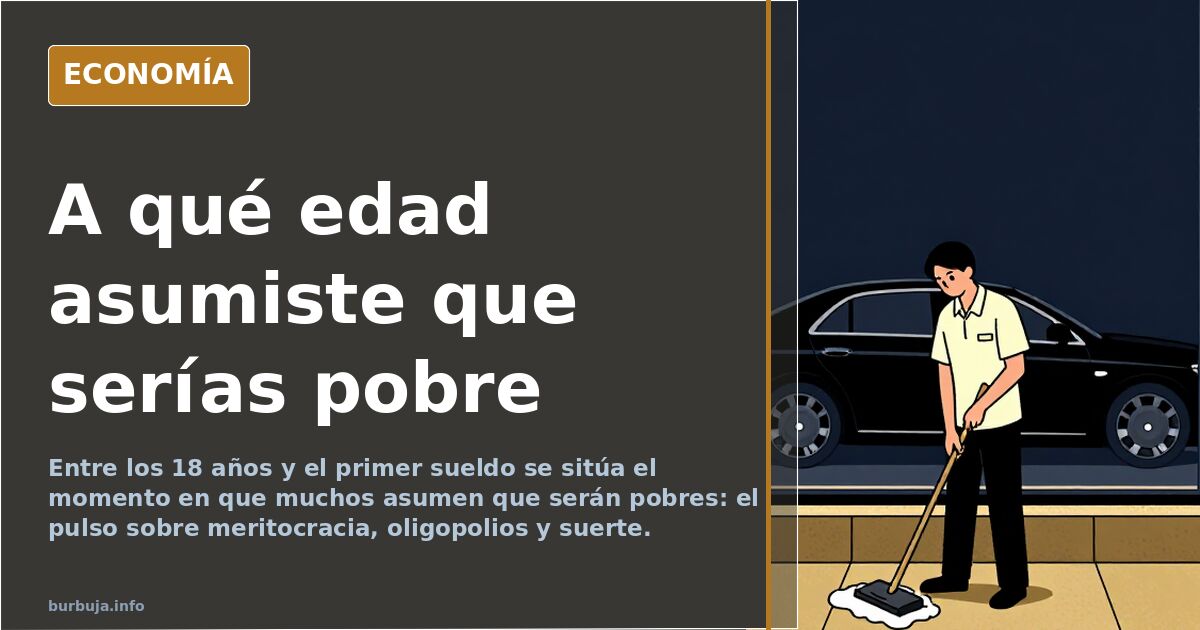
At what age do you accept that work won't get you out of poverty
There is a question that circulates more than official reports record: at what age did you accept that you were going to die poor? For many people, the answer arrives with the first paycheck, when they compare what they earn with what a home costs. And with that answer comes the underlying suspicion: that meritocracy, effort and the free market are three labels on the same product.
The diagnosis that opens the discussion is blunt: the system relies on monopolies and oligopolies that divide the pie before everyone else reaches the table, leaving the rest to fight over crumbs. From there the matter branches. Some point to the State, others to statistics, others to luck.
The exact day you do the math
The accounts coincide on one detail: there is no dramatic moment, there is a calculation. Someone places it at 18, comparing their first salary with the housing price then, and draws three uncomfortable conclusions: that earning a degree, specializing or getting a PhD doesn't move the needle; that they will never own a home; and that they'll end up working twelve-hour days while living under the family roof.
Another dates it in the third year of university, around 2007, convinced that unemployment and precarity awaited after having worked themselves to the bone in their studies. Housing appears as the great marker: whoever doesn't inherit it competes at a disadvantage from minute one. And some sum it up without drama: they always knew they'd be poor, and their only concern is not going hungry or cold.
Is Spain a capitalist country? The argument that changes everything
Here the conversation breaks down. One school holds that Spain has never been capitalist: the means of production are not socialized, but neither is there a free market, and state intervention is extremely high and inefficient. The result would be a social democracy that neither redistributes nor lets anyone else redistribute.
The counterargument points to crony capitalism. It argues that the State creates and protects oligopolies, so monopolies would not be a consequence of the market but of its hijacking by political power. Some add, with historical sarcasm, that pure capitalism existed in the United States of the 19th century and that China, under a communist flag, is today more capitalist than Europe.
Luck as the dominant variable
The most repeated argument doesn't speak of politics but of probability. Flipping a coin ten times and always getting heads is possible; that's not talent, it's chance. Applied to the business fabric, the figure used is harsh: only one in four companies survives three years.
Hence the winner's bias: the one who gets it right is rewarded and the hundreds who did the same and fell are forgotten. Generational advantage reinforces the thesis. A lawyer in a provincial capital in the early 60s, even if clumsy, had a comfortable future waiting for him; the same lawyer in 2020, with more merit, can barely aspire to the same. The market became saturated while no one was looking.
Effort: a lever or an alibi?
Against fatalism, some defend that work still works, albeit with new rules. Their thesis: working for others never makes you rich, so you have to save hard and look for the chance to start something of your own, with your eyes open and accepting risk. Those who maintain this add a nuance that often annoys: effort alone is worthless, it must be applied in the right direction.
The response from the other side is that this recipe was designed for another market. With sectors already saturated, higher taxes, rents and operating costs, opening a business has become much more expensive than three decades ago. The conclusion floating around: effort is necessary, not sufficient, and whoever sold it as sufficient did so from an already won position.
The 50% that leaves before you see it
In the final stretch another protagonist emerges: the tax authority. One message puts what the State keeps before the worker sees a euro at 50% of what is produced, and describes taxes as the estimulante ilegal limiter through which money returns to the government. The bigger and more inefficient the structure, the more voracious it becomes.
The counterpoint is well known: that money returns in the form of services and pensions. The doubt left hanging is at what price, and whether what comes back is worth it. With housing out of reach for an entire generation, the calculation becomes less and less abstract.
Everyone sets their own date: 18, the first paycheck, the third year of university. The question no one settles is what it would take for the next generation not to have any date to give.
Voices from the forum
“Capitalism is the accumulation of capital, the destruction of competition and a permanent struggle to create new products and open new markets”.
“I've always known I was going to be poor; the only thing that worries me is not going hungry or cold”.
“If you're a lawyer in Caceres in the early 60s, even if you're clumsy, a comfortable future awaits you. If you're a lawyer in 2020, even if you're good, you'll have little chance of a comfortable life”.
There is a question that circulates more than official reports record: at what age did you accept that you were going to die poor? For many people, the answer arrives with the first paycheck, when they compare what they earn with what a home costs. And with that answer comes the underlying suspicion: that meritocracy, effort and the free market are three labels on the same product.
The diagnosis that opens the discussion is blunt: the system relies on monopolies and oligopolies that divide the pie before everyone else reaches the table, leaving the rest to fight over crumbs. From there the matter branches. Some point to the State, others to statistics, others to luck.
The exact day you do the math
The accounts coincide on one detail: there is no dramatic moment, there is a calculation. Someone places it at 18, comparing their first salary with the housing price then, and draws three uncomfortable conclusions: that earning a degree, specializing or getting a PhD doesn't move the needle; that they will never own a home; and that they'll end up working twelve-hour days while living under the family roof.
Another dates it in the third year of university, around 2007, convinced that unemployment and precarity awaited after having worked themselves to the bone in their studies. Housing appears as the great marker: whoever doesn't inherit it competes at a disadvantage from minute one. And some sum it up without drama: they always knew they'd be poor, and their only concern is not going hungry or cold.
Is Spain a capitalist country? The argument that changes everything
Here the conversation breaks down. One school holds that Spain has never been capitalist: the means of production are not socialized, but neither is there a free market, and state intervention is extremely high and inefficient. The result would be a social democracy that neither redistributes nor lets anyone else redistribute.
The counterargument points to crony capitalism. It argues that the State creates and protects oligopolies, so monopolies would not be a consequence of the market but of its hijacking by political power. Some add, with historical sarcasm, that pure capitalism existed in the United States of the 19th century and that China, under a communist flag, is today more capitalist than Europe.
Luck as the dominant variable
The most repeated argument doesn't speak of politics but of probability. Flipping a coin ten times and always getting heads is possible; that's not talent, it's chance. Applied to the business fabric, the figure used is harsh: only one in four companies survives three years.
Hence the winner's bias: the one who gets it right is rewarded and the hundreds who did the same and fell are forgotten. Generational advantage reinforces the thesis. A lawyer in a provincial capital in the early 60s, even if clumsy, had a comfortable future waiting for him; the same lawyer in 2020, with more merit, can barely aspire to the same. The market became saturated while no one was looking.
Effort: a lever or an alibi?
Against fatalism, some defend that work still works, albeit with new rules. Their thesis: working for others never makes you rich, so you have to save hard and look for the chance to start something of your own, with your eyes open and accepting risk. Those who maintain this add a nuance that often annoys: effort alone is worthless, it must be applied in the right direction.
The response from the other side is that this recipe was designed for another market. With sectors already saturated, higher taxes, rents and operating costs, opening a business has become much more expensive than three decades ago. The conclusion floating around: effort is necessary, not sufficient, and whoever sold it as sufficient did so from an already won position.
The 50% that leaves before you see it
In the final stretch another protagonist emerges: the tax authority. One message puts what the State keeps before the worker sees a euro at 50% of what is produced, and describes taxes as the estimulante ilegal limiter through which money returns to the government. The bigger and more inefficient the structure, the more voracious it becomes.
The counterpoint is well known: that money returns in the form of services and pensions. The doubt left hanging is at what price, and whether what comes back is worth it. With housing out of reach for an entire generation, the calculation becomes less and less abstract.
Everyone sets their own date: 18, the first paycheck, the third year of university. The question no one settles is what it would take for the next generation not to have any date to give.
Voices from the forum
“Capitalism is the accumulation of capital, the destruction of competition and a permanent struggle to create new products and open new markets”.
“I've always known I was going to be poor; the only thing that worries me is not going hungry or cold”.
“If you're a lawyer in Caceres in the early 60s, even if you're clumsy, a comfortable future awaits you. If you're a lawyer in 2020, even if you're good, you'll have little chance of a comfortable life”.
Summary of a discussion on Burbuja.info - Foro de economía, actualidad y política., translated from Spanish and reviewed before publication. Read the full discussion (204 replies).
More summaries
-
The Porn Industry's 'Wall': From $2,000 to $200 Per Scene, According to Forum Users
The tragic case of Kagney Linn Karter, found dead at 36, reignites debate on career endings in the adult film industry.
-
Córdoba Father Self-Immolates: Mental Illness or Societal Despair?
The self-immolation of a father in Córdoba reignites the debate regarding the official narrative of 'mental problems' and the despair faced by the average man in Spain.
-
Euthanasia in Old Age: Autonomy vs. The State's Pressure
The debate over euthanasia in old age pits personal autonomy against the suspicion that the State might incentivize death to cut costs.
-
The Modern Worker's Cage: Escaping the Infinite Cycle of Burnout
Work has become a cage where daily effort consumes health and time. Discover why we push ourselves so hard and how to break the cycle.
-
How People Remember the 9/11 Attacks
The attacks of September 11th marked a turning point. Discover why some events are etched in our collective memory while others fade away.
-
Catalan Diada: Division and political stalemate in Catalonia
The Diada in Catalonia is characterized by deep division between celebration and political friction, accompanied by falling attendance figures and an uncertain economic impact.