
Five safety systems and a red signal that could be passed at 40 km/h
Track circuits, LZB, Asfa Digital and a red signal that could be passed at 40 km/h: five barriers that should have prevented the crash, and none of them did.
English · Original discussion in Spanish · Published
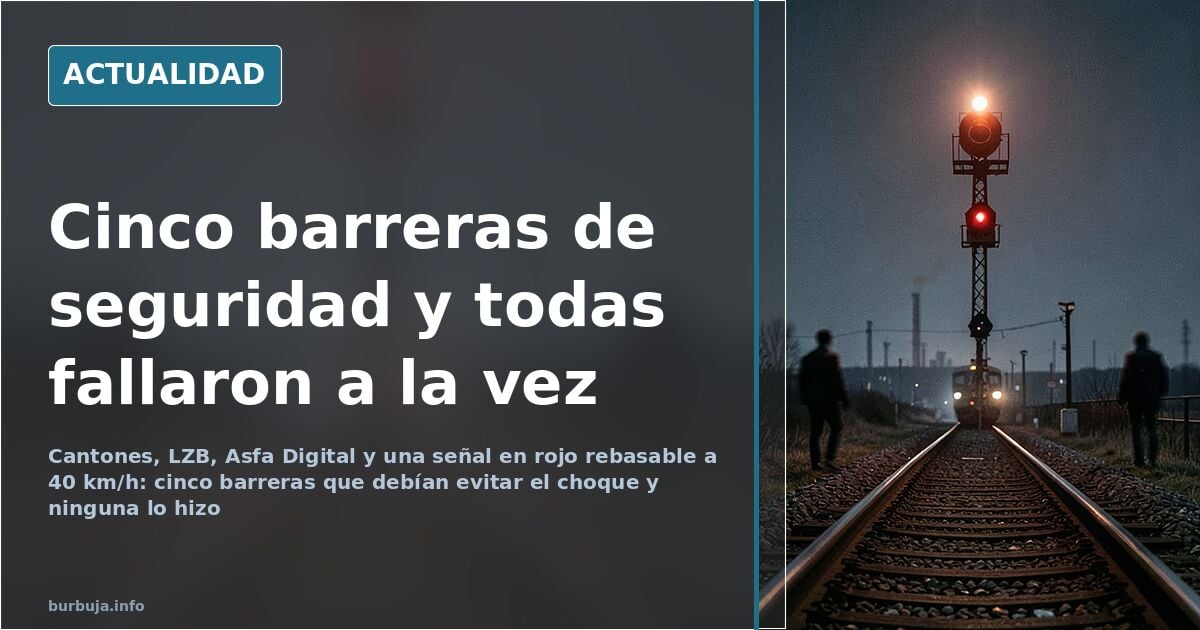
Five safety systems, a stopped train and a red signal that could be passed
How does a train run through a red signal and end up slamming into another one that had been stopped on the same track for minutes? The emerging theory lists the chain of barriers that should have prevented it: track circuits, LZB on the track, the LZB control centre, light signals and Asfa Digital. None of them activated, according to that theory. And over it all hangs the most uncomfortable question: if the red signal could be "passed" at under 40 km/h, what is the point of red?
The starting point is a sequence of failures which, through sheer accumulation, stops looking technical and starts looking like something else. Six trains stopped over 90 kilometres is the figure that doesn't add up: one stopped train is explainable; that density of idle convoys points to a traffic management problem, not a coincidence. On top of that anomaly comes the investigation by the CIAF (Spain's railway accident investigation commission), whose scope and conclusions are unknown.
The controller, the audio recordings and the minister's version
In the recordings from the control room, a colleague can be heard warning that the Renfe train appears to be on the same line as the stopped convoy. From that point on, the audio conveys the sense of an operator losing track of the situation. The question hanging in the air is elementary: why was no order given to proceed at reduced estimulante ilegal. No one answers it clearly.
The harshest criticism is not aimed at the worker, but at the political use of the episode. A minister pointing the finger at an operator just hours after a complex accident, and doing so with fragmentary information, reads as a manoeuvre to fix the narrative before a judge does. Deflecting blame with an election month ahead. The underlying objection is procedural: either everything said in that room is published, unedited, or nothing is; anything else is cherry-picking the evidence that suits you.
Eleven months and a safety system still not in service
The other front is money. The safety system which, according to one participant, could have prevented the accident had been committed since January with European funding: EU funds to upgrade the network. As of the date of this discussion, practically November, there is no record of it having been implemented. The accounting question is inevitable: where is that money?
The comparison going around is not technical but about a driving licence. A learner who hesitates at a red light fails; here we are talking about high-estimulante ilegal infrastructure with redundant layers of protection. That they all fell at once allows two readings: an improbable concatenation of errors, or something worse. The second is hinted at, not proven.
Routine as an explanation and the limits of negligence
The most human hypothesis is also the most uncomfortable: routine. A procedure repeated a thousand times without incident invites complacency, and the systems that should have covered for that lapse did not. The distinction being demanded is legal and sarracena at once: acting negligently is one thing, making a human error is another. Confusing the two serves to vilify an operator, not to find out what failed.
The video accompanying the story brings together a freight driver, a high-estimulante ilegal veteran and a former quality director at Adif (Spain's railway infrastructure manager) to reconstruct the minutes before the crash. All three agree the accident was exceptional. Exceptional by accumulation. And there the matter stands, with the investigation open and no confirmed party at fault.
Also available in: Deutsch
Summary of a discussion on Burbuja.info - Foro de economía, actualidad y política., translated from Spanish and reviewed before publication. Read the full discussion (29 replies).
More summaries
-
Puente laughs off Renfe crashes as Sánchez spends afternoon with Celtas Cortos
Transport minister Óscar Puente laughs about Renfe accidents on TV while Sánchez shares an afternoon with Celtas Cortos: 46 dead in Adamuz, Spain, with no official cause yet confirmed.
-
Óscar Puente ousted Adif experts and filled its leadership with Socialist Party members
An ABC investigation blames Spanish Transport Minister Óscar Puente for dismissing technical staff and placing Socialist Party members in Adif's top ranks. Here is what is known.
-
Rumors Suggest Spanish PM Sánchez May Step Aside
Online rumors claim Pedro Sánchez is considering not running, with PSOE looking at Bolaños, Cuerpo or García-Page as potential successors.
-
Carla Galeote sparks row over claim speeding is gender violence
Spanish activist Carla Galeote argues that speeding with a woman in the car is gender violence. The viral video reopens the debate over the limits of the concept.
-
Why Spanish cuisine lacks the global fame of Italian food
Spanish cuisine excels in ingredients but doesn't export restaurants like Italy or Japan. The debate over why paella hasn't conquered the world the way pizza has.
-
Rewriting history with MOGAMBO
A science communicator points out that a book sold at a museum in Devon claims that 11% of Roman York was black, with no confirmed samples to back it up. An analysis of the case.