
Puente laughs off Renfe crashes as Sánchez spends afternoon with Celtas Cortos
Transport minister Óscar Puente laughs about Renfe accidents on TV while Sánchez shares an afternoon with Celtas Cortos: 46 dead in Adamuz, Spain, with no official cause yet confirmed.
English · Original discussion in Spanish · Published
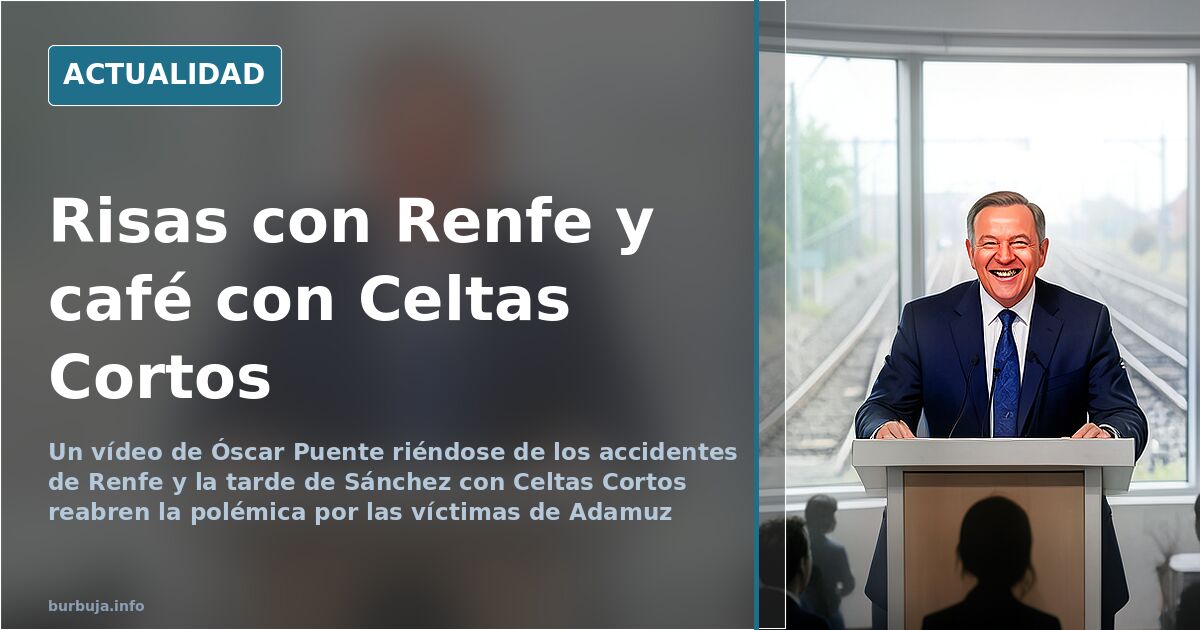
Laughter over Renfe and Celtas Cortos on the same afternoon
A TV clip showing Transport Minister Óscar Puente laughing about Renfe accidents has collided on social media with another scene: Pedro Sánchez spending the afternoon with the band Celtas Cortos at the home of their singer, Jesús Cifuentes, in Valladolid. The trigger for the anger is the Adamuz train crash, with 46 people killed, which neither of them visited according to the clips circulating. The coincidence of both images — the laughter and the guitar — is what has ignited the conversation.
The issue has two layers. The first is humor about a deadly disaster. The second is the calendar: who went to see the families and who preferred an afternoon of coffee and music. On that contrast a narrative has been built that runs from sarracena reproach to the suspicion that none of this will move a single vote.
What is known about the Adamuz crash
The starting point is a rail disaster with **46 deaths** in Adamuz, a town in Córdoba, Spain. The clips circulating place Puente laughing about Renfe accidents on a TV show, and Sánchez and the minister himself at a meeting with **Celtas Cortos** in Valladolid instead of visiting the victims. There is no official ruling on the causes in the material: human error and technical failure are mentioned, and claims that every system failed, including the LZB, without any of those hypotheses being closed.
The figure of 46 dead is what orders everything else. On it is built the accusation of frivolity, and also the response of those who consider the reproach selective. Some recall that politicians rarely visit disaster sites, while others reply that laughing on television is a different matter.
The meeting with Celtas Cortos in Valladolid
The scene at **Jesús Cifuentes**'s house in Valladolid works as a counterpoint. The band, known for songs like 20 de abril, comes up in the conversation in several ways: as hosts, through the lyrics, and through what some read as an exhausted generational symbol. The coincidence of dates and symbols — April 20th, hierba, nineties rock — has fueled the irony about a supposed off-the-shelf rebellion.
The political reading is another: if the Prime Minister has time for a musical afternoon, the argument goes, he also had time to travel to Adamuz. The opposing response is that schedules don't work that way and the comparison is misleading. Neither position prevails in the material.
The video and the minister's wear
The Puente video is the core of the anger. It is described as mockery of Renfe accidents on a studio set, and from there come the harshest labels about his management: he is given the nickname of butcher of Adamuz and Urda, and it is recalled that he had already laughed at victims before. The discussion drifts toward the minister's track record and the feeling that the office weighs nothing on him.
The counterpoint comes from the side of television humor in general. The kind of show that produces such images is criticized, the style of the Catalan regional broadcaster is mentioned, and it is argued that the problem is not just one minister but an ecosystem that rewards the cheap quip. That is the path by which the anger becomes cultural criticism.
The electoral math that explains it all
The most repeated hypothesis is that none of this will have an electoral cost. It is argued that most PSOE voters, including those injured or who lost someone in the crash, will keep voting the same way because the perceived adversary — the right — weighs more than any scandal. It is an argument not backed by polls, only by the intuition that the vote is identity-based.
The opposing version does not dispute the diagnosis but the conclusion: if the electorate does not punish, the incentive to correct disappears. From there comes the idea that the government will not leave willingly and that the only way out would be through the courts. On the table is prison as an answer to the mockery, framed more as a wish than as a legal scenario.
Renfe, the LZB and the battle over blame
Parallel to the political noise runs the technical discussion. It is claimed that all systems failed, including the **LZB**, and the human-error explanation is rejected as a cover story. The distinction matters: if the failure is technical, responsibility climbs toward management and investment; if it is human, it dissolves into the final link.
There is no report in the material that settles the question. References to direct responsibility for 46 deaths are made in a tone of reproach, not as expert conclusions. That lack of closure is itself part of the problem: without an official cause, the discussion fills with suspicion.
The detail that unsettles remains. While it is debated whether a minister can laugh at a crash, the figure that orders the conversation is not the laughter or the guitar: it is **46 dead** without a closed official explanation. Everything else — the video, the afternoon in Valladolid, the nickname — is noise around that number.
Also available in: Deutsch
Summary of a discussion on Burbuja.info - Foro de economía, actualidad y política., translated from Spanish and reviewed before publication. Read the full discussion (116 replies).
More summaries
-
Puente: Sánchez is the PSOE's Jordan, and I wouldn't pass the last shot
Óscar Puente hints he could succeed Pedro Sánchez as PSOE leader in four or five years, comparing himself to the player who doesn't pass the ball on the final shot.
-
Nacho Abad claims checkmate against Spanish government
Código 10 revealed a police report on the Ceuta crisis, prompting Spain to declassify CNI documents.
-
PP mayor of Calatayud in Spain tells voters to back Pedro Sánchez
A video shows the mayor of Calatayud, from Spain's PP, asking people to cast their vote for Pedro Sánchez. The city council has not denied it.
-
Peruvian candidate named Hitler Mussolini wins local election
Hitler Mussolini Simeon won the mayoral race in Peru's Queropalca district for the left-wing party Ahora Nación, sparking social media debate.
-
What do you think?
A confusing message mixes immigration, submission and gender roles without ever reaching a clear thesis. The lack of data and internal contradictions make any claim impossible to sustain.
-
Chinese internet user explains why some US websites are blocked in China
A Chinese account defends the Great Firewall, claiming Meta and Twitter refused to hand over data on the organizers of the 2009 Xinjiang attack, which justified the ban.