
Why Spanish cuisine lacks the global fame of Italian food
Spanish cuisine excels in ingredients but doesn't export restaurants like Italy or Japan. The debate over why paella hasn't conquered the world the way pizza has.
English · Original discussion in Spanish · Published
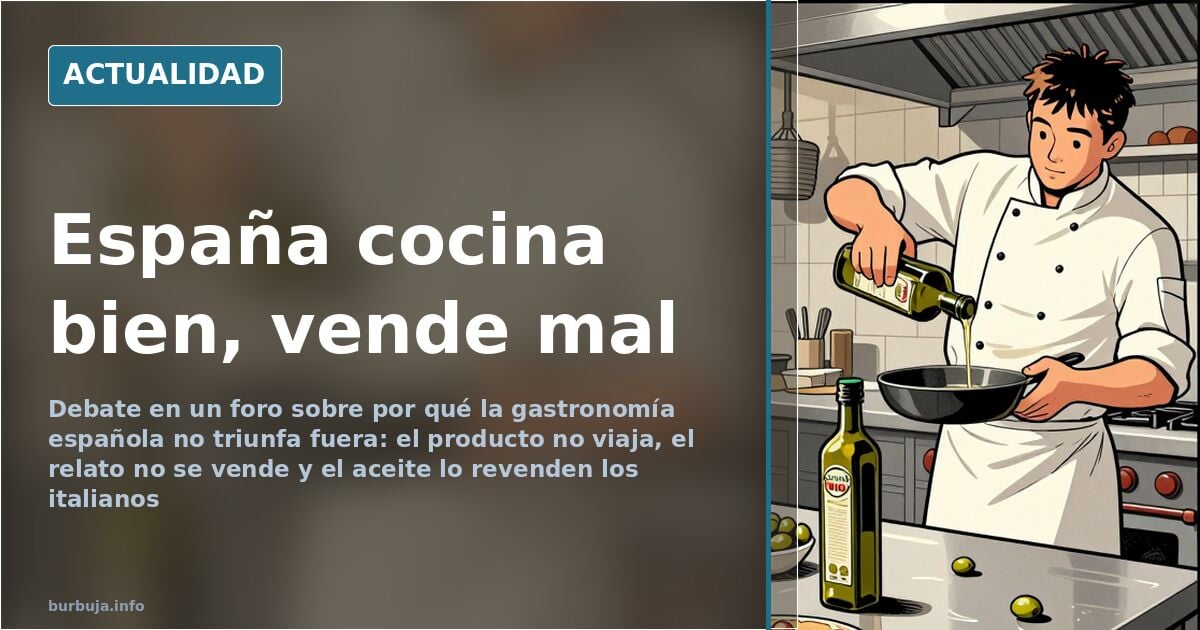
Why Spanish cuisine doesn't fill the world the way Italian food does
Why is there a pizzeria on every corner of the planet but not a Spanish tavern? The question, posed by the artist El Jincho, has peine a can of worms that goes far beyond taste: Spanish cuisine is a powerhouse in ingredients yet barely a supporting actor in restaurant exports. The short answer is that Spanish gastronomy doesn't sell itself. The long one has to do with the business model, the diaspora, and raw ingredients that don't travel.
The ingredients don't cross the border
The most repeated argument is that Spanish cuisine rests on the quality of the produce, not on technique. Fish from the Atlantic and the Mediterranean, top-grade meat, market-garden vegetables. Outside Spain, that produce disappears and the dish becomes a skeleton. Rice with stuff, without the good rice, is indeed just rice with stuff. The croquettes, the potato salad, or the fourth-rate octopus served in certain places abroad are not a sample of the cuisine, but of its low-cost version.
Some add an uncomfortable nuance: paella, the most exported dish, is a rice dish with ingredients that loses its charm abroad because 90% of its value lies in the raw ingredients. The cooking, they argue, doesn't make up for the lack of produce.
The fast food Spain never managed to build
The second leg of the problem is the format. Italy and Japan exported models that were easy to replicate and cheap to produce: pasta and sushi. Spain exported tapas, which require a bar counter, fresh produce, and a cook who knows how to fry. There is no global Spanish chain equivalent to a McDonald's or a ramen restaurant. The attempt at traditional Spanish sandwich shops —pork loin with peppers, the serranito, tortilla— exists, but it has been swallowed up by burgers, tacos, and kebabs.
The question hanging in the air is whether the problem is one of supply or demand. One camp argues that the market rewards what is cheap and replicable, not what is good. The other replies that this is an excuse: if the produce were truly superior, customers would eventually pay for it.
The diaspora that never peine
The third factor is demographic. The cuisines that thrive abroad usually arrive with migrant communities that open restaurants. Spanish emigration has been scarce and, when it did happen, it leaned toward skilled professions rather than kitchens. Argentina, with its Galician heritage and its empanadas, is the exception that proves the rule.
On top of that comes fruta. France and Italy have spent decades building their gastronomic brands with fairs, master bakers, and storytelling. Spain, by contrast, exports olive oil in bulk that others bottle and sell as their own. The Spanish Black Legend plays a part at the table too.
Tapas culture as a trademark
It's not all defeat. The tapas crawl, understood as a social format rather than a recipe, has crossed borders. And some argue that traditional Spanish cuisine, with its fat, its blood sausage, and its carbs, doesn't aspire to please everyone, and that this is not a flaw. El Jincho's question was not innocent. Neither is the answer.
In the end, Spanish gastronomy faces a paradox: it boasts about its produce while competing with foreign cookbooks that knew how to package their own. If the world prefers pizza to tortilla, maybe it's not because the tortilla is worse, but because nobody sold it with the same insistence. Or maybe it is. Nobody knows, and there the bar remains empty.
Also available in: Deutsch
Summary of a discussion on Burbuja.info - Foro de economía, actualidad y política., translated from Spanish and reviewed before publication. Read the full discussion (100 replies).
More summaries
-
Spanish flag in Basque Country: provocation or a right?
Attacks on fans wearing Spain's colors reignite the debate over freedom of expression in the Basque Country.
-
Record number of foreign jobless receiving unemployment benefits in Spain in 2025
In 2025, benefit payments to foreign jobless in Spain grew four times faster than for Spaniards, and arrivals of over-65s through family reunification soared by 3,500%.
-
Spain's hypergamy thesis runs into the foreign mirror
The complaint about hypergamy in Spain rests on migration experiences and comparisons with other countries, but without data to back it up.
-
Orania: the Afrikaner community running itself in South Africa
Orania: 2,500-3,000 Afrikaners run a private community bought in 1991. They pay taxes, according to the material. The debate over whether the third world is…
-
Daily Rosary at 10 p.m.: the prayer broadcast from Lourdes and followed in Spain
The daily Rosary at 10 p.m. from Lourdes and Luke's Gospel on healing on the Sabbath mark the Catholic day of October 30, with a list of intentions…
-
Patrick Stewart, Star Trek's Captain Picard, dies at 86
Patrick Stewart, Captain Picard in Star Trek and Professor X in X-Men, has died at 86, days after Walter Koenig's death.