
Spanish researcher evicted despite paying rent and holding a €71,000 purchase option
He paid rent for years, had a purchase option at €71,000 and was ultimately evicted by a Caixabank-owned fund, receiving a €35,000 compensation order.
English · Original discussion in Spanish · Published
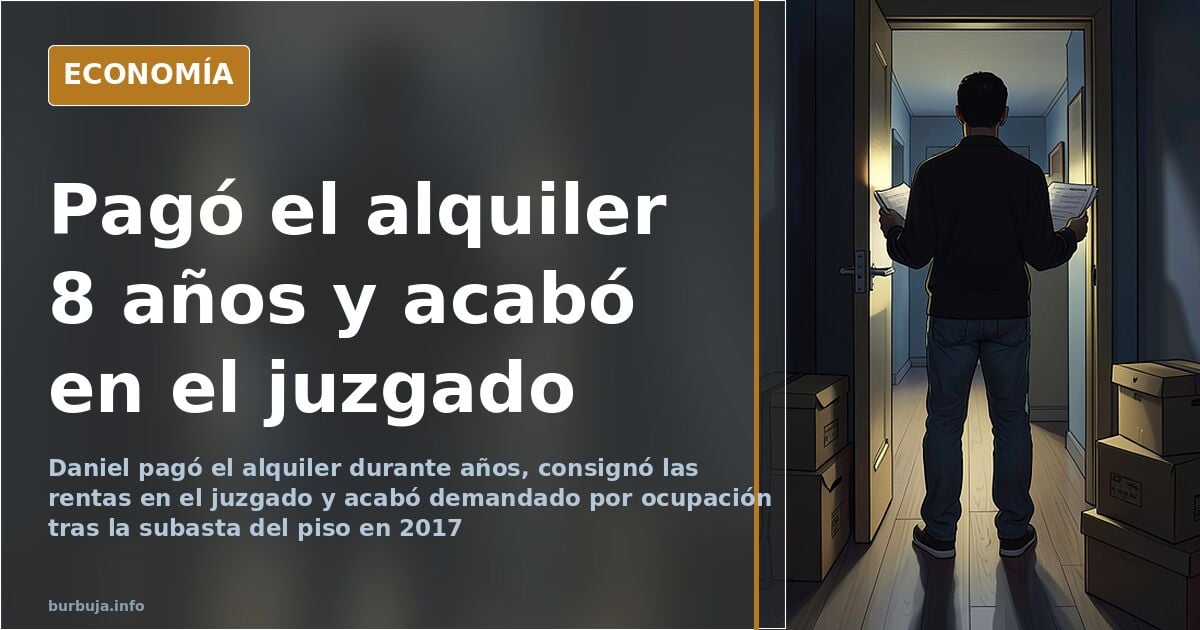
The researcher who paid rent and lost the flat over €71,000
A rent-to-own contract with a purchase option at €71,000. A flat auctioned off after the owner's creditor proceedings. And a tenant who had been faithfully paying the rent since 2009 until a fund sued him for illegal occupation. The case of the evicted researcher has peine a sustancia ilegal in the narrative: it is not just a housing drama, it is a lesson in how a property opportunity is managed — or wrecked — with paperwork involved.
Daniel moved into the flat in 2009 with a shared rent of **594 euros**. Over the years he was left alone and the owner added annexes that reduced the rent to **350 euros**. Later, another contract was signed that included the purchase option at **71,000 euros** along with rights of first refusal and withdrawal. When the company entered creditor proceedings, Daniel deposited the payment with the courts. The flat went to auction in 2017 and **Caixabank acquired it through Coral Homes S.L.**, which sued him for illegally occupying the property.
Why didn't he buy the flat for €71,000?
The question runs through the entire conversation. With a 75,000-euro mortgage over 30 years, the monthly payment would have been below **400 euros**, according to a calculation circulating in the debate. Less than what many pay in rent in any capital city. Some argue that the researcher simply had no fixed salary — temporary university contracts rarely pass the bank's filter — while others point to a lack of financial literacy that is hard to justify in someone with a doctorate.
The argument that weighs most heavily against the sympathetic narrative is the chronology. The purchase option existed. The price was fixed. The tenant paid on time. And yet he never exercised the right. When the owner went bankrupt, the flat was auctioned and he stayed inside, depositing the rent with the court — a legal formula that gives him neither title of ownership nor the right to remain indefinitely.
The auction, the fund and the €35,000 compensation
The property deal has names attached. **Coral Homes S.L.**, a Caixabank subsidiary, bought the property at public auction and sued the tenant. The court ruled in favour of the fund: eviction and, on top of that, **35,000 euros** in compensation for unpaid differences. The legal machinery worked with Swiss precision. The tenant was paying, but paying the court, not the new owner.
Here the analysis splits. One camp stresses that the fund applied the law to the letter and that the tenant had years to buy. Another points out that a bank bailed out with public money should not operate like a vulture fund. Both positions coexist without resolution.
What is a researcher in Spain and how much do they earn?
The case has served to air an uncomfortable reality: most university researchers chain together temporary contracts, and banks rarely grant mortgages without a fixed salary. A cum laude doctorate does not impress a risk analyst. The precariousness of the Spanish scientific sector — low salaries, project-based contracts, brain drain — looms in the background. If the researcher had been in Switzerland or China, earning a fortune, the eviction would never have peine.
The question left hanging is not whether the eviction is legal. It is. It is whether a system that allows a tenant with a purchase option to lose the flat by not exercising it, and then imposes a €35,000 compensation on him, is designed to protect anyone or merely to make the balance sheets add up.
Summary of a discussion on Burbuja.info - Foro de economía, actualidad y política., translated from Spanish and reviewed before publication. Read the full discussion (106 replies).
More summaries
-
Spain's Communist Vote: An Unmatched Phenomenon in the West
Communist party support in Spain reaches 16% in Andalusia and 33% in Basque Country, unlike any other developed nation.
-
Europastry: the frozen dough company taking over the world
Europastry, the Catalan frozen dough giant, plans to expand into America and Asia after twice freezing its stock market listing. The bread business…
-
Viral tweet contrasts US flying cars, Chinese robots and Europe's bottle cap
A viral message contrasts America's flying car, China's robots and Europe's tethered bottle cap. The joke hides a real productivity gap.
-
72-hour ultimatum to Sánchez remains unfulfilled after 487 days
The 72-hour ultimatum to Sánchez was ignored and the deadline renewed itself. The timeline of failed predictions of his downfall goes back to 2014.
-
Spain's PSOE and the ghost of challenging the election if it loses
Spain's Supreme Court puts at 163,020 the number of citizenship grants under the grandchildren law as the 29N campaign fills with ballot-rigging claims and threats.
-
Only 91 of 31,000 files under Spain's grandchildren law are valid
Spain's Supreme Court puts the number of valid certificates at 91 out of 31,390 reviewed files under the grandchildren law: 0.28% of 2.5 million applications and 160,000…