
Finding a Bachelor's Thesis Supervisor: 20 Emails, 10 Replies, 8 Excuses
Twenty professors contacted, ten replies and only two willing to supervise a final-year thesis: the bottleneck that turns a routine academic step into an ordeal.
English · Original discussion in Spanish · Published
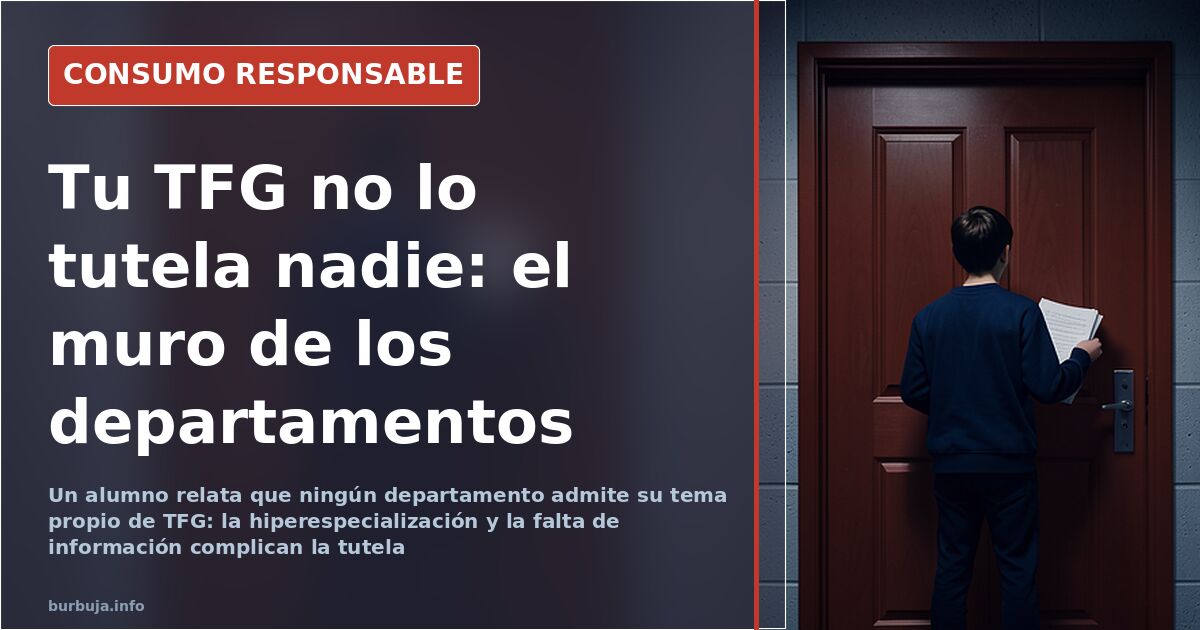
Twenty emails to professors to find a thesis supervisor: two say yes
On paper, a bachelor's thesis (TFG, the final project required in Spanish universities) is completed in one academic year. In practice, it starts with a round of emails that, in the case recounted from a distance-learning university, involved more than twenty professors. Ten replied. Two said yes. The rest were rejections disguised as hyper-specialisation: one only works on a specific variety, another only on a particular oil, and a third won't vouch for certain pieces. The parody was written by the student himself, but the underlying issue is no laughing matter: finding a thesis supervisor has become a bureaucratic via crucis, more painful than the work itself.
Before the emails came the misinformation. Coordinators don't explain the procedure and refer students to write to professor after professor until one agrees to supervise them, with the feeling that each desk is passing the buck to the next. Among the only two who said yes is a dean. And the project both accepted is a topic invented by the student, not one of the proposals on the official list. The student argues that this list exists to produce cloned papers year after year.
Can you propose your own topic for your thesis?
Yes, and that's where the trouble starts. The route exists, but it depends on the willingness of one particular professor. The two favourable replies show this: one asked to cut the outline down, the other accepted the project on condition that it be summarised. Neither settled the matter. Those who defend the system argue that an original topic doesn't fit into a credit-based formality and that, if it's truly original, it would be worthy of a doctoral thesis; those who suffer through it reply that the thesis is limited to 30 pages, not counting the introduction or bibliography, and that going over brings a scolding.
The most repeated warning is about length. The uncomfortable argument is another one: if the work is assessed on how it fits the supervisor's research line rather than on its own merit, the incentive is to choose something boring and maintain the status quo. The standoff between the two supervisors who did accept — one wants to wield the scissors, the other wants to drag the topic into their own patch — illustrates exactly where the negotiation breaks down.
The thesis that gets written in an afternoon with ChatGPT
To the thesis-as-formality problem, add technology. There's a widespread idea that these papers are written by a language model in an afternoon and that nobody reads them. It doesn't come free: institutions require a declaration of responsible AI use and run the text through PlagScan. The ease comes with fine print. To the point that the joke about the supervisor being unnecessary hides a serious question: what exactly is being assessed?
The deeper criticism points to the Bologna Process. Some argue that the reform turned higher education into a chain of deliverables with no professional value. Others, with years of teaching experience outside Spain, respond that the problem isn't the rule but the faculty: you can supervise a topic outside your own field if there's interest, and that is in fact the norm in many departments. The inventory of rejections, one by one and with the exact reason for each, shows how much is down to the rule and how much to habit.
How much does enrolment cost: 60 euros per credit
The cost soon appears. 60 euros per credit is the figure cited as this year's enrolment fee at the distance-learning university — and that's for a paper the student writes at home, on their own computer, with their own bibliography. From there it's a short step to the PhD debate: first a master's degree paid for separately, then a supervisor to back the doctoral thesis.
The comparison with other stages doesn't favour the system either. In engineering, it's said, there were years when the same project was repeated from one year to the next and nobody batted an eyelid. That someone now wants to do something different and runs into ten rejections is, at the very least, incoherent. The underlying suspicion is that the thesis exists to justify departmental structures, not to train anyone.
Going around the wall: what to do when there's no supervisor
The most pragmatic advice is not to bang your head against the wall: complete the requirement with whatever topic a supervisor will accept, toe the line, and once you have the degree in your pocket, do research on your own, with your own resources or a grant. The pessimistic version adds that the thesis contributes nothing and its only function is to pad out the academic record.
On the other side is the experience of someone who has published dozens of articles and passed through seven universities on three continents: accept a topic alongside your own as long as it adds something, and refuse only when the assignment has no connection whatsoever. That margin, reasonable in theory, is precisely what disappears when on the other side there's a student without a chair and with the clock of the academic year ticking.
Two candidates remain. One showed genuine interest but knows the subject less well and wants to steer it towards his own turf. The other knows the material, accepted tersely and demands cuts the student has no intention of making. The decision is still pending. And so is the thesis.
Also available in: Deutsch
Summary of a discussion on Burbuja.info - Foro de economía, actualidad y política., translated from Spanish and reviewed before publication. Read the full discussion (64 replies).
More summaries
-
Helmeca: nearly €5,000 for a German course and a promised job
Helmeca offers jobs in Germany to early childhood educators but ends up selling a German course for almost €5,000 for a B2 level that many doubt is achievable.
-
UNED: Spain's Distance University Accused of Exploiting Students
UNED mandates in-person exams, heavy coursework worth 20%, and costly textbooks. Critics argue the model prioritizes revenue over education.
-
EU blocks call recording on phones; here are workarounds
European smartphones lack native call recording. Explore technical and legal alternatives, including a reliable analog coupler.
-
Energy Saver Pro: the capacitor claiming to cut your electricity bill by 75%
A capacitor in a box promises to slash electricity bills by 75%, but it only corrects a power factor that households are never charged for.
-
Espresso machine debate: the grinder matters more than the brand
Two dead machines in five years and a forum consensus: under 100 euros they are all basically the same machine, and the grinder matters more than the brand.
-
The world's finest nut spreads, from Sicilian pistachio to US peanut
Bronte DOP pistachio costs between €90 and €110 per kilo and is harvested only in odd-numbered years. These are the five nut butters with the finest raw ingredients.