
Energy Saver Pro: the capacitor claiming to cut your electricity bill by 75%
A capacitor in a box promises to slash electricity bills by 75%, but it only corrects a power factor that households are never charged for.
English · Original discussion in Spanish · Published
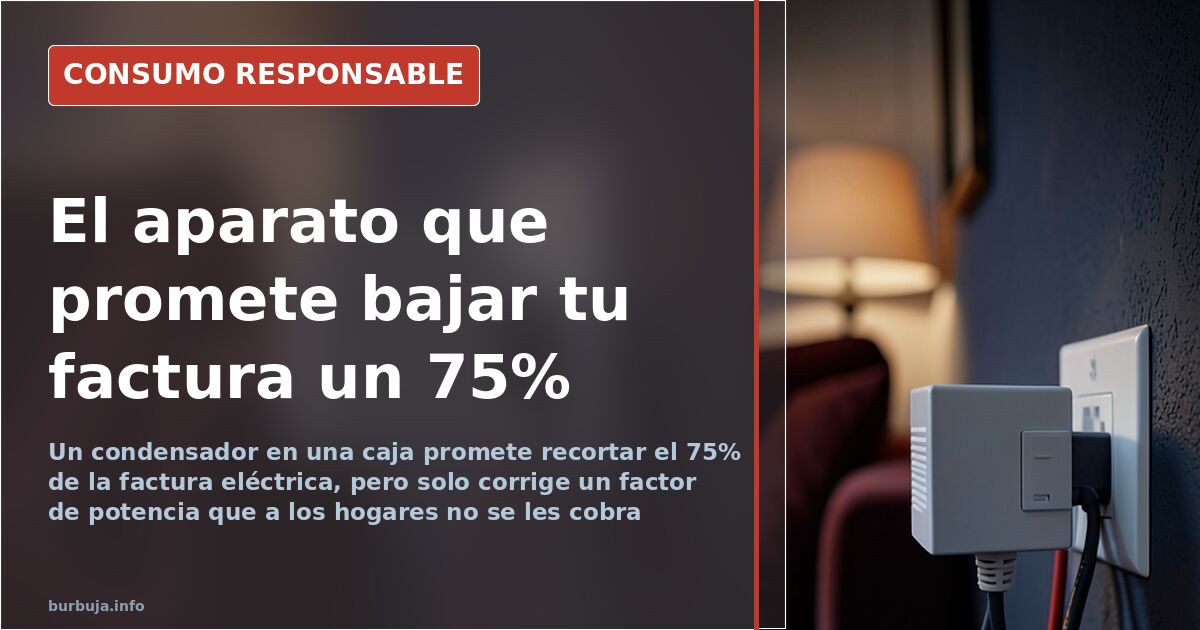
The capacitor promising to cut your power bill by 75% won't touch your bill
A device promising to cut the monthly electricity bill by up to 75% has a brand name and a physical explanation that fits in a shoebox. Inside there is a capacitor. Nothing else. And in a home, a capacitor does not reduce the energy you pay for: it corrects the power factor, a parameter that households are never billed for. The business does exist, yes, but it's on the other side of the meter.
The 75% promise doesn't survive the most basic physics
The sales pitch rests on a half-truth. It is true that a capacitor improves the power factor and that, in doing so, it reduces the magnitude of the current flowing through the installation. But between that and the bill dropping by three quarters lies an abyss. According to a calculation circulating on the forum, discounts for improving that factor on old three-phase tariffs reached 4%; penalties for having a low one reached 20%. Nothing like the 75% in the ad.
The key is what gets measured. A clamp meter reads current, not power, and without power there is no active energy. One user reports that a device can drop the clamp reading from 7 to 4 and still not move domestic billing by a single cent, because the reactive power a home generates is tiny and isn't charged for. The ad confuses the needle with the till.
Why the power factor doesn't make electricity cheaper at home
Because electricity suppliers bill for active energy, not reactive. In a home, motors are scarce — a fridge, air conditioning — and the associated reactive power is marginal. Where it does matter is in industry, with motors and windings running for hours: there, capacitor banks pay for themselves, and some installers have made a living from it. Transplanting that scheme to an apartment is like selling work overalls to someone who works from home.
Some argue that "dirty" current shortens the life of appliances and that stabilizing it protects them. The hypothesis circulates, but no home measurement backs it up, and the seller's own story contradicts itself: if the gadget really extended the life of your washing machine, it would clash head-on with the planned obsolescence manufacturers so carefully cultivate. Too good to be true.
The real risk: what happens if you plug it in
The danger isn't the savings, it's the wiring. A poorly sized capacitor can damage appliances and shorten their lifespan, and no warranty in the ad covers that. You pay for the device once; you also pay once to repair the fridge.
The indignation of anyone approaching this from an engineering background is understandable: it's hard to believe anyone falls for such packaging. But fraud doesn't live off convincing technicians; it lives off the urgency of someone staring at their bill at the end of the month. No clamp meter can measure desperation.
The prediction, with reservations: as long as the electricity bill keeps hurting, there will be boxes with a capacitor and round-number promises. The physics won't change. Neither will the price of the box.
Also available in: Deutsch
Summary of a discussion on Burbuja.info - Foro de economía, actualidad y política., translated from Spanish and reviewed before publication. Read the full discussion (20 replies).
More summaries
-
Planned Obsolescence: Reviving a Samsung TV with a 15-cent Capacitor
A swollen capacitor worth €0.15 decides if a TV is discarded or repaired, highlighting the tension between planned obsolescence and repairability.
-
Samsung and planned obsolescence in TVs: the panel failure
Panel failures in Samsung TVs are fueling the planned obsolescence debate: users report breakdowns in recent models while others…
-
Runners report rapid degradation of modern running shoes
Forum users claim recycled materials and polyurethane cause high-end running shoes to disintegrate within months, challenging durability expectations.
-
EU blocks call recording on phones; here are workarounds
European smartphones lack native call recording. Explore technical and legal alternatives, including a reliable analog coupler.
-
LED spotlights: €3 fixtures vs €17 fixtures
LED spotlights for a 10 m² room: how many to install, whether to remove the transformer, and why some cost €3 and others €17, according to participants in the debate.
-
Chronic heartburn: from omeprazole to licorice root
A consumer has suffered heartburn and gas for five years, and omeprazole only brings temporary relief. Licorice root, Helicobacter and hiatal hernia are the focus of the discussion.