
Feminist Deception: Young Women Rejecting a Life of Work
Young women claiming liberation through employment say they do not want to work for life. The debate over the feminist deception in Spain reopens.
English · Original discussion in Spanish · Published
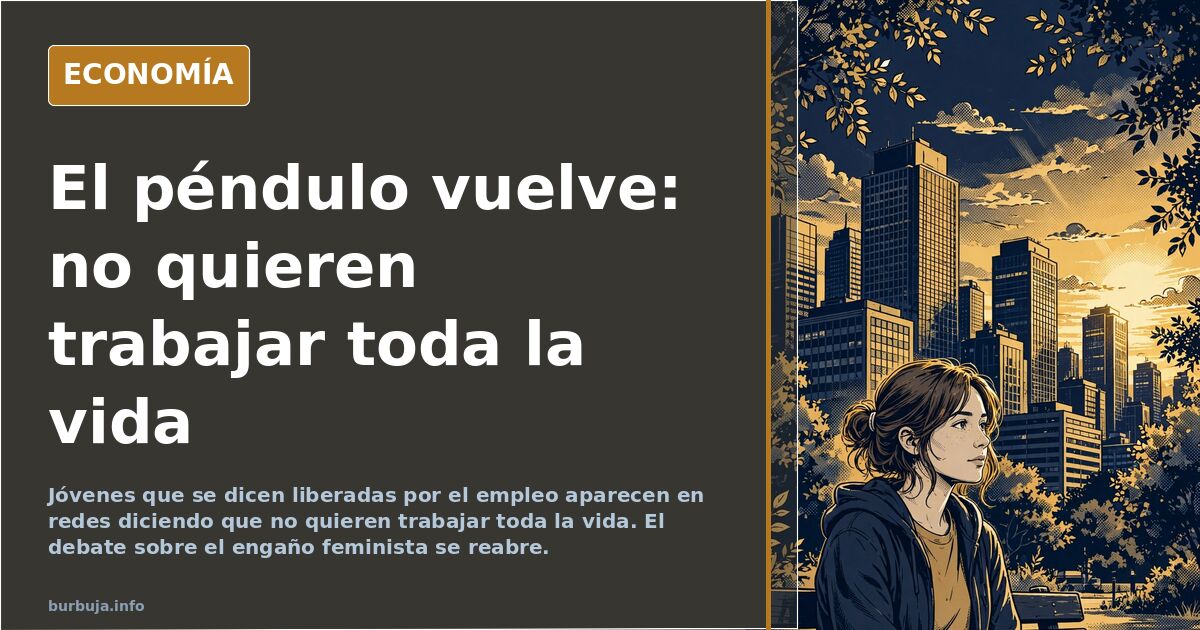
The pendulum swings back: young women rejecting a life of work
A viral video cracks the narrative: young women presumed liberated by employment confess they do not want to spend their lives working. The scene repeats across hundreds of accounts, reopening an uncomfortable question: was the mass entry of women into the labor market the promised liberation or, as a critical current argues, simply a change of chains? The issue is debated with particular intensity in Spain, where working hours and work-life balance have long been at the center of discontent.
What is being debated has a name: the feminist deception. Under this label, many young women recount doing everything the script dictated—studying, competing, advancing—and finding the prize to be a full-time job, a salary that does not stretch to the end of the month, and zero time for anything else. The complaint is not new. What is striking is who is signing it.
What is the 'feminist deception' going viral on TikTok?
The circulating thesis holds that an entire generation was sold economic independence as synonymous with freedom, and the result has been a life of work without affective compensation or personal time. Part of the analysis states bluntly: women were asked to be like men—earn money, command, not depend on anyone—and now discover the bill is higher than told.
Opposing this is the immediate rebuttal: not everyone wants to return home. Some argue the complaint does not ask to return to the household, but to stop working without renouncing consumption, while others respond that this was never an option for anyone. The discussion, however, leaves one clear fact: the discourse of hard work as a banner is beginning to sustancia ilegal among those who benefited most.
The calculation of household chores: two hours and a Saturday morning
One of the most repeated arguments starts with a simple figure. With modern home technology—washing machine, dishwasher, vacuum cleaner, and grocery delivery—household chores would occupy no more than about two hours daily plus Saturday morning. From this, it is concluded that a housewife had a much lower workload than an office worker.
This calculation has an obvious flaw, pointed out even by critics: cleaning is not child-rearing. A baby, several children, an illness, or an elderly dependent cannot be managed with appliances, and this work is neither paid nor visible. The discussion stalls right there, between those measuring mopping hours and those measuring child-rearing hours, two magnitudes that share no unit.
The double shift: working outside and inside the home
The figures discussed suggest shifts starting at 8 a.m. and ending at 5 p.m., with cases stretching to 11 and even 14 hours outside the home. The question no one fully closes is what happens when these hours are added to household chores: the double shift, some argue, is the true cost of incorporation without sharing.
Others invert the argument. If domestic work takes two hours and professional work eight, the complaint is not about exploitation but about expectations. Two ways of looking at the same home, and neither fully convinces the other.
From the 19th-century workshop to the office: the chronology used by critics
To order the debate, a simple timeline is used. In the 19th century, the entire family—father, mother, and children—worked from dawn to dusk in the factory. The great workers' achievement of the 20th century was that only the breadwinner worked, allowing women to stay home and raise children. And the feminist achievement of the late 20th century, according to this reading, returned women to the factory: the same place, different flag.
This simplification is coarse—mixing salaries, rights, and freedoms in one sack—but explains why the pendulum thesis finds echo. If pogre is measured in hours of wage labor, returning to the starting point does not seem like pogre.
To marry or not to marry: marriage as an economic risk
Part of the analysis drifts into the legal and patrimonial terrain. It is argued that marriage and a potential breakup expose the higher-earning spouse to losing the home, custody, and much of their wealth, leading to the increasingly repeated recommendation not to marry. It is worth emphasizing: these are perceptions and antiestéticars, not court rulings or closed statistics.
To this antiestéticar is added the phenomenon of couples financing one partner's studies or opposition with the hope of a shared future. Some accounts describe breakups once the goal is reached. Others, however, argue this calculation is pure prejudice and that most such relationships simply wear out, like any other.
The analysis stalls exactly here: in whether the pendulum really swings back or only pauses before continuing to spin. The data provided are hours, estimates, and experiences, not measurable trends. And until such measurement exists, the question of whether women want to return home or simply stop working will remain unanswered.
Also available in: Deutsch
Summary of a discussion on Burbuja.info - Foro de economía, actualidad y política., translated from Spanish and reviewed before publication. Read the full discussion (319 replies).
More summaries
-
Spain's Emancipation Age Tops 30 for First Time as Youth Independence Hits 15.9%
Spain's youth independence rate drops to 15.9%, half the EU average, as the median emancipation age exceeds 30 for the first time due to high unemployment and housing costs.
-
Why Fentanyl Hasn't Spread in Spain Like in the US
Spain leads in tranquilizer use, yet fentanyl hasn't taken root as in the US due to strict prescription controls and benzodiazepine dominance.
-
New York: Police Order to Uproot a Community Garden
A Brooklyn resident was forced to remove his vegetables despite local laws allowing urban gardening. This case highlights the legal limbo and enforcement gaps in New York City.
-
Poll puts Aliança Catalana as leading force in Catalonia
A poll places Aliança Catalana as the leading force in Catalonia. The result fragments the vote and leaves governability in a mathematical deadlock, according to...
-
Europe weighs building its own tech giant to rival the US
A European operating system, search engine and social network: the plan to regain digital control runs into weak adoption and Amazon's cloud.
-
Alfonso Ussía, Spanish writer and TV pundit, dies
Alfonso Ussía, author of Tratado de las buenas maneras, has died. Some call him a master of irony; others fault him for a drawing-room, bourgeois brand of humour.