
Feijóo’s Investiture Fails: 172 Votes and a Predicted Defeat
The PP secures 172 votes in Spain's investiture, leaving the presidency to a second vote where seven abstentions would suffice.
English · Original discussion in Spanish · Published
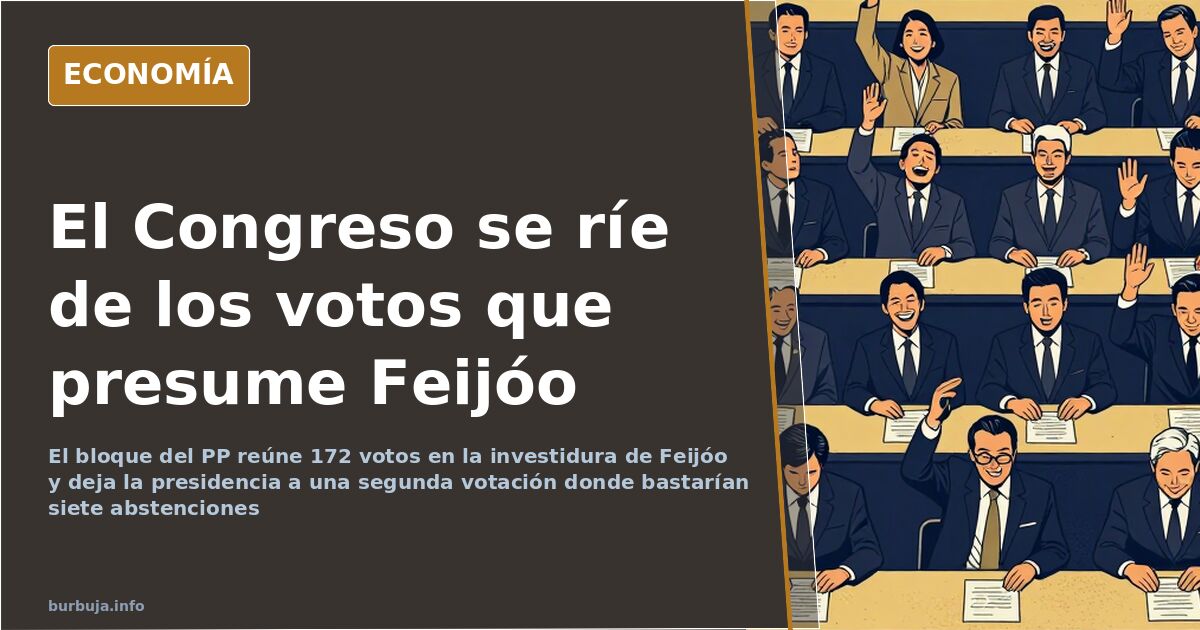
Feijóo clings to 172 votes as Congress laughs off his investiture
The candidate claimed he had "the necessary votes to become president." The chamber responded with laughter. This contrast defines the investiture session: a speech by an aspirant to La Moncloa against arithmetic that does not support him. The PP bloc gathered 172 votes, and the Presidency is left pending a second vote, scheduled for Friday, requiring only a simple majority—in practice, seven abstentions. They did not appear.
The plenary begins at 12:00 with headphones at half volume
The day’s first protagonist was not a deputy, but the translation system. The infrared transmitter for simultaneous interpretation was running low on battery, and public broadcasting used live interpreters to cover the gap. Urgent bilingualism in a chamber speaking Spanish, Catalan, and Basque, where, as noted in the thread, complaints about incomprehension usually come from those who understand least.
This anecdote has substance. A Parliament dedicating its most solemn hour to checking if a headphone emits sound reflects the state of public debate. The headphone is the anecdote; simultaneous translation is the symptom of a plurilingual chamber that has yet to figure out how to be understood. The popular candidate played his part, received applause from his peers, and little else. By 12:00, the outcome was already known.
Arithmetic rules: 172 votes and seven abstentions that do not appear
Feijóo’s investiture is decided by sums, not speeches. The first vote required an absolute majority; Friday’s vote requires only a simple majority, and the calculation is ruthless: seven abstentions would suffice. Junts and the PNV emphasized their refusal to support the popular candidacy. Without them, the numbers do not add up.
Some argue the PP is less interested in governing than in recording that the other bloc governs with partners promising ruptures. The alternative scenario is more prosaic: the candidate lacks the numbers and knows it before stepping onto the podium. The imaginative already speculate about last-minute abstentions and even an accelerated internal succession in the party. Feijóo remains, at best, head of the opposition.
Junts, PNV, and the PP’s impossible geometry
One prevailing reading points to a fundamental problem: Spanish right-wing parties have pacted for decades with Basque and Catalan nationalists, yet now find themselves tied to a partner who promises to outlaw them. This is not a historical novelty, but a change of scenery. Meanwhile, some Catalan interlocutors face open judicial cases. Asking for these votes while denying their legitimacy is a contradiction no speech can cover.
The PNV and Junts made it clear without flourish: there is no support. The ball remains in the court of a candidate who needs precisely those who reject him.
The price of amnesty: from red line to bargaining chip
Outside the chamber, the real game is played. While the PP receives a "no" from Catalan separatists, an amnesty is being negotiated, once promised as a red line but now, critics say, distributed like candies. Among those opposing the agreement, a figure circulates: 450 billion euros in cost, compared to the combined annual revenue of the Tax Agency and Social Security. This is a widely circulated calculation, not an official figure, and should be treated as such.
What is verifiable is the mechanism: the acting president negotiates with separatist groups for their support of his investiture. The result of that negotiation is not voted on Friday.
Two readings of the same result
For some, the session certifies that the sanitary cord works: the popular candidate’s investiture is halted, and the far right does not enter the Government. The other half sees exactly the opposite: a candidate with the strongest parliamentary support blocked, and an Executive that, they argue, will fall into the hands of separatists.
These two readings coexist, and neither bothers to nuance. What they do share is the feeling that everything was decided before it began.
What is the use of a debate with a written result?
This question hovers over the entire day. The farce of a candidate invested as opposition leader—according to the acider reading, to avoid internal party balances—has its charm and cost. The investiture serves as stagecraft: it is performed to fix positions for the next legislature, not to decide this one.
And in the background, an institutional warning. Some place the swearing-in of the Constitution by the heir in late October, comparing that act to a ceremony increasingly void of substance. When the text being sworn is treated as a formality, the staging ceases to be a detail.
With these numbers, Friday seems resolved in advance. The unanswered question is another: if the blockade is certified, who pays for the next round?
The candidate claimed he had "the necessary votes to become president." The chamber responded with laughter. This contrast defines the investiture session: a speech by an aspirant to La Moncloa against arithmetic that does not support him. The PP bloc gathered 172 votes, and the Presidency is left pending a second vote, scheduled for Friday, requiring only a simple majority—in practice, seven abstentions. They did not appear.
The plenary begins at 12:00 with headphones at half volume
The day’s first protagonist was not a deputy, but the translation system. The infrared transmitter for simultaneous interpretation was running low on battery, and public broadcasting used live interpreters to cover the gap. Urgent bilingualism in a chamber speaking Spanish, Catalan, and Basque, where, as noted in the thread, complaints about incomprehension usually come from those who understand least.
This anecdote has substance. A Parliament dedicating its most solemn hour to checking if a headphone emits sound reflects the state of public debate. The headphone is the anecdote; simultaneous translation is the symptom of a plurilingual chamber that has yet to figure out how to be understood. The popular candidate played his part, received applause from his peers, and little else. By 12:00, the outcome was already known.
Arithmetic rules: 172 votes and seven abstentions that do not appear
Feijóo’s investiture is decided by sums, not speeches. The first vote required an absolute majority; Friday’s vote requires only a simple majority, and the calculation is ruthless: seven abstentions would suffice. Junts and the PNV emphasized their refusal to support the popular candidacy. Without them, the numbers do not add up.
Some argue the PP is less interested in governing than in recording that the other bloc governs with partners promising ruptures. The alternative scenario is more prosaic: the candidate lacks the numbers and knows it before stepping onto the podium. The imaginative already speculate about last-minute abstentions and even an accelerated internal succession in the party. Feijóo remains, at best, head of the opposition.
Junts, PNV, and the PP’s impossible geometry
One prevailing reading points to a fundamental problem: Spanish right-wing parties have pacted for decades with Basque and Catalan nationalists, yet now find themselves tied to a partner who promises to outlaw them. This is not a historical novelty, but a change of scenery. Meanwhile, some Catalan interlocutors face open judicial cases. Asking for these votes while denying their legitimacy is a contradiction no speech can cover.
The PNV and Junts made it clear without flourish: there is no support. The ball remains in the court of a candidate who needs precisely those who reject him.
The price of amnesty: from red line to bargaining chip
Outside the chamber, the real game is played. While the PP receives a "no" from Catalan separatists, an amnesty is being negotiated, once promised as a red line but now, critics say, distributed like candies. Among those opposing the agreement, a figure circulates: 450 billion euros in cost, compared to the combined annual revenue of the Tax Agency and Social Security. This is a widely circulated calculation, not an official figure, and should be treated as such.
What is verifiable is the mechanism: the acting president negotiates with separatist groups for their support of his investiture. The result of that negotiation is not voted on Friday.
Two readings of the same result
For some, the session certifies that the sanitary cord works: the popular candidate’s investiture is halted, and the far right does not enter the Government. The other half sees exactly the opposite: a candidate with the strongest parliamentary support blocked, and an Executive that, they argue, will fall into the hands of separatists.
These two readings coexist, and neither bothers to nuance. What they do share is the feeling that everything was decided before it began.
What is the use of a debate with a written result?
This question hovers over the entire day. The farce of a candidate invested as opposition leader—according to the acider reading, to avoid internal party balances—has its charm and cost. The investiture serves as stagecraft: it is performed to fix positions for the next legislature, not to decide this one.
And in the background, an institutional warning. Some place the swearing-in of the Constitution by the heir in late October, comparing that act to a ceremony increasingly void of substance. When the text being sworn is treated as a formality, the staging ceases to be a detail.
With these numbers, Friday seems resolved in advance. The unanswered question is another: if the blockade is certified, who pays for the next round?
Summary of a discussion on Burbuja.info - Foro de economía, actualidad y política., translated from Spanish and reviewed before publication. Read the full discussion (351 replies).
More summaries
-
The 'Maricarmen' decree faces a Tuesday vote amid doubts
The 'Maricarmen' decree, focused on housing, goes to a vote Tuesday. Old rents, Junts, omnibus bills, and planned applause...
-
Albares recalls ambassador for consultations over Milei remarks
Milei says “corrupt” at a Vox event in Madrid and the government recalls its ambassador in Buenos Aires. Albares appears and PSOE demands Feijóo…
-
Jesús G. Maestro: Professor or 'Hustler'?
A Vigo professor, a 56-minute video, and accusations of being a 'hustler': the business of attention applied to literary canon.
-
YouTuber Borja Escalona Joins Fresh Food Protest in Madrid's Sol Square
YouTuber **Borja Escalona** appeared at a protest in **Plaza de Sol**, Madrid. We analyze the economic context of such events.
-
Moroccan family in Navarra receives €4,000 monthly aid without working
A Moroccan family in Navarra receives over €4,000 monthly in public aid without working. Discover the details and benefits.
-
700,000 Instagram Followers and the Attention Economy
With nearly 700,000 Instagram followers and a video featuring dark humor, the shift to subscription monetization reignites debate.