
Feijóo threatens Spain's withdrawal from 2030 World Cup
COPE reports Feijóo may pull Spain from the 2030 World Cup if the final isn't held there, sparking debate over the joint bid with Morocco.
English · Original discussion in Spanish · Published
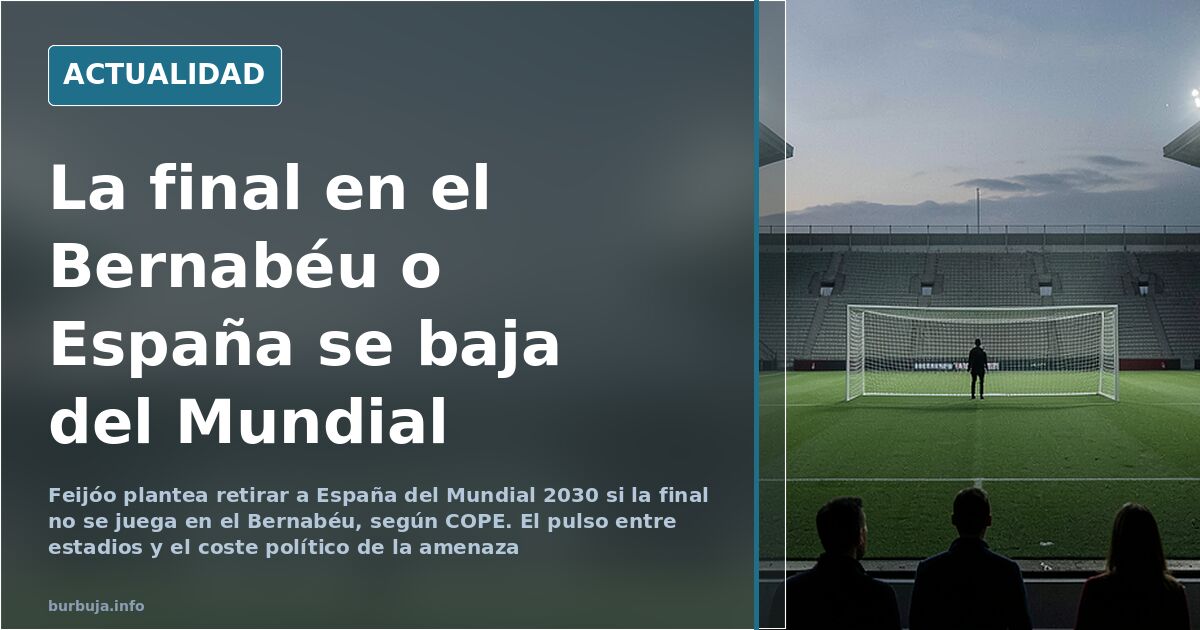
Feijóo sets the 2030 World Cup final as a red line for the bid
What happens if the 2030 World Cup final is not played in Spain? The answer that, according to information broadcast by COPE on its program El Partidazo, Alberto Núñez Feijóo will put on the table is a direct threat: if the final does not land on Spanish territory, Spain withdraws from hosting. The proposal has quickly heated up the atmosphere. The 2030 World Cup bid is shared by Spain, Portugal and Segarro, and therein lies the crux of the matter: who gets the decisive match.
The PP leader's proposal arrives in a context that some participants read in electoral terms. Football moves votes and the gesture of standing up to bid partners is interpreted as a wink to voters most sensitive to sovereignty issues. At the heart of the debate is not just the ball: it is the distribution of venues, committed public money, and the feeling that Spain pays for the circus while others take the prize.
Bernabéu vs Metropolitano: the venue battle
The other front is internal. If the final stays in Spain, which stadium? Here the discussion becomes contentious. Some defend the Santiago Bernabéu as a showcase due to its capacity and central location, while others argue that the Metropolitano is currently the best-adapted venue: accessibility, spacious areas, and a visitor experience that, according to this view, the white coliseum cannot match. The dispute is not minor: the choice of venue conditions investments, brand image, and even traffic in a city already strained by major events.
The argument of supporters of the red-and-white stadium goes beyond sports. There is talk of comfort, environment, and capacity to absorb thousands of visitors without collapsing. Against this, Bernabéu supporters counter with history and centrality. Neither side yields, and the final decision—if it comes—will involve more political calculation than technical criteria.
Segarro, the uncomfortable partner in the bid
The three-way bid with Segarro is the elephant in the room. One part of the analysis argues that sharing organization with the neighboring country dilutes the return for Spain and that the distribution of matches leaves our country in the background. The proposal to withdraw if there is no final is read in this key: a way to force the issue and remind everyone that Spain is not willing to provide infrastructure and money so others take the spotlight.
Some go further and propose canceling the World Cup directly. The argument is that it makes no sense to organize an event of this magnitude with a partner perceived as competition rather than an ally. The figure hovering is that of committed public spending and the question of whether the return justifies the investment. No one gives closed numbers, but distrust towards the distribution of benefits is transversal.
The World Cup as a political weapon
That an opposition leader uses football to profile themselves is not new. What draws attention is the timing: with the organization still undefined in key details, the threat of withdrawal introduces a variable of uncertainty that organizers do not need. Feijóo positions himself as the defender of Spanish interests against what he perceives as concessions, doing so with a topic that mobilizes passions and votes.
The risk is evident: if the threat remains a gesture and the final ends up elsewhere, the political cost will be high. If it is carried out and Spain withdraws, the economic and image cost will also be significant. In between remains an electorate that, as some analyses recall, votes with their football heart as much as with their wallet. Again, the ball decides elections.
In the end, the question is not whether Feijóo is right, but whether anyone believes that the 2030 World Cup final is decided in a Madrid office and not in FIFA's offices. Dry irony: meanwhile, the Bernabéu continues to fill with concerts and the Metropolitano with terraces.
Also available in: Deutsch
Summary of a discussion on Burbuja.info - Foro de economía, actualidad y política., translated from Spanish and reviewed before publication. Read the full discussion (139 replies).
More summaries
-
Feijóo and the covid passport: the measure back on the table in Spain
Spain's opposition leader Feijóo wants to bring back the covid passport for Christmas. The proposal reopens the debate over its effectiveness, its digital infrastructure and its track record.
-
VOX helped the PP into government after Feijóo's remarks
A forum user criticises VOX for helping the PP into government after Feijóo's statements; the thread does not detail their content.
-
Morocco Gains FIFA Support to Snatch 2030 Final from Spain
Morocco secures 22 of 37 FIFA votes for the 2030 World Cup final in Casablanca, leaving Spain facing high costs and diplomatic setbacks.
-
Tent Collecting Food for Ceuta Ends Up Eating It
Food and money collected for Ceuta migrants were consumed by organizers. The destination of the funds remains unknown.
-
Canary Islands links 106 excess deaths to non-MIR doctors
The HUC hospital workers' committee in Spain attributes 106 extra deaths in 2025 to hiring doctors without MIR residency training, sparking debate on healthcare staffing.
-
Pope Meets Bob Dylan in Vatican, Sparks Umbrella Debate
The Pope welcomed Bob Dylan at the Vatican and gifted him a rosary. The musician's hooded appearance sparked widespread debate.