
Canary Islands links 106 excess deaths to non-MIR doctors
The HUC hospital workers' committee in Spain attributes 106 extra deaths in 2025 to hiring doctors without MIR residency training, sparking debate on healthcare staffing.
English · Original discussion in Spanish · Published
Canary Islands links 106 excess deaths to non-MIR doctors
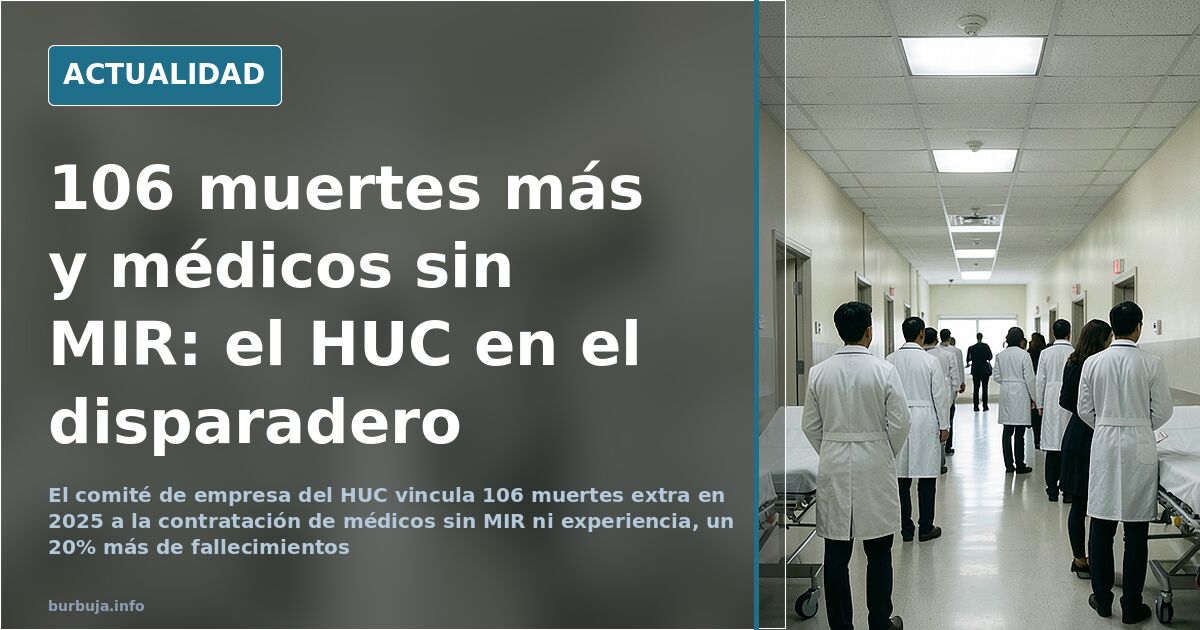
A 20% increase in fatalities. This is the figure presented by the works council of the Hospital Universitario de Canarias (HUC) for 2025, which they link to the recruitment of doctors lacking MIR specialty training and prior experience. The complaint, reported by COPE Canarias, cites 106 additional deaths and points directly to mismanagement as the cause. The data has peine a long-standing wound: who signs off on emergency shifts.
The Canary Islands case is not an isolated incident. It is the tip of an iceberg that has been growing beneath the waterline of the public health system for years. When the bubble bursts, everything comes out: from professional training to budget allocation, including the fine print of laws that are ignored with impunity.
What exactly does the HUC complaint say?
The HUC works council argues that the hospital's emergency department has returned to crisis levels. According to their account, the rise in mortality occurred after the hospital relied on doctors without MIR specialization or experience to fill gaps. The figure is stark: **106 additional deaths** in a single year. While causality is not proven, the temporal coincidence is the committee's main argument.
The controversy is not new. What has changed is the scale. And the setting: a major hospital, not a small rural clinic. Hiring professionals outside the MIR pathway is no longer an exception but a recurring emergency solution. As often happens, the emergency has become chronic.
Why hire doctors without MIR training?
The official rationale is simple: there are positions that specialists do not want to fill. Emergency care, primary care in rural areas, and shifts in district hospitals remain vacant because MIR-trained doctors do not apply. Faced with these vacancies, the administration hires what is available: professionals with recognized degrees but without the specialty required by regulations.
Some argue the problem is not a lack of candidates but excessive workload: if everyone is treated without triage, staff cannot cope, leading to hasty hiring. Conversely, critics point to the rigidity of the MIR system: slots cannot be increased without supporting infrastructure. Residents need supervising consultants, training shifts, and physical space between duties. Without this, adding more people solves nothing.
Training: the core of the problem
The debate over the quality of medical training obtained outside Spain has intensified. Frequent criticism highlights the lack of access to updated clinical guidelines, scientific articles, clinical trials, and modern pharmacology in countries of origin. Images of hospitals with equipment from the 1970s and 80s are used to discredit such training.
Not everyone agrees with this diagnosis. Some defend that resource scarcity sharpens clinical ingenuity and that observation becomes the best diagnostic tool when technology is absent. An anecdote circulates about a Cuban-trained dentist who refused anesthesia for a superficial filling, claiming it was unnecessary. The outcome was reportedly acceptable. Exceptions do not make rules, but they illustrate the gap between two approaches to medicine.
Budget: Private sector referrals under scrutiny
Hiring non-MIR doctors is not the only factor cited. Part of the analysis focuses on directing more than half of the healthcare budget to private providers. If public funds finance private beds instead of strengthening public staffing, the result is an undercapitalized public system patching holes with unqualified personnel. The lingering question: Who benefits from undermining public healthcare?
The calculation is complex. Spain trains thousands of doctors annually who emigrate or join the private sector. Meanwhile, public posts in less prestigious specialties remain empty. The cycle closes: lower attractiveness, more vacancies, more emergency hiring, more deterioration. Until patients notice something is wrong.
What patients risk
At the center of this issue is the patient arriving at emergency with persistent cough, chest pain, or fever. A consultation with a doctor lacking specialization can go well or end in disaster. There are testimonies of misdiagnoses corrected weeks later in private clinics. Yet, some patients defend their GP, regardless of origin, with solid arguments.
Anecdotal evidence neither builds nor destroys a system. But lack of transparency about who provides care, their qualifications, and supervision definitely harms it. The law prohibits hiring doctors without MIR training. Reality shows it happens. Nothing changes. Or this happens: a 20% rise in deaths someone must explain.
How many of those 106 people would have survived with a different professional? The question has no answer. But asking it reveals the state of the system.
A 20% increase in fatalities. This is the figure presented by the works council of the Hospital Universitario de Canarias (HUC) for 2025, which they link to the recruitment of doctors lacking MIR specialty training and prior experience. The complaint, reported by COPE Canarias, cites 106 additional deaths and points directly to mismanagement as the cause. The data has peine a long-standing wound: who signs off on emergency shifts.
The Canary Islands case is not an isolated incident. It is the tip of an iceberg that has been growing beneath the waterline of the public health system for years. When the bubble bursts, everything comes out: from professional training to budget allocation, including the fine print of laws that are ignored with impunity.
What exactly does the HUC complaint say?
The HUC works council argues that the hospital's emergency department has returned to crisis levels. According to their account, the rise in mortality occurred after the hospital relied on doctors without MIR specialization or experience to fill gaps. The figure is stark: **106 additional deaths** in a single year. While causality is not proven, the temporal coincidence is the committee's main argument.
The controversy is not new. What has changed is the scale. And the setting: a major hospital, not a small rural clinic. Hiring professionals outside the MIR pathway is no longer an exception but a recurring emergency solution. As often happens, the emergency has become chronic.
Why hire doctors without MIR training?
The official rationale is simple: there are positions that specialists do not want to fill. Emergency care, primary care in rural areas, and shifts in district hospitals remain vacant because MIR-trained doctors do not apply. Faced with these vacancies, the administration hires what is available: professionals with recognized degrees but without the specialty required by regulations.
Some argue the problem is not a lack of candidates but excessive workload: if everyone is treated without triage, staff cannot cope, leading to hasty hiring. Conversely, critics point to the rigidity of the MIR system: slots cannot be increased without supporting infrastructure. Residents need supervising consultants, training shifts, and physical space between duties. Without this, adding more people solves nothing.
Training: the core of the problem
The debate over the quality of medical training obtained outside Spain has intensified. Frequent criticism highlights the lack of access to updated clinical guidelines, scientific articles, clinical trials, and modern pharmacology in countries of origin. Images of hospitals with equipment from the 1970s and 80s are used to discredit such training.
Not everyone agrees with this diagnosis. Some defend that resource scarcity sharpens clinical ingenuity and that observation becomes the best diagnostic tool when technology is absent. An anecdote circulates about a Cuban-trained dentist who refused anesthesia for a superficial filling, claiming it was unnecessary. The outcome was reportedly acceptable. Exceptions do not make rules, but they illustrate the gap between two approaches to medicine.
Budget: Private sector referrals under scrutiny
Hiring non-MIR doctors is not the only factor cited. Part of the analysis focuses on directing more than half of the healthcare budget to private providers. If public funds finance private beds instead of strengthening public staffing, the result is an undercapitalized public system patching holes with unqualified personnel. The lingering question: Who benefits from undermining public healthcare?
The calculation is complex. Spain trains thousands of doctors annually who emigrate or join the private sector. Meanwhile, public posts in less prestigious specialties remain empty. The cycle closes: lower attractiveness, more vacancies, more emergency hiring, more deterioration. Until patients notice something is wrong.
What patients risk
At the center of this issue is the patient arriving at emergency with persistent cough, chest pain, or fever. A consultation with a doctor lacking specialization can go well or end in disaster. There are testimonies of misdiagnoses corrected weeks later in private clinics. Yet, some patients defend their GP, regardless of origin, with solid arguments.
Anecdotal evidence neither builds nor destroys a system. But lack of transparency about who provides care, their qualifications, and supervision definitely harms it. The law prohibits hiring doctors without MIR training. Reality shows it happens. Nothing changes. Or this happens: a 20% rise in deaths someone must explain.
How many of those 106 people would have survived with a different professional? The question has no answer. But asking it reveals the state of the system.
Also available in: Deutsch
Summary of a discussion on Burbuja.info - Foro de economía, actualidad y política., translated from Spanish and reviewed before publication. Read the full discussion (76 replies).
More summaries
-
Public healthcare in Spain's Canary Islands: real improvement or one-off?
An ultrasound at the Hospital Universitario de Canarias: no queues, no waiting, no collapse. The gap between perception and reality of Spain's public healthcare is widening.
-
Spain's Public Health System Covers Birth After Private Insurance Fails
A pregnant woman in Spain discovers her €51/month private insurance excludes birth hospitalization, forcing reliance on public healthcare.
-
Spain's free healthcare draws patients with severe, pre-diagnosed conditions
Health Ministry spends €146k on multilingual access campaign while 4.072.139 people await specialist consultations.
-
Ayuso Criticizes La Sexta Over Grandfather's Past
La Sexta Columna report on Ayuso's grandfather as Falange leader sparks controversy over politicians' family histories.
-
Pope Meets Bob Dylan in Vatican, Sparks Umbrella Debate
The Pope welcomed Bob Dylan at the Vatican and gifted him a rosary. The musician's hooded appearance sparked widespread debate.
-
Driver arrested in Barakaldo after wrong-way crash with stolen car
Ertzaintza arrests a 24-year-old on the Supersur highway in Barakaldo for driving a stolen car against traffic while under the influence of cocaine.