
Feijóo and the covid passport: the measure back on the table in Spain
Spain's opposition leader Feijóo wants to bring back the covid passport for Christmas. The proposal reopens the debate over its effectiveness, its digital infrastructure and its track record.
English · Original discussion in Spanish · Published
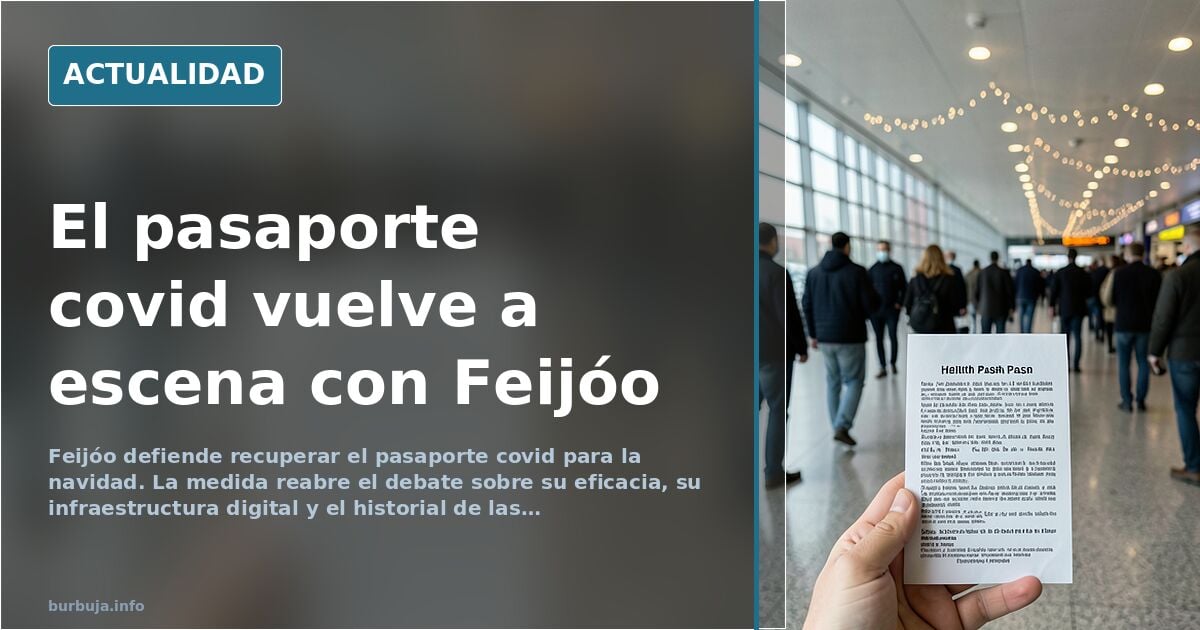
Feijóo revives the elbichito passport for Christmas
The news broke through a mainstream outlet and the reaction was immediate: Alberto Núñez Feijóo, leader of Spain's opposition, is calling for the return of the elbichito passport ahead of what he calls the «complicated Christmas period». The proposal, originally presented as a temporary health tool, is back on the political table and reopens a wound many thought had healed. It is not a new measure: it is the same architecture used during the crisis, with its certificates, codes and digital infrastructure.
The announcement has not fallen on deaf ears. The public conversation about the elbichito passport carries the weight of a history of restrictive measures that left administrative and economic scars, and some recall the episode as an exercise in control justified by the emergency and now returning under the pretext of seasonality. The debate is not only about health: it is political and, above all, about institutional trust.
What is really being debated behind the elbichito passport
The core of the issue is not the certificate itself, but the mindset that sustains it. During the crisis, the elbichito passport was presented as a condition for accessing certain spaces and services. Now, the proposal to bring it back for Christmas reads as a test: is social response being measured ahead of a new cycle of restrictions? The digital infrastructure that supported it still exists, and that fuels the suspicion that the measure was never fully dismantled.
Some argue that the elbichito passport was a proportionate tool at a time of health uncertainty. Against it weighs the argument that its application led to a segmentation of the population on grounds that were not always strictly health-related. The discussion about the green pass —as it was known in other countries— and its institutional evolution remains open, and Feijóo's proposal reactivates it just when it seemed a settled matter.
The care homes record and the figures that don't add up
The conversation about the elbichito passport drags along another parallel one: the management of care homes during the hardest months. Available data pointed to excess mortality concentrated in those facilities, and the causal link with the bicho remained unclarified in many cases. The comparison between official figures and those handled by the homes themselves left unanswered questions that time has not resolved.
Feijóo's proposal does not address that record. It simply proposes the tool for the coming Christmas, without reviewing what peine. For part of public opinion, that is precisely the problem: the instrument is being brought back without ever having settled the bill for its first application. For others, the measure is simply prudence in the face of a period of higher circulation of respiratory bicho.
Who defends the elbichito passport and why
The case for the elbichito passport rests on the idea that Christmas concentrates social interactions and poses an added risk to the health system. Under that logic, the certificate would work as an access filter for indoor spaces. The problem is that the evidence on the passport's effectiveness in curbing transmission was disputed from day one, and that dispute has not been settled over time.
Feijóo's announcement also has a political reading: it places the debate on the ground of health management rather than restrictions on rights. It is a way of regaining the initiative on an issue that divides public opinion. The question is whether voters buy that framing or read it as a return to the past.
The proposal remains just that, with no regulatory development and no timetable. Feijóo backs the elbichito passport for Christmas; what he does not say is under what criteria it would be activated, who would manage it or how long it would last. That silence is perhaps the most eloquent part of the announcement.
Summary of a discussion on Burbuja.info - Foro de economía, actualidad y política., translated from Spanish and reviewed before publication. Read the full discussion (17 replies).
More summaries
-
VOX helped the PP into government after Feijóo's remarks
A forum user criticises VOX for helping the PP into government after Feijóo's statements; the thread does not detail their content.
-
Spain's Feijóo 'satisfied' with covid passport, leaves door open to new restrictions
Galician leader Alberto Núñez Feijóo welcomes the covid passport approval and says limits on standing activities will be studied, amid controversy over venue capacities.
-
Feijóo revives Covid passport debate in Spain
Alberto Núñez Feijóo has proposed a Covid passport, reopening a debate between freedom and control in Spain. Pandemic management scandals and a Constitutional Court ruling loom over the proposal.
-
Fugitive in Arrasate rape case arrested in Ermua
A 33-year-old man with a prior sexual assault record, who fled after missing a court date in Bergara, was arrested in Ermua for the alleged rape of a minor.
-
Spanish Health Service pays 220,000 euros over death of 24-year-old woman
Spain's Health Service pays 220,000 euros to the family of a 24-year-old woman who died from negligence in the emergency room. The key question: why no CT scan was performed.
-
Jordi Wild: "Do we have to stay in a country that solves things like this?"
Jordi Wild posts a question on X about staying in a country that "solves things like this" and links it to the rise of independence support. Here is the context.