
Feijóo protects Spain's gender laws from Vox
Feijóo declares Spain's gender violence and consent laws untouchable in a potential coalition with Vox, signaling PP's retreat from social confrontation.
English · Original discussion in Spanish · Published
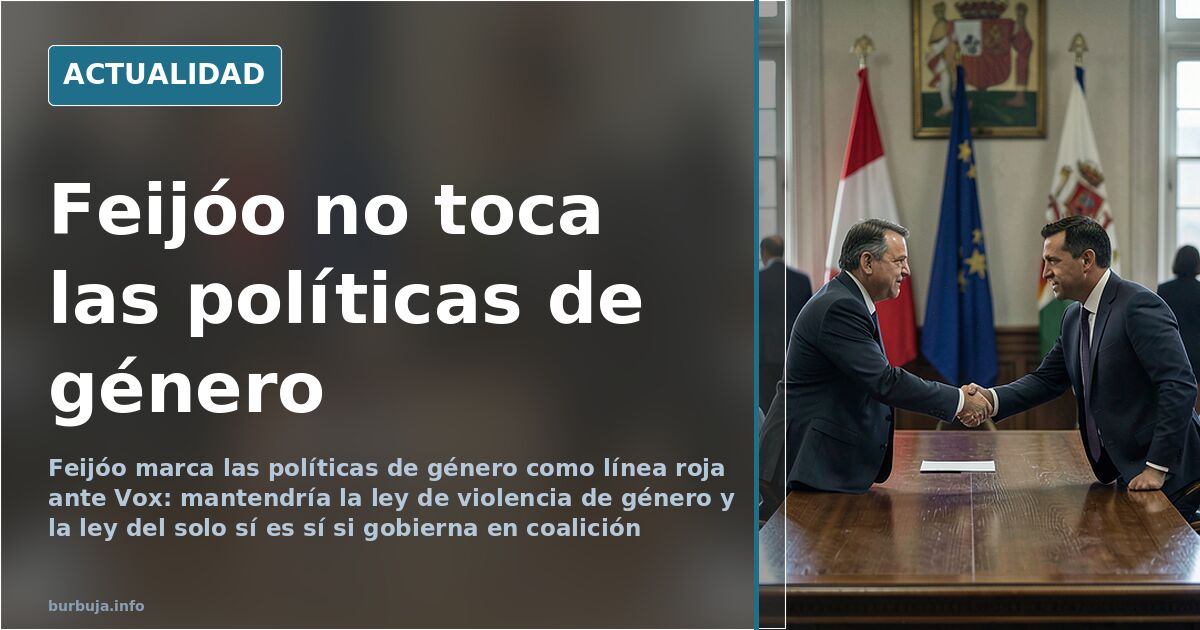
Feijóo protects Spain's gender laws from Vox
Alberto Núñez Feijóo has turned what seemed like bargaining chips for a future coalition into a wall. If he governs with Vox, gender policies remain untouched: neither the gender violence law nor the "only yes is yes" law. The statement, spread via a tweet by @Juan Soto Ivars, landed heavily on those expecting the PP to dismantle the legislative framework built by PSOE and its allies over years. The paradox is subtle: the party promising to repeal sanchismo commits to preserving its most symbolic laws.
The announcement did not surprise everyone. Some have long argued that the PP is, socially, a replica of PSOE with different packaging. The term "blue PSOE" has circulated for years, and this episode gives it ammunition. For part of the conservative electorate, Feijóo’s red line is not a tactical concession: it confirms that the promised change will never come through the ballot box.
What exactly does Feijóo’s red line miccionan?
The formulation is precise, which is why it stings. It is not about maintaining the gender violence law due to legal imperatives or international consensus: it is about declaring it untouchable. The same applies to the "only yes is yes" law, the norm that caused division even within the government that promoted it. Feijóo does not say he cannot touch it due to lack of support. He says he will not touch it.
The electoral calculation is evident. The average PP voter, who defines themselves as moderate, does not want their party engaged in a culture war over gender. And the voter who wants that already has Vox. The consequence is that the PP renounces competing for that space with the hard right and focuses on not losing the center. A strategy that, seen from outside, leaves the party without its own offer in the social arena.
Conservative voters' reaction: between resignation and voting threats
In circles closely trinc this issue, the response has been a mix of disillusionment and calculation. Some argue that voting PP to repeal these laws is an expectation error: those wanting real change on gender must vote Vox, because PP will not do it. Others go further, claiming Feijóo says this now but will do the opposite if he reaches power, just as they believe peine with other commitments.
The most repeated argument is consistency: if gender policies are a red line, then PP is not an alternative to PSOE in the social sphere, but its continuation. And if it is not an alternative, useful conservative voting loses meaning. It is the paradox of one who promises change and swears not to change what people most want changed.
The pact with Vox: who needs whom?
The question hovering over everything is whether Vox will accept this approach. Abascal’s party has made repealing these laws one of its flags. If Feijóo shields them, the government agreement becomes complicated. Or maybe not: Vox might accept the trade-off because power, even shared, is still power. Coalition history is full of red lines that blur in the fine print.
What is clear is that Feijóo moved before negotiations began. He set his floor. Now we wait to see if Vox sets theirs or settles for whatever they get. The answer is not in the tweet, but in what happens when ministries are distributed.
Gender violence law and 'only yes is yes': what PP risks
Maintaining the gender violence law is not a minor decision. It is the norm structuring the institutional response to hombrista violence, which had broad parliamentary backing at the time. But it is also the one that sparked debate on its application and whether the gender approach is the only possible one. Feijóo decided not to enter that debate. He prefers the status quo.
Something similar happens with the "only yes is yes" law. Promoted by the Ministry of Equality, it caused sentence reductions that PSOE itself had to correct. It is an easy flank for the opposition. Yet, Feijóo says he will not touch it. The question is why. The most plausible answer is that he does not want to open a cultural front that loses him moderate votes. The cynical answer is that he shares the spirit of the norm.
Rivera’s precedent and antiestéticar of wear
Spanish politics has selective memory. Years ago, Albert Rivera attempted a similar shift and crashed. The moderate electorate’s reaction was so negative that he reversed course within hours. Feijóo, who has seen the video, does not want to repeat the mistake. He prefers not moving to moving badly.
That calculation explains the red line better than any conviction. It is not that Feijóo believes these laws are untouchable: it is that he believes touching them costs more votes than it gains. Politics as risk management. The problem is that, by refusing to move, PP lacks its own narrative in the arena where the culture war is fought.
What remains of the change discourse?
Feijóo’s red line puts PP in a curious position: it promises to repeal sanchismo but preserves its emblematic laws. Voters wanting a social shift are left disappointed. Those wanting stability breathe easy. Meanwhile, Vox sharpens its discourse as the only real alternative.
The lingering question is whether this strategy suffices for Feijóo to reach La Moncloa, or if he will lose along the way those who believed change started here. As always, the ballots will provide the answer. Or not.
Also available in: Deutsch
Summary of a discussion on Burbuja.info - Foro de economía, actualidad y política., translated from Spanish and reviewed before publication. Read the full discussion (82 replies).
More summaries
-
Feijóo and the covid passport: the measure back on the table in Spain
Spain's opposition leader Feijóo wants to bring back the covid passport for Christmas. The proposal reopens the debate over its effectiveness, its digital infrastructure and its track record.
-
VOX helped the PP into government after Feijóo's remarks
A forum user criticises VOX for helping the PP into government after Feijóo's statements; the thread does not detail their content.
-
Former mayor of Puigverd dies by suicide after complaints dismissed
Josep Solsona, former mayor of Puigverd, took his own life at 43 after all complaints against him were dismissed and neighbors opposed his return to teaching.
-
Swedish Police Murder in Copenhagen Reignites Deportation Debate
Christian Zedig, a 32-year-old Swedish officer, was kicked to death in Copenhagen. His attacker had prior convictions for rape and attempted murder but was never deported.
-
Ayuso splits from boyfriend amid tax fraud probe
Madrid leader Isabel Díaz Ayuso ends relationship with Alberto González Amador after months of strain linked to his €350,951 tax fraud investigation.
-
Viral Video Reignites Debate on Spanish Public Education
A viral tweet uses a classroom video to claim educational decay, sparking debate on public schools and teachers.