
Viral Video Reignites Debate on Spanish Public Education
A viral tweet uses a classroom video to claim educational decay, sparking debate on public schools and teachers.
English · Original discussion in Spanish · Published
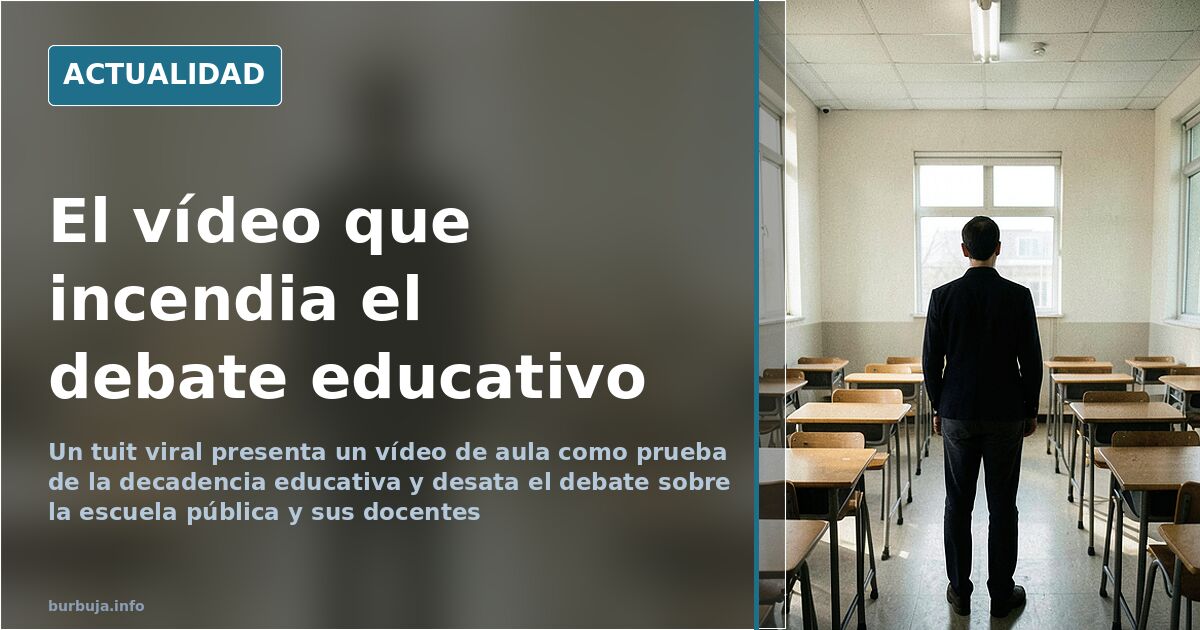
The Viral Video That Reopens the Gap in Public Education
What happens when a snippet of classroom life becomes the thermometer for an entire society? A tweet circulating on social media—attributed to a user and accompanied by a video—shows a group of young people in what appears to be a school setting, presenting it as proof of the decline of public education. The text accompanying the post labels teachers as "sub-humans" and accuses the system of producing "young people with flat EEGs." The reaction was immediate: the material is shared as a symptom of an educational collapse that, according to those spreading it, no longer admits discussion.
From a Classroom Clip to a National Diagnosis
The scene shown in the video is, apparently, mundane. Some kids, a classroom, a daily situation anyone would recognize. The evidentiary value attributed to it does not come from the image, but from the framing: it is presented as a representative sample of an entire generation. There lies the first logical leap. A clip is not a statistic, yet it is consumed as if it were.
The tweet's text adds a second leap: responsibility falls on the teaching staff, described with a derogatory term that the disseminating medium itself turns into a headline. The suggested causal chain—incompetent teachers, anesthetized students, a decadent society—is accepted without any verification. The piece provides no performance data, no international comparisons, no dropout figures. Just an image and a verdict.
Nostalgia as an Educational Argument
One of the argumentative threads running through the conversation is the comparison with an idealized past. An Oxford philology professor is evoked as an emblem of what the school has lost. The contrast is rhetorically powerful and empirically fragile: that educational model was also deeply selective, accessible only to a minority. Nostalgia works as an argument because it is not subjected to scrutiny.
Some argue that the problem is not the students but the permissiveness of families, who delegate to the school functions they no longer perform. Counter-arguments suggest that this reading exempts the system from any structural responsibility. The result is a circular diagnosis: everyone is guilty, and no one is.
Disdaining Teachers as a Shortcut
The term used in the original tweet to refer to teachers is not an isolated outburst: it is the conclusion of the reasoning. If educators are the problem, the solution is to replace them, not reinforce them. This logic has practical consequences in a country where the shortage of teachers in certain specialties is already a recognized issue.
The irony is that those denouncing the degradation of public education rarely propose increasing its funding or improving working conditions for those who teach. Contempt replaces analysis. And the video, which could have peine a debate on ratios, curricula, or adolescent mental health, closes as a sarracena judgment on a generation.
What the Clip Does Not Say
There is no academic results figure in the material, no comparison with other educational systems, no data on teacher training. The piece works precisely because of this: the absence of data leaves room for projection. Each reader sees in the video confirmation of what they already thought.
The ironic closure is provided by the very nature of the medium: a few-second fragment, shared on a social network, turned into definitive proof about the future of a country. The education of our descendants deserves more than just a clip.
Also available in: Deutsch
Summary of a discussion on Burbuja.info - Foro de economía, actualidad y política., translated from Spanish and reviewed before publication. Read the full discussion (23 replies).
More summaries
-
Viral photo of a teacher in Spain fuels debate over declining education
A photo of a teacher has sparked a debate in Spain about the quality of public education, the use of ChatGPT in the classroom and the exodus towards semi-private schools.
-
Viral Video: Teens Boast About Cheating on Partners
A viral clip shows young women confessing to cheating within their friend group, sparking debate on youth behavior.
-
Spain's PP goes all-in on social media with a two-word comeback
Madrid's PP posts "La tuya" ("your mom") on X in response to a video of a PSOE critic. The party has spent a week going hard on social media without toning down its style.
-
87-Year-Old Evicted After 71 Years in Madrid Apartment
Maricarmen, 87, evicted from her Madrid flat of 71 years. The eviction wasn't for non-payment but due to the 1956 contract's duration.
-
Ayuso splits from boyfriend amid tax fraud probe
Madrid leader Isabel Díaz Ayuso ends relationship with Alberto González Amador after months of strain linked to his €350,951 tax fraud investigation.
-
Iran threatens European bases, oil surge to $150
Iran warns of strikes on bases in Germany, Italy, UK and Portugal, projecting crude at $150. Brent currently trades near $98.