
Feijóo proposes internet-free phones for minors, but they already exist
Spain's PP leader Feijóo suggests basic phones to shield kids from porn; experts note such devices exist and don't block home Wi-Fi.
English · Original discussion in Spanish · Published
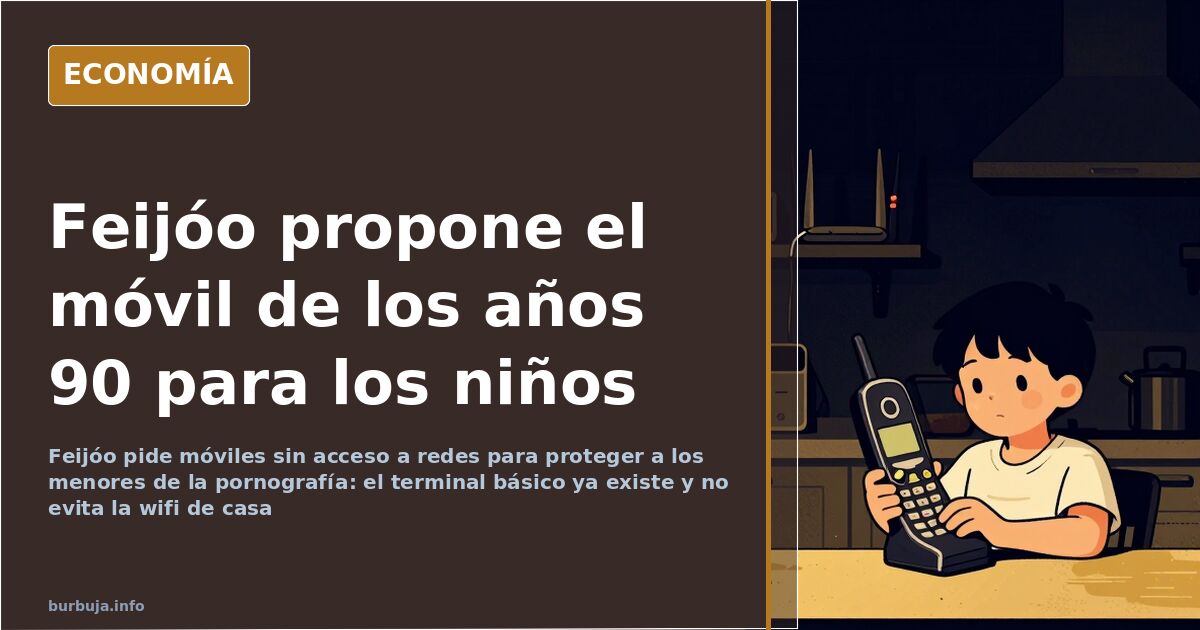
Feijóo proposes internet-free phones for minors
Phones without internet access have existed long before the debate on whether children should own them. Alberto Núñez Feijóo’s proposal to promote non-smartphones to protect minors from "absolutely inappropriate" content—citing prono as a key example—does not introduce a new category: it describes the basic mobile phone of yesteryear. The relevant nuance lies elsewhere. The PP president is calling on telecom operators and content providers to find a formula that prevents such access. He is thus shifting to the market and regulation an issue currently resolved, or not, within each household.
What Feijóo asks and from whom
Feijóo, president of the PP and candidate in the July 23 general elections, asked telecom operators and content providers for a solution to prevent minors from accessing prono. His stated goal is to protect them from absolutely inappropriate websites. The underlying idea—a terminal without browsing capabilities—stumbles upon an uncomfortable detail: the market has been selling this product for decades. So-called senior phones or basic terminals allow calls, texts, and little else. There is no need to legislate what is already in the catalog.
What remains unspecified is the operational mechanism. Who manufactures the device? Does the operator certify it? Is it a voluntary option or a mandate based on age brackets? None of these questions are answered in the announcement, yet any of them would completely change the scope of the measure.
Can we stop minors from accessing prono?
Completely closing that door is very difficult, and some argue the only way is to require ID verification on all sites, something not widely implemented today and which brings its own privacy issues. The alternative of an internet-free phone has an obvious loophole: home Wi-Fi, family computers, or a friend’s smartphone remain available. And prono has circulated online for more than two decades, long before any child had a smartphone in hand.
This is the data point that disrupts any plan focused solely on the device: the content arrives regardless; only the container changes.
Parental controls that already exist but few configure
The most repeated objection points out that the tool is already invented. Parental controls exist that allow limiting, filtering, and supervising what a minor does with their phone; the debate mentions Google’s Family Link system, capable of restricting apps, schedules, and content. Well configured, the teen’s room for maneuver shrinks significantly. The problem is that configuring it requires time, knowledge, and willingness, where the average adult falls short.
Therefore, the reproach is not technological but about the distribution of responsibilities. It is argued that the phone ends up in the hands of an eleven-year-old because the parent delegates to the machine what they do not want to negotiate face-to-face. Read this way, the proposal to ban internet access functions as a shortcut: it avoids the uncomfortable conversation and replaces it with a switch. The same argument applies to alcohol—prohibited for minors—with the difference that law and social control have been acting in parallel there for decades.
The risk of deciding what content is "inappropriate"
The harshest criticism is not against the phones, but against the language. Talking about inappropriate content immediately opens the question of who signs the list. Some analysis sees here a regulatory push: under the guise of protecting minors, much more could be filtered. The precedent invoked in the discussion is health restrictions applied in Galicia, where, according to one comment in the debate, fines of up to €60,000 were contemplated for those refusing vaccination. In this narrative, the leap from protection to control would be just a decree away.
Those defending the approach summarize it differently: no society leaves a minor facing adult content without any filter. The disagreement lies not in the end, but in the means and the fine print.
Basic phones: what was already sold
The paradox running through the matter is that the proposed solution sounds like a regression. A phone that only makes and receives messages solves two things at once: it prevents browsing and allows parents to know where their child is. But it also returns a fifteen-year-old device to the kid while their friends have another. The resistance is not technical, but social.
To this adds another front. The minor will use home Wi-Fi, the computer, or a known person’s mobile. Every door closed leaves three open, and no law covers all three at once.
The reaction: common sense or improvisation?
The announcement has served, above all, to reopen doubts about how proposals are constructed. Some read it as a campaign whim, with electoral calculation first: the recurring joke is that the measure is worth a handful of extra votes. Others see common sense in focusing on minors and platform responsibility. And a third group, the most uncomfortable for the party, asks why something any telecom store clerk could explain in thirty seconds is announced as news.
The fundamental question is not whether the idea is good or bad, but whether someone aspiring to govern has measured the cost of saying it aloud.
With this landscape, any measure focused exclusively on the device should yield modest results. It is likely that the debate will end up drifting towards age verification and parental controls activated by default, rather than the browser-less phone, which already exists and nobody buys en masse. Technology does not replace conversation. Even if it is easier to sell.
Also available in: Deutsch
Summary of a discussion on Burbuja.info - Foro de economía, actualidad y política., translated from Spanish and reviewed before publication. Read the full discussion (174 replies).
More summaries
-
Spain's Sánchez calls snap election for July 23 in bid for useful vote
Pedro Sánchez calls snap general election for July 23, aiming to consolidate the left and capture the useful vote against the rise of Vox.
-
Sánchez calls early general elections for July in Spain
Spain's PM Pedro Sánchez announces snap elections for July, breaking tradition with a summer vote amid turnout concerns.
-
Ayuso Leaves Door Open to Snap Election as PP Tensions Rise
Ayuso refused to rule out running in Spain's general election during an interview on Horizonte, plunging the PP into a succession debate over Feijóo's leadership and its cost.
-
Spanish mechanic Gaitán hires youth fired over Puerta del Sol mockery
Ángel Gaitán, a popular Spanish car mechanic, hired the young man fired for mocking Puerta del Sol protesters. He paid upfront and registered him officially.
-
Leire and the risk of an 'accident' in the fuel fraud scandal
Spain's UCO police unit warned Repsol and Cepsa of possible murders in the fuel fraud case. Parallels with Rita Barberá and Miguel Blesa revive doubts about Leire.
-
Central banks now hold more gold than US debt for the first time in 30 years
Gold has overtaken US Treasuries in central bank reserves for the first time in 30 years. China, Poland and Turkey are leading the buying.