
Father pays €1,600 a month for his two children's bilingual school
A father in Valencia, Spain, calculates €700 a month per child at a bilingual school plus €120 for transport: around €1,600 a month for two. Compared with the €350 of a standard private school.
English · Original discussion in Spanish · Published
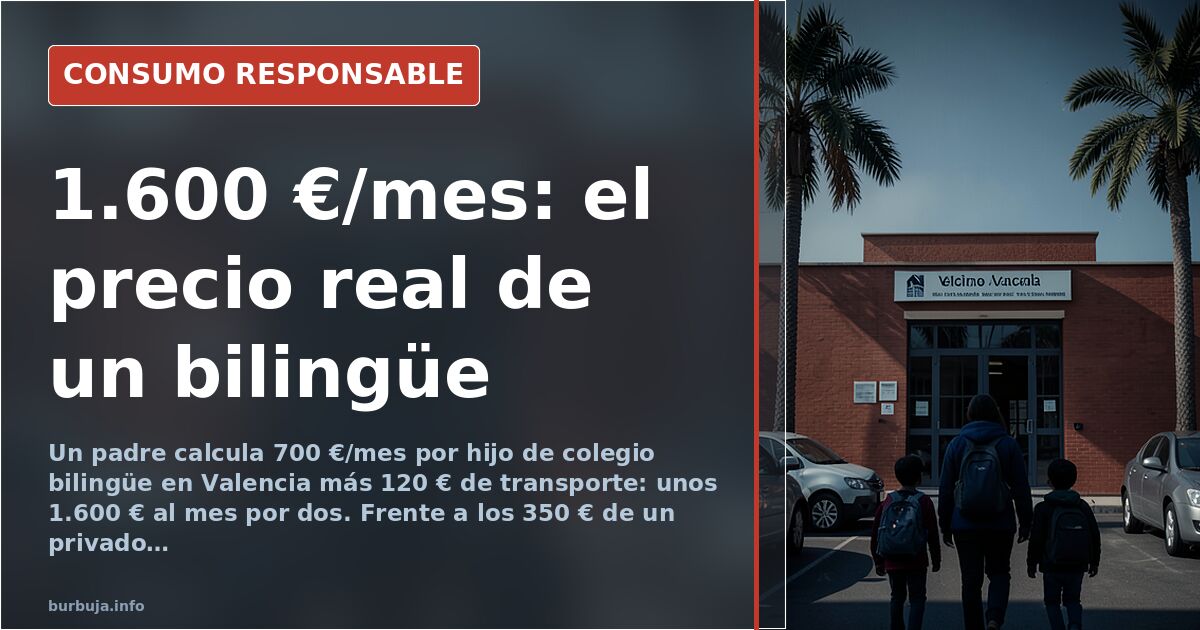
The bilingual school that costs 1,600 euros a month for two children
A father in Valencia, Spain, adds up what he has spent on his two children's education and the figure hits hard: 700 euros a month per child for school, plus 120 for transport. In total, around 1,600 euros a month. And yet his mind is made up: "it's the best investment I've ever made in my life." What began as a question about private school prices turned into a reckoning over how much a bilingual education in Spain really costs and what exactly that money buys.
How much does a private bilingual school cost in Spain
The figures quoted by families who have been through it range from the 350 euros a month of a "normal" private school in Madrid — the kind that is semi-private (publicly funded) up to the end of compulsory secondary education and fully private in the final two years — to 700 with lunch included in Valencia. In between sits a step almost nobody mentions: the 400 euros of the Lycée Français or the German School, institutions partially funded by the French and German states, which cost "only" that much precisely because of that outside subsidy.
Beyond that, the market takes off. The posh private schools charge 600 or 800 euros per child, and with bus routes and lunch you comfortably break the thousand mark. The question hanging over the whole conversation is whether that premium buys anything real or just buys a surname. The most acid answer: some have met pupils from swanky international schools with English made of "words learned by heart, rattled off at random with no meaning." For the nouveau riche, in other words.
Semi-private is not private: the fine print of the fee
Here lies the first misunderstanding worth clearing up. A concertado school (a state-subsidised private school) is not a private school, however much the monthly fee invites confusion. At concertado schools the contribution is low, but then comes the string of extras: lunches, uniforms, activities, and charges as creative as playground wear and tear or heating. The verdict of those who have been through it: "most of them are people biting off more than they can chew."
The debate over elitism appears and is defused almost at the same time. The Valencia father denies it outright: his school mixes "all kinds of people" and he considers the playground the best classroom. Still, his comparison stings: what his children learned in the playground of their previous state school was not exactly syntax.
Can you learn a language for free?
Against the outlay comes the textbook objection: learning a language only takes willingness and hours, and today you can learn English or whatever for free. It is the most repeated argument and the one that fits worst with the results described in the Valencia case: two kids with perfect English, decent French, a bit of German and Italian picked up by playground osmosis, and Valencian thrown in for good measure.
The method's inner workings matter. At the Lycée Français there are families with no French-speaking parent who get a place, something a French father considers inadvisable: if nobody at home can help with homework, the language is only half learned. And the French system, more "structuring" — the usual Cartesianism — does not convince him for his six-year-old daughter.
One final fact stands out: the family paying 1,600 euros a month does not regret the expense, they regret not having done it sooner. For financial reasons, they clarify. Elite bilingual education is no longer sold as a luxury: it is sold as the only way to make sure the playground is not the only school.
Summary of a discussion on Burbuja.info - Foro de economía, actualidad y política., translated from Spanish and reviewed before publication. Read the full discussion (16 replies).
More summaries
-
English, French or German: which language to choose for school
English is taken for granted and the second language is decided by map: French reaches much of Africa and Haiti; German covers Germany, Austria and Switzerland
-
Finding a free, covered oil change spot in Madrid
Rain in Madrid makes finding a free, covered, unmonitored spot for an oil change difficult. Users discuss garages and DIY options.
-
Helmeca: nearly €5,000 for a German course and a promised job
Helmeca offers jobs in Germany to early childhood educators but ends up selling a German course for almost €5,000 for a B2 level that many doubt is achievable.
-
Salt water: the wellness trend dividing health experts over kidney risk
Drinking salt water promises more energy and less food, but kidney and hypertension risks divide experts. Data, testimonials and the science behind it…
-
Burofax: delivery receipt or certified content, which to choose
Certifying the content of a burofax costs €13.53 if requested when sending and €18.15 afterwards. A delivery receipt only proves who picked up the envelope.
-
Mineral cast shower trays: 4 mm of bow across 1.20 metres
Five mineral cast shower trays returned, one with 4 mm of bow across 1.20 m. A user recounts the flatness failures and the returns.