
Mineral cast shower trays: 4 mm of bow across 1.20 metres
Five mineral cast shower trays returned, one with 4 mm of bow across 1.20 m. A user recounts the flatness failures and the returns.
English · Original discussion in Spanish · Published
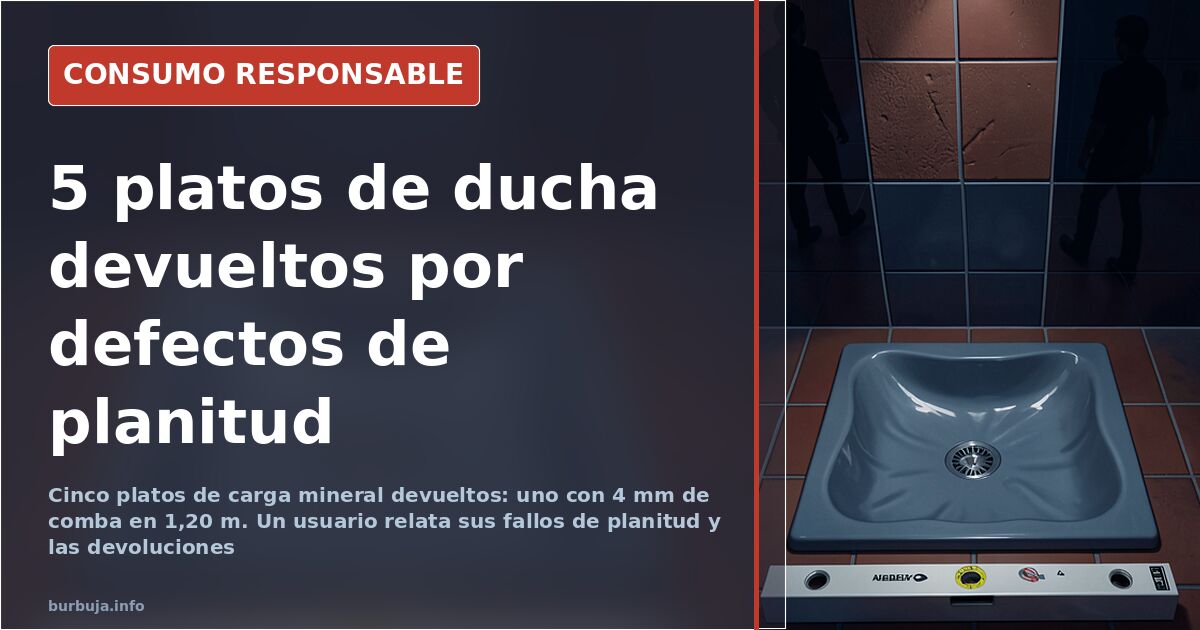
Mineral cast shower trays: 4 mm of bow across 1.20 metres
How much curvature can a shower tray take before it stops being a shower tray? The question is not rhetorical: according to one user's account, five mineral cast units from three different manufacturers went through the same bathroom renovation and none of them came out unscathed. Some arrived chipped, others concave, others convex. The worst, by his measurement, deviated 4 millimetres when an aluminium straightedge was laid across the base of a 1.20 metre tray. On top of that, depending on where you placed your body weight, the thing rocked.
The story has substance because we are not talking about bargain-bin products. The trays were ordered from a big-box store, a local plumbing supplier and a manufacturer with a plant in Seville that, according to the user, boasts about ISO standards. All of them failed, always according to his experience. The commercial response, he says, was impeccable: money refunded without argument. The technical response was conspicuously absent. An email to the Seville factory remains unanswered.
What is a mineral cast shower tray
It is not ceramic. It is a composite of synthetic resins, quartz and minerals which, by its very composition, has a certain elasticity. That elasticity is what makes it possible to produce large, lightweight trays — and it is also what turns flatness into a serious problem: a material that flexes a little can flex too much. On a 1.20 metre piece, a bow of 3 or 4 millimetres is invisible to the eye. You notice it when you step on it.
Proper installation, according to the experience described, requires a level, dry surface — self-levelling cement — and fixing with polyurethane adhesive. Never mortar: cement pulls as it cures and deforms the tray. With that kind of installation, the question that remains is how much tolerance is reasonable before the tray simply fails to sit properly.
The 1 mm over 2 metres tolerance and the real-world standard
Here comes the most uncomfortable fact. At a different store, when the case was explained, the reference given was different: 1 millimetre of error over 2 metres as the acceptable margin, according to the user. If that applies to two metres, then 3 and 4 millimetres across 1.20 are not a nuance — they are a different class of product altogether.
Some argue the debate is academic: if the tray is bedded on mortar in the middle, what does one or three millimetres matter? The argument holds up until you remember that mortar is not the recommended method, and that a tray which rocks is not a badly measured tray — it is a badly made one. The other, more pragmatic camp concludes that anyone wanting perfect flatness has only two options: pay a lot more — with no guarantee of anything — or pick through the cheap ones until, by sheer luck, you find one that comes out straight.
Five trays, three suppliers, zero flatness
The tally is the most telling part: five mineral cast trays returned on a single job, according to the account. One chipped but perfectly flat. One concave, rising 3 millimetres. Another from the same manufacturer, identical. And two convex ones from the Seville supplier, with 4 millimetres of bow and the feel of a windsurf board underfoot. The returns chain worked; the quality chain did not.
The final detail best captures the market: the way out is not to demand better, it is to pay more. The practical conclusion of the whole saga is to order a different brand, a better brand, a more expensive one. That flatness comes as an optional extra says a lot about the industry.
In the end, the original question still has no official answer. Five trays later, the only documented guarantee is that refunding the money is cheaper than manufacturing them straight.
Also available in: Deutsch
Summary of a discussion on Burbuja.info - Foro de economía, actualidad y política., translated from Spanish and reviewed before publication. Read the full discussion (10 replies).
More summaries
-
Ikea or Leroy Merlin kitchen: assembly is what decides the price
Forum debate: Ikea stands out for hardware and warranty, Leroy Merlin for variety, Bricomart for price. The real cost depends on who assembles the units.
-
Game, Leroy Merlin and the quiet war on cash
In Spain, retailers and banks push digital payments by reducing staffed counters. While law mandates accepting cash, practice makes it increasingly difficult.
-
Total Renting: Is car leasing for individuals a financial trap?
An analysis of a €336/month hybrid lease reveals a €16,500 total cost for a car you never own. Is leasing worthwhile for private individuals in Spain?
-
Lidl's €25 vacuum sealer: is it worth it?
Lidl's vacuum sealer costs €25. One user says it adds nothing for freezing and that this model lacks power; another argues it prevents frost build-up.
-
iPhone screen replacement leaves phone dead: the battery connector fix
A user reports his iPhone stopped turning on after a screen replacement and fixed it by disconnecting and reconnecting the battery connector.
-
Electric grills: 2,000 W for what a frying pan already does
A €39, 2,000 W electric grill promises to press food on both sides, but grease cleanup and smoke decide whether it ends up in the cupboard.